
The full weight of ‘Broken Britain’ is bearing down on adult and children social services, leaving them crumbling in the face of rising demand and deep austerity.
Nationally, local councils have overspent their children’s social services budgets by an average of 14.2 percent per year for the past three years, and by approximately 5.2 percent on adult services.
In 2025, despite a funding increase of £3.4bn, councils’ social service spending once again came in over budget.
This shouldn’t come as a shock to anyone who has been paying attention to the deteriorating living standards in Britain today. Labour’s increase in social services funding barely scratches the surface of what is needed after a decade of austerity.
Probation services have shut down. Charities which offered provision to families in need are stretched to breaking point, and waiting lists for the NHS and mental health services are at record highs.
As a result, the threshold for getting support through these services often feels insurmountable.
Some of the most traumatised children I work with have been declined for mental health support due to their home conditions continuing to be ‘difficult’ or for their needs being ‘too complex’.
Untenable situation
Social services therefore have very little to offer families in desperate need amidst grinding poverty.

In this climate, social workers are facing ever-increasing workloads and are frequently met with aggression from service users when it becomes clear just how little help there is.
Social services therefore often have very little to offer families in desperate need. In this climate, social workers are not just facing ever-increasing workloads, but are frequently met with aggression from service users when it becomes clear just how little help there is.
In a meeting in my service about this hostility, every worker present had experienced aggression or felt unsafe whilst on the job. Management told us that this isn’t okay and that we can always take another worker with us when entering precarious situations.
But in an oversubscribed and underfunded service, nobody wants to burden another stretched worker with a small concern over personal safety. The culture is just ‘that’s the job’.
It’s no surprise then that across the country, 11 percent of vacant local authority social worker positions go unfilled. A 2023 YouGov study found that only 16 percent of social workers would ever recommend social work as a profession, despite more than 80 percent still being proud to be social workers.
The government has created an independent commission to deal with this crisis, which is set to publish an initial report this year.
But the dire state of things is no secret. Last year, a select committee report found the social care services to be “untenable” – and directly states this is the consequence of chronic underfunding by successive governments.
This report correctly observes that, as it stands, “taxpayers are currently paying £32 billion a year for a broken system” and calls for ‘significant’ reform.
Genuine solutions
‘Significant’ reform barely covers it. Current projections state that tens of billions of extra funding will be needed for simply maintaining social services in the next decade, let alone improving these.

The majority of the small increases made in social care funding we see today are already funnelled out of public services and directly into the pockets of private industry. Only 10 percent of care provision is now publicly owned – all other establishments are for-profit.
Worse still, the government’s current top idea to improve social care services relies not on improving the conditions for social workers, but investing in ‘technology-enabled care and artificial intelligence’!
This is clearly insanity and would only place more pressure on an already struggling workforce. Besides, where would any of this money come from, amidst today’s £22bn ‘black hole’ in Britain’s public finances?
The reality that capitalism not only starves funding from social services, but creates the need for them through subjecting the working class to widespread precarious work, social isolation, and so on.
And so the only genuine solution to this crisis facing social services has to take aim at the capitalist system itself – to expropriate the parasites making profits off people’s hardships, take the industry under workers’ control, and plan the whole economy for the good of the working class.
Doctors out of work
Nick, Elephant and Castle
As doctors we were sold the profession meant stable, meaningful work – but doctors out of university now are facing joblessness. That’s why in October, 97 percent of first year trainee doctors voted to give a mandate for future strike action.
We need more training jobs that allow doctors to specialise into different roles – GP, hospital medicine, surgery, etc.
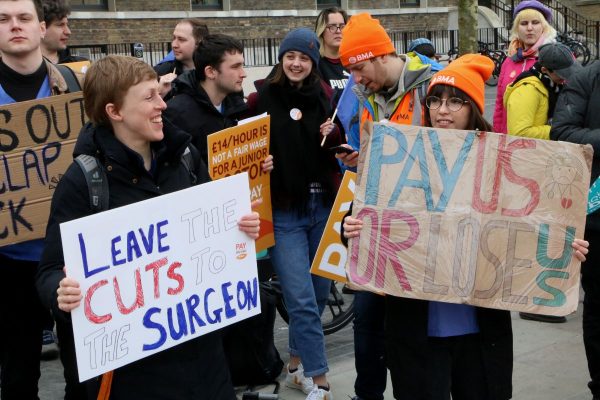
This was one of the demands of the BMA strike back in November. Following this, Wes Streeting made us a laughable “blockbuster” offer: 1,000 new training places in 2025, and 4,000 over the next ten years.
In the small print, these training places were going to be taken from other non-training, “locally employed” doctors. The British Medical Journal has highlighted how many doctors are international graduates from ethnic minorities who “are trapped in insecure NHS contracts with no access to training, career progression, or national safeguards”.
Fortunately, members of the BMA could smell a rat and voted resoundingly to reject this offer.
Streeting’s strategy was pretty obvious. He wanted the largely unionised doctors in training to be satisfied with the prospect of career progression. Meanwhile, the largely non-unionised reserve workforce of doctors would be scrabbling for lower pay and more precarious contracts.
Shamefully, the BMA has played into this division of the workforce by raising the demand that UK graduates should be prioritised over international graduates for training jobs.
First year training doctors, who are largely unionised, feeling the squeeze of low pay and no career progression have been leading the fight for more training jobs. But the BMA needs to also unionise locally employed doctors, a large proportion who are foreign nationals on visas. They face the exact same pressures as first year doctors. This would leave Streeting no room to play divide and rule.
In the last analysis, this is a fight for an NHS worthy of the name. The NHS right now is trapped in the contradictions of capitalism: while waiting lists stretch years, and emergency services can no longer function, an army of workers who are ready to treat the sick face joblessness.