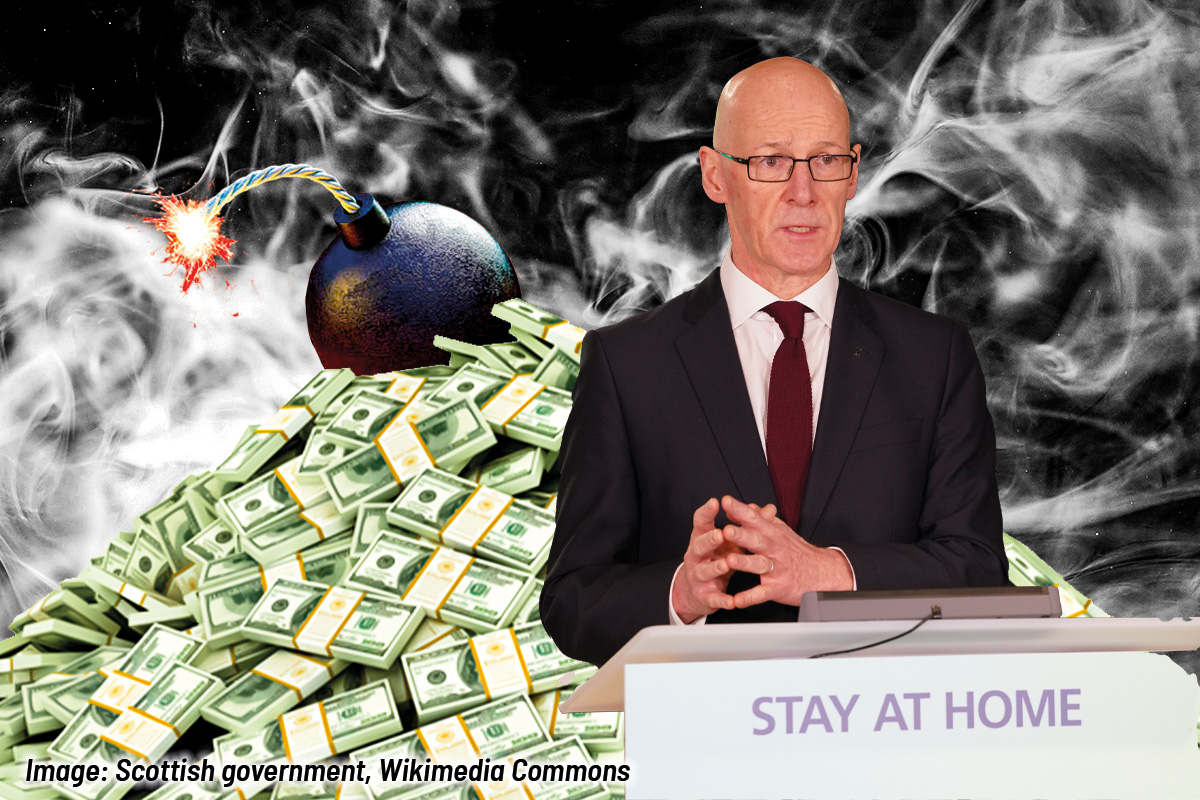

John Swinney’s SNP government recently announced that, from next year, they aim to start issuing Scottish government bonds.
This move exposes much of what is driving the SNP’s unpopularity, with the party now sitting at a 56 percent disapproval rating, according to a recent YouGov poll.
This includes – but is not limited to – their entrenchment as a part of the political establishment; their readiness to sell Scotland off to the bosses and bankers; and their unwillingness and inability to follow-through on independence promises.
What are bonds?
Bonds are an asset that investors – such as central banks, pension funds, and wealthy individuals – can buy, in return for lending their money to the government. They are effectively a type of loan; a debt that governments pay back to bond owners, with interest, through installments over an agreed period.
The Scottish government has had the power to issue bonds since 2016. But the SNP previously declined to utilise this power, instead taking on debt as part of the UK’s National Loans Fund.
Recent credit ratings, however, have put Scotland on par with the UK as a whole. Swinney and his supporters see this as a sign of Scotland’s rock-solid economic reliability, providing the capacity to take on a wider variety of debts.
Yet the UK’s debt-to-GDP ratio currently sits at almost 100 percent. Meanwhile, Chancellor Rachel Reeves is scrambling to fill a budgetary ‘black hole’, and spiraling interest rates threaten to send Britain into a ‘debt death spiral’. So the Scottish government is hardly in good company!
Independence or subjugation?
At the same time, global credit rating agencies such as Moody’s and S&P have both stated that, should the SNP move towards independence, Scotland’s ability to borrow could be at risk.
This does not seem to worry Swinney, however. In fact, the SNP leader and First Minister has suggested precisely the opposite: that newly-issued government bonds are a step along the path to an independent, prosperous Scotland, in control of its own destiny.
Speaking with @JohnSwinney about the Scottish Government’s plan to raise money by issuing bonds in the next parliament
It’s after two global credit rating agencies awarded Scotland the same ranking as the UK
The First Minister’s describing it as a ‘proud day’ pic.twitter.com/gle1YfQ9gZ
— Alan Smith (@Political_AlanS) November 13, 2025
In reality, far from making Scotland sovereign, this move provides the financiers and speculators with more power over the Holyrood government. And these well-heeled ladies and gentlemen have openly expressed their concerns about Scottish independence.
The issuing of these bonds, if anything, would push Scotland further away from independence – and further into the grip of finance capital.
None of these grand plans chime with the reasons why workers put their faith in independence and the SNP in the first place.
Less austerity; more houses; better education; more control over our lives: the list of hopes and aspirations crushed over the last ten years of SNP rule goes on.
In fact, Swinney’s vision of an ‘independent’ Scotland would offer the opposite: a small country dominated by foreign capital and riddled with debt.
Pound of flesh
By submitting themselves to the whims of the bankers, the SNP hope that extra borrowing will provide a magic bullet for funding what is left of their social-democratic policies, in order to placate voters.
This is all well and good, if these debts can be paid back. The prospects for economic growth in Scotland, however, are no better than in the rest of Britain.
As with other parts of the UK, Scotland has long been deindustrialised. Proposals for tax-free ‘green freeports’, meanwhile, are unlikely to provide the government with much revenue. And Swinney has so far failed in his appeal to Trump to reduce tariffs on Scotch whisky.
So where will the money come from when it’s time to pay up? The truth is, investors will get their pound of flesh through attacks on the working class.
Seize their wealth!
We are already seeing this in countries like France, for example, where Macron has consistently struggled to form a stable government, due to political opposition against the austerity budget that the bond markets are demanding to combat high levels of national debt.
Closer to home, as already mentioned, the Labour leaders have faced an internal revolt over the question of welfare cuts – austerity measures required to reduce public spending and balance the books, whilst meeting the UK’s eye-watering borrowing costs.
Voir cette publication sur Instagram
The same picture can be seen across the world, with government after government implementing austerity under the diktats of the bankers and bond holders. And within the confines of capitalism, there is no reason why the SNP would be immune from these same economic pressures.
To properly fund our public services, free from the tyranny of the billionaires, we need to seize the wealth that already exists in abundance – the wealth that sits in the vaults of the big banks and the pockets of the capitalists.