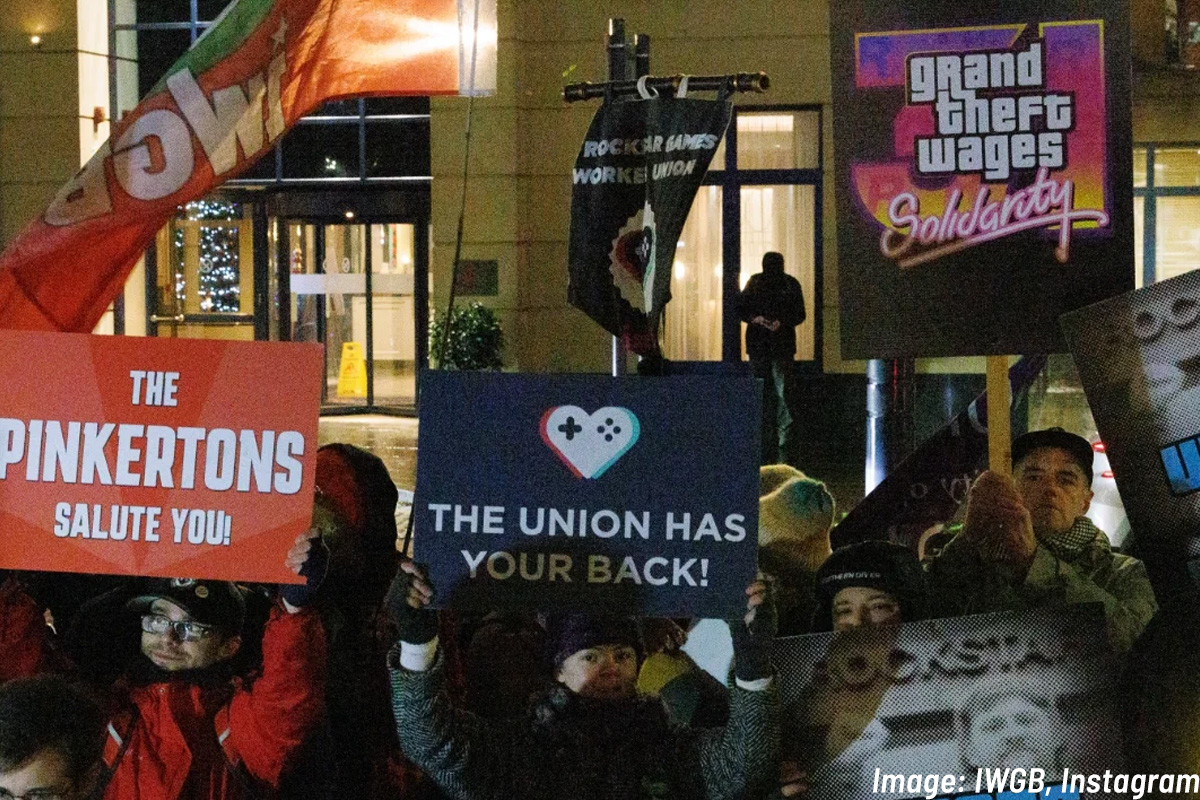

On 30 October last year, 31 workers at Rockstar Games, the company behind Grand Theft Auto and Red Dead Redemption, were fired.
Without evidence being presented, and with little explanation, they were accused of “gross misconduct” and dismissed effective immediately.
Office workers were escorted from the building by security. Remote workers were locked out of company systems and had their equipment seized almost instantly. “In the span of five to ten minutes, I’d gone from a completely normal workday to jobless,” one worker told The Communist.
Rockstar publicly claims the workers leaked confidential information on a public forum. However, the alleged “public forum” was in fact a private, invite-only Discord server used for union organising and workplace discussion.
The server was not publicly accessible, and had strict rules forbidding discussion of games or projects. Conversations focused on pay, bonuses, and company-wide HR communications – discussions that are protected under trade union law.
Rockstar refused to provide evidence to justify the sackings at the time, even though employers are legally required to do so. Workers were dismissed without being told what specific information they were accused of sharing, or where.
The timing is impossible to ignore. The mass firing took place just two weeks after the Independent Workers Union of Great Britain (IWGB) reached the threshold required to apply for statutory recognition.
Voir cette publication sur Instagram
Many of those dismissed were among the most active organisers. As one worker put it, “if unions are considered ‘damaging’ to the company, that tells its own story.”
The case has now moved to employment tribunals. In a deeply political decision, the emergency tribunal rejected the workers’ application for interim relief.
This means the sacked workers will receive no pay while proceedings continue, a ruling that overwhelmingly favours a multibillion-dollar corporation over victimised employees.
Rockstar hails this as vindication. The workers see it for what it is: further proof that when workers organise, the legal system intervenes on the bosses’ side.
In recent months, games workers have mobilised in solidarity internationally, with protests and actions taking place in multiple cities, including London, Edinburgh, Paris, and even New York.
Voir cette publication sur Instagram
In the process, six games workers’ unions in different countries have met together to form a “united front against AI, toxic workplaces, and layoffs”.
This level of cross-border coordination is rare. The united front statement itself says: “Multinational companies already operate globally… It follows, then, that unions must also organise across borders.”
This approach is a significant step forward. If coordinated action between these unions is stepped up, it could embolden workers in other industries to push for international solidarity action themselves.
But conversely, if Rockstar Games get their way it will embolden bosses elsewhere to treat union busting as the norm, that would signify a step back for the labour movement. Unfortunately, many of the top union leaders have remained silent about this so far.
The labour movement must stand openly with Rockstar’s victimised workers, denounce this attack on basic trade-union rights, and escalate solidarity: industrially and internationally.