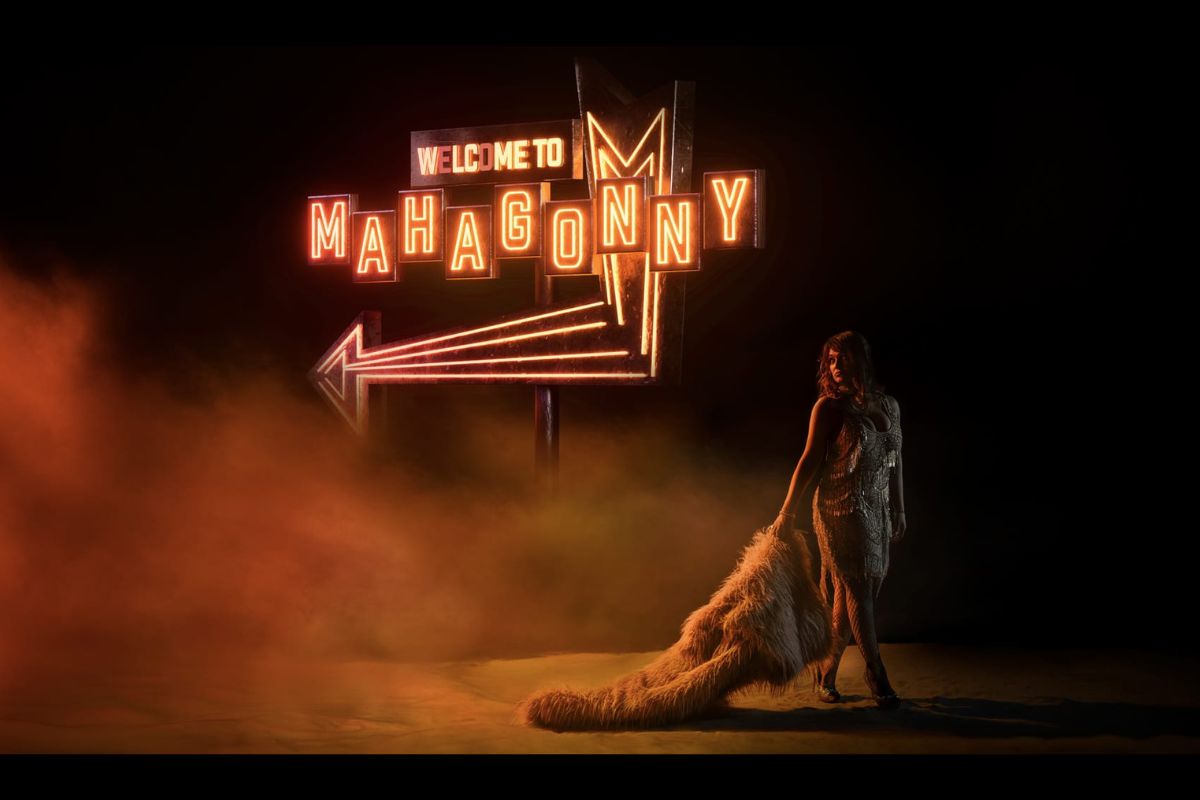

The English National Opera’s production of The Rise and Fall of the City of Mahagonny faithfully captures the confrontational spirit of Bertolt Brecht and Kurt Weill’s ‘anti-opera’ about a society eating itself alive.
The most ambitious product of Brecht and Weill’s brief creative partnership, Mahagonny could be seen as a satirical retelling of the Biblical story of Sodom and Gomorrah. The doomed titular city is founded by criminals and dedicated to the satisfaction of every human vice. Or, in the words of Mahagonny’s four-part manifesto:
“First thing’s first you have to eat…Having sex is number two; Bare-knuckle fights are hard to beat…Four, you drink until you spew.”
Mahagonny ensnares riff-raff and vagabonds looking for a distraction from their meaningless lives in brothels and whiskey bars. Hence why the city’s founders declare its name means ‘Spider’s Web’, though the word is actually a piece of nonsense invented by Brecht.
“Why, though, do we need a Mahagonny?” sing the founders Widow Begbick, Moses and Fatty: “Because this world is a foul one.”
Sliding towards barbarism
The target of Mahagonny’s satire is not easy to pin down. Brecht implied he was criticising American capitalism of the Roaring Twenties, and the setting vaguely resembles Las Vegas.
But he was evidently also inspired by the decay of the Weimar Republic, where Mahagonny provoked controversy by holding a mirror up to a corrupt society sliding towards barbarism during a period of profound crisis for world capitalism.
When the opera debuted in Leipzig in March 1930, the Nazi Party organised furious protests at the Neues Theater, and Mahagonny was later added to a list of ‘degenerate’ works that could not be shown in Germany.
Over the years, Mahagonny has tended to be a Rorschach test for the sins of society at any given moment. John Fulljames, director of a 2015 production at the Royal Opera House, said he was inspired by the turmoil following the 2008 financial crisis.
Reviews of this latest production describe the ‘Trumpian’ overtones of a society in thrall to demagogic swindlers. One could also draw comparisons with the sadistic hedonism exposed in the Epstein files.
But a real strength of Jamie Manton’s direction for the ENO is that it eludes any obvious, direct political commentary. In line with Brecht and Weill’s original intentions, this version concerns the corrosive effect of capitalism in general, preserving the timeless quality of Brecht’s libretto.
Brecht wrote Mahagonny at a time when he had just begun engaging with Marxism, starting by picking up Lenin’s State and Revolution in 1926.
He was studying Marx’s Capital while he wrote the opera, later claiming that it was only in doing so that he “truly understood [his] plays.” Brecht’s interpretation of Marx’s ideas was always idiosyncratic, but they certainly had a profound impact on his art.
In his writings on Mahagonny, Brecht outlined his vision for a new epic theatre. This would be the antithesis of dramatic theatre, which aims to ensnare the audience in the ‘spiderweb’ of its fiction.
Epic theatre would instead destroy all illusion: breaking the fourth wall, and forcing the viewer to confront the truth, and think critically about what they are seeing, rather than take it at face value.
Debauchery and sin
One of the clearest subjects of Brecht’s satire is opera itself. As the ultimate ‘culinary art’ of aristocratic and bourgeois excess, he wrote Mahagonny as an opera about excess: Hence why much of the opera is devoted to the characters’ indulgences in every sin of the flesh: getting drunk, stuffing themselves, frequenting prostitutes and beating each other senseless.
In a famous scene, one of Jimmy’s companions, ‘the Glutton Jack’, brags about eating “a whole cow” and six calves “for dessert”, before dropping dead.
This can be seen as both a dig at the shamelessness of the ruling class, living the high life while ordinary people suffer poverty and starvation, and a jab at the operagoing audience enjoying their spectacular amusements, while horror and hardship persist outside the walls of the theatre.
The ENO production employs the Brechtian technique of Verfremdungseffekt, or ‘defamiliarising effect’: deliberately revealing the artifice of the production to prevent the audience from suspending their disbelief.
The set consists of little more than a couple of cleverly arranged shipping crates, the technical equipment in the wings is visible, and the costumes look like they might have come out of a bargain bin at Primark.
It has to be said, John Fulljames’ 2015 production was a superior visual spectacle, evoking the ultimate sin city with a cacophony of neon lights and elaborate choreography.
The ENO’s humble sets can feel a little jarring in the cavernous auditorium of the London Coliseum. Still, the pared-back staging is much more in-line with Brecht’s philosophy.
The ENO’s production is far from a glum moral lecture. The performers are superb across the board, with the Wagnerian tenor Simon O’Neill being a particular stand out in the lead role of Alaskan lumberjack Jimmy McIntyre.
Jeremy Sams’ English translation of Brecht’s libretto is occasionally darkly hilarious, and the score is often thrilling: decaying into discordant cacophony as Mahagonny itself collapses under the weight of its sins.
Musically, Weill understood that opera had to contend with mass electronic media like radio and cinema, and consciously sought to advance operatic composition with a ‘modern’ score that drew on contemporary forms like ragtime and jazz, saying of Mahagonny that:
“Opera should focus on the interests of a broad public, which will need to become its target audience in the near future if it wants to retain any kind of raison d’être.”
Despite these efforts, some listeners might find the hybridisation of classical music and ‘20s showtunes ironically dated. But the fact that one of Mahagonny’s numbers, Alabama Song, went on to be covered by David Bowie and The Doors suggests Weill was at least partially successful in bringing the artform into the 20th Century.
The lyrics of Alabama Song encapsulate the ethos of Mahagonny, sung by prostitutes en route to ply their trade:
“Oh, show us the way to the next little dollar!Oh, don’t ask why, oh, don’t ask why!For if we don’t find the next little dollarI tell you, we must die!”
Cautionary tale
Little wonder that the tragic end of Jimmy McIntyr – seemingly the only man in Mahagonny with an ounce of humanity – comes after he commits the greatest sin imaginable in this capitalist hellscape: being unable to settle his bar tab.
The ENO’s recent financial difficulties, which saw it forced to relocate from London or face having its Arts Council funding slashed, creates an interesting bit of metanarrative subtext here.
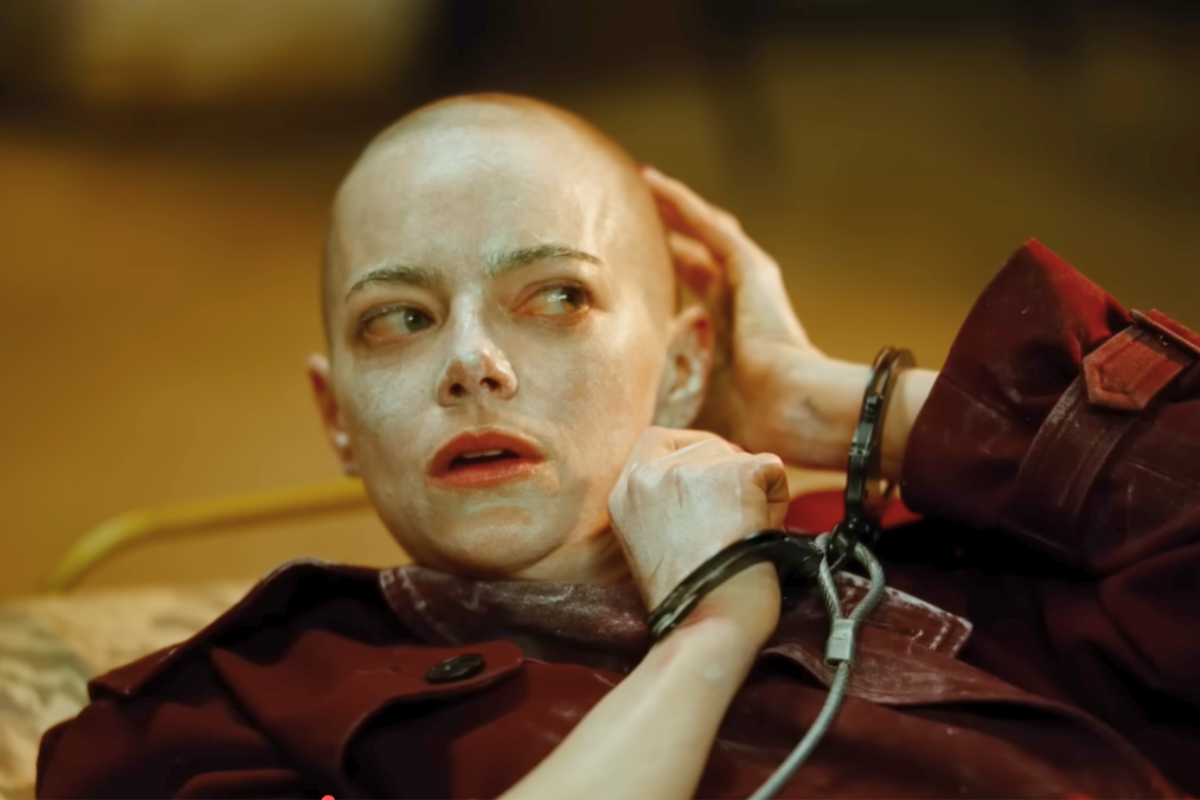
After being coldly betrayed by the prostitute Jenny, with whom he thought he formed a connection, if not a romance, Jimmy is sentenced to death by a kangaroo court. By this time, Mahagonny and its residents have descended into apocalyptic debauchery, writhing around half-naked, stained with whiskey, lipstick, and blood.
As the citizens of Mahagonny assemble for the final number after Jimmy’s execution, their mournful words resonate both with the fate of the Weimar Republic, and stand as a warning to the modern audience assembled in the Coliseum:
“You can’t do anything to help a dead man… You can talk about the glory of his heyday. You can also forget his old days completely. But you can’t help him, or you, or me, or no one.”
Mahagonny is occasionally described as nihilistic. But it is better understood as an urgent cautionary tale about how readily a society ruled by money and excess can descend into barbarism – by which time is it too late to mourn.