No Other Choice – How to win the job hunt
Dakota Nayler and Mia Foley Doyle
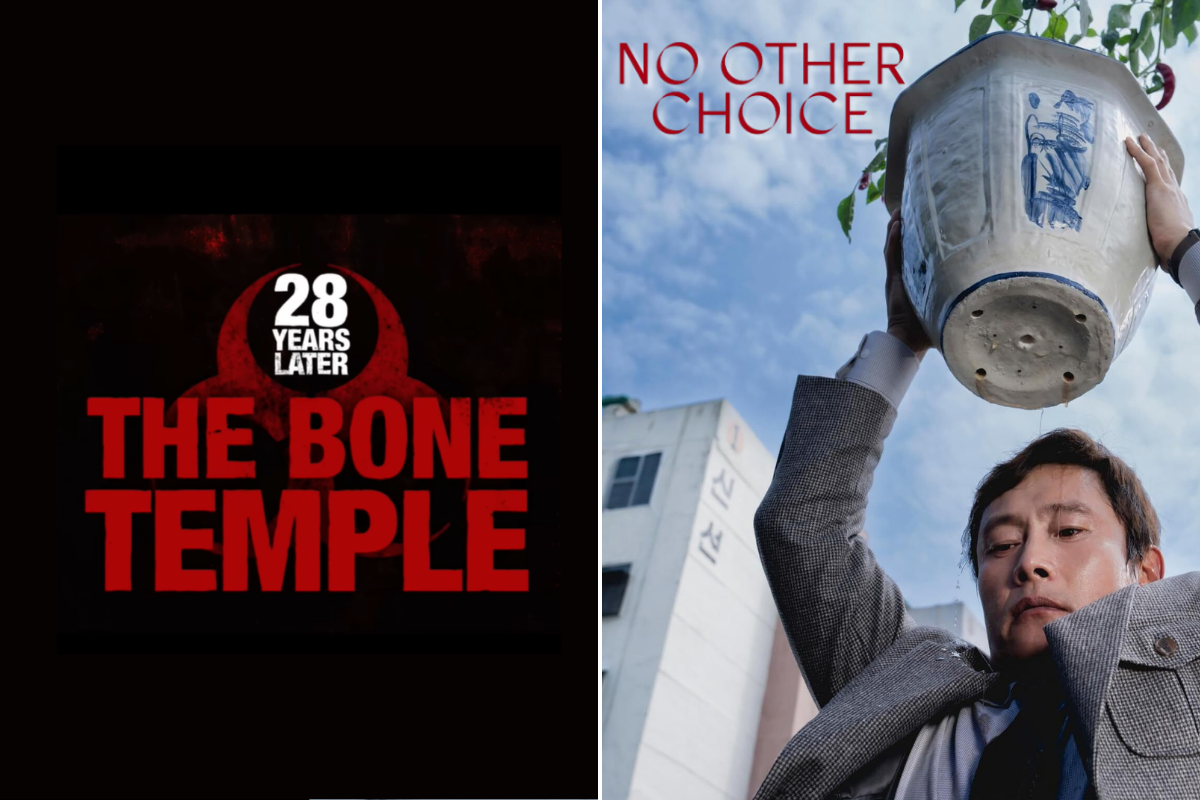
Three people. That’s all that stands in the way of protagonist Yoo Man-su (played by Lee Byung-Hun of Squid Game fame) in his quest to re-enter the job market after being laid off as manager of the paper factory he has worked in his whole life.
A year into a fruitless job search, and with the comfortable family life he’s built crumbling, Man-su commits to murdering the competition. No other choice.
Park Chan-Wook’s new black-comedy thriller, based on Donald E. Westlake’s 1997 novel The Ax, presents a harrowing and nuanced portrait of our current job market. With immaculate technical prowess No Other Choice captures the anger, sorrow, and tragic irony of the world that capitalism has carved out for us.
Automation
A core element of No Other Choice’s commentary concerns specialised trade skills and their changing place in an increasingly automated market.
Near the start, Man-su delivers an impassioned speech to his fledgling union, expositing the importance of their work as paper chemists and identifying that their value exists in the sheer amount of time it took to learn their trade.
View this post on Instagram
By all rights under capitalism, their hard work should be rewarded and protected – but their jobs are cut. The investors couldn’t care less when these men can be replaced by cheaper and faster machines to get an edge on the competition. “No other choice,” one executive explains with a shrug.
One of the great ironies of the film is that Man-su only has to kill three other people in pursuit of his role. As anyone currently looking for a job knows, most roles today see an avalanche of thousands of applicants!
Personal misery
In his skewering of the job market, Park also delves into the personal misery brought about by unemployment.
The film opens showing a family so stereotypically, traditionally ‘perfect’ it becomes rapidly surreal; an impression which is aided by these frames’ massively ramped-up saturation.
Man-su defines his worth and identity solely on his ability to hold down a job, to provide for his family and the lifestyle they are accustomed to. Early on, Park concisely sums up the consequences of unemployment, highlighting the Korean euphemism for severance: “off with your head”.
Without the stable base of a nice middle-management job for the head of the household, things quickly begin to unravel. Man-su’s wife, Mi-ri, gets a job. The house quietly falls into disrepair. Bit by bit, the less-than-perfect reality of the family’s relationship is exposed.
A man eroded
We watch Man-su blunder his way through various murders, like a Looney Tunes character, barely escaping scenarios that evidently require him to act in a way completely antithetical to who he is.
The film lingers on shots where he struggles to pull the trigger, hesitating, hands shaking. A real standout scene – where Man-su almost fumbles the murder entirely – involves an extended, comical three-way brawl for the gun, with everyone yelling nonsensically in complete confusion, the music blasting painfully loud.
The chaos of this first murder stands in sharp contrast to the cold calculation of the last. Man-su is not, by nature, a murderer. But he is a man desperately trying to secure stability in a deeply unstable system – this erodes and withers away the earnest man we see at the start of the film.
This is what strikes a real emotional chord with the audience. Although most are not pushed to murder(!), there are very few people who haven’t had to sacrifice themselves in some way for employment.
No choice?
Skillfully, No Other Choice accepts that Man-su has been pushed by the system to extreme violence, while graphically showing how his actions aren’t any less violent for this.
It accepts, on the surface, the premise that there is ‘no other choice’ – yet it also challenges this by highlighting numerous ‘other choices’. Even Man-su himself does make a choice.
You are not told which choice is ‘right’, or if such a thing even exists. But rather than creating a frustrating, dissatisfying, on-the-fence story, this balance is at the core of what makes No Other Choice an excellent film: the title itself becomes both a statement and a question, leaving viewers with plenty to chew over.
‘No Other Choice’ is showing in cinemas now.
28 Years Later: The Bone Temple – Blood, guts, and hope
Isaac Thompson, Lancaster
28 Years Later is back with a bang… and fire, and gore, and screams of agony… and most importantly: hope.
The Bone Temple follows on almost immediately from last year’s instalment of the 28 Years franchise. Nia DeCosta takes over the directorial reins, and this change of hands generates an altogether different take on the horror genre – leading to rave reviews from critics.
The first film focused on themes of fear, isolation, and nostalgia. Following the stories of Spike (Alfie Williams) and Dr Ian Kelson (Ralph Fiennes), The Bone Temple plunges us back into a post-apocalyptic Britain – and the barbarism brewing within it.
It soon becomes clear that, 28 years on from the zombie-virus outbreak, the threat of the ‘infected’ are the least of people’s concerns: trauma, ignorance, mysticism, and ritualistic murder stalk the land.
The film opens with a teenage Spike being forced into a death match to secure a place in a Jimmy Savile-themed Satanist clan. The camera does not shy away from the brutality as it lingers on his bested opponent bleeding out.
Viewer discretion is essential: The Bone Temple is not for the young, the faint of heart, or the easily-spooked. From torn-off heads, to torture and psychological abuse, this does not make for easy viewing.
Yet woven throughout all the blood and guts is a thread of hope, humour, and humanity.
Throughout the film, we are treated to despairing shots of the ruins of British civilisation: overgrown and collapsing houses, dilapidated streets, and the giant pillars of factory chimney-stacks, barely holding on as nature reclaims them.
Cut to Dr Kelson’s sanctuary – the titular Bone Temple. The stacks of skulls and bones clearly parallel the looming chimney-stacks. But their sinister appearance masks the humanity and warmth of Kelson’s idyll – a bastion of civilisation, science, and reason.
Dr Kelson’s temple is in the middle of ‘infected’ territory. At one point, he notices that one of his neighbourhood zombies, Samson (Chi Lewis-Parry), has become riddled with arrows, branches, and other debris.
In a standout scene, Kelson’s sense of duty at the sight of these injuries overcomes his fear: with the help of some tranquilisers, he sets about tending to Samson’s wounds.
Lewis-Parry’s performance here is an exemplary display of micro-expression: with Samson made docile, we can see the internal battle taking place between his infection-induced rage and what remains of his human mind. Perhaps, beneath the beastly exterior, there is something to be restored.
Sending Samson on his way, Dr. Kelson states firmly that Samson owes him – before joking, “No, there’s no charge… I’m NHS.”
All in all, The Bone Temple is a glorious return to the world of the 28 Days Later franchise. Amidst all the gore is a grounded, thoughtful story of people trying to survive in their isolated corner of a very British apocalypse.
Of course, this is the middle film in a trilogy, so in the final minutes the stakes are ramped up. The stage is set for what should be an equally entrancing final act.
‘28 Years Later: The Bone Temple’ is showing in cinemas now.
Escape from Shadow Physics – Challenging quantum theory’s dead end
Tommaso Verga, Brixton
Quantum phenomena present many complex problems for our understanding of reality. For example, at the sub-atomic scale particles seemingly behave as if they were waves.
The Copenhagen interpretation proposes that sub-atomic particles do not exist in the way we think of normal objects existing.
We cannot simultaneously accurately pinpoint both the location and momentum of a quantum particle. Under the Copenhagen interpretation, this means when we do locate one it must be the act of consciously observing it that makes the particle ‘appear’ where it is.
In other words, the mainstream interpretation of quantum physics has been to abandon the assumptions that things like an external reality and causation exist at all.
The meaning of probability
In his 2024 book Escape from Shadow Physics, Adam Forrest Kay attacks not only the Copenhagen interpretation, but also other outlandish interpretations of quantum theory – like the idea that new universes ‘spawn’ every time a quantum event happens that might have more than one outcome.
Before turning to physics, Kay studied literature and mathematics. This gives him a broader outlook than that of most scientists today, who have been funnelled into a system based on narrow hyper-specialisation – which, for all its advantages, clearly discourages ‘big picture’ thinking.
His background may also be what gives the book such a clear, focused and engaging style. Despite many biographical digressions and ‘parables’ aimed at showing how often science has gotten stuck in dead ends in the past, the book admirably develops a central argument.
This argument is backed up by hard data, analogies, intuition – and a deep understanding of probability, which is the key to understanding the approach Kay is defending.
View this post on Instagram
With our current theory and instruments, we can only discuss quantum events through a probabilistic approach. For example, ‘there is a 30 percent chance that the electron is in this area, a 10 percent chance that it is in this other area’, and so on.
The Copenhagen interpretation insists that this probability is all there is to reality – there are no ‘hidden variables’ to explain why certain probabilities can be observed.
Kay highlights a minority view which has always existed within physics, championed most notably by Albert Einstein: behind probabilities, there must be hard facts. That is, there must be objective processes happening at an even smaller and more fundamental level than the quantum which we simply cannot yet access.
This idea is not isolated to quantum mechanics. Many extremely complex phenomena can only be analysed at the level of probability – but we can still observe stable and reliable generalisations, which can then be applied in scientific study.
This is how meteorologists can explain the chaotic system that is the weather. And, we would add, it is also how Marxists are able to derive reliable laws from the complex interaction of the millions of unpredictable individuals that make up society.
Science and politics
‘This far and no further’ has been the motto of decrepit ruling classes throughout the history of human culture. Kay recognises this tendency to put a hard limit to science’s scope.
But without a class analysis of society, he is left without an explanation for quantum theory’s dead end. Is this down to bad luck? The random failure to spot something that should be obvious? Perhaps it’s the charisma of those behind the Copenhagen interpretation.
None of the above. The explanation for the stagnation of foundational quantum theory in the past century lies in the stagnation and crisis of an entire system – capitalism – which has especially come to a head since the 2008 economic crisis.
Only a socialist revolution can create the conditions for unprecedented developments in science and culture. In the meantime, books like Escape from Shadow Physics offer a much-needed antidote to the poison of the ruling class when it comes to our understanding of science – and a glimpse into the insights that await us.
‘Escape from Shadow Physics: Quantum Theory, Quantum Reality and the Next Scientific Revolution’ is available to buy from all booksellers.