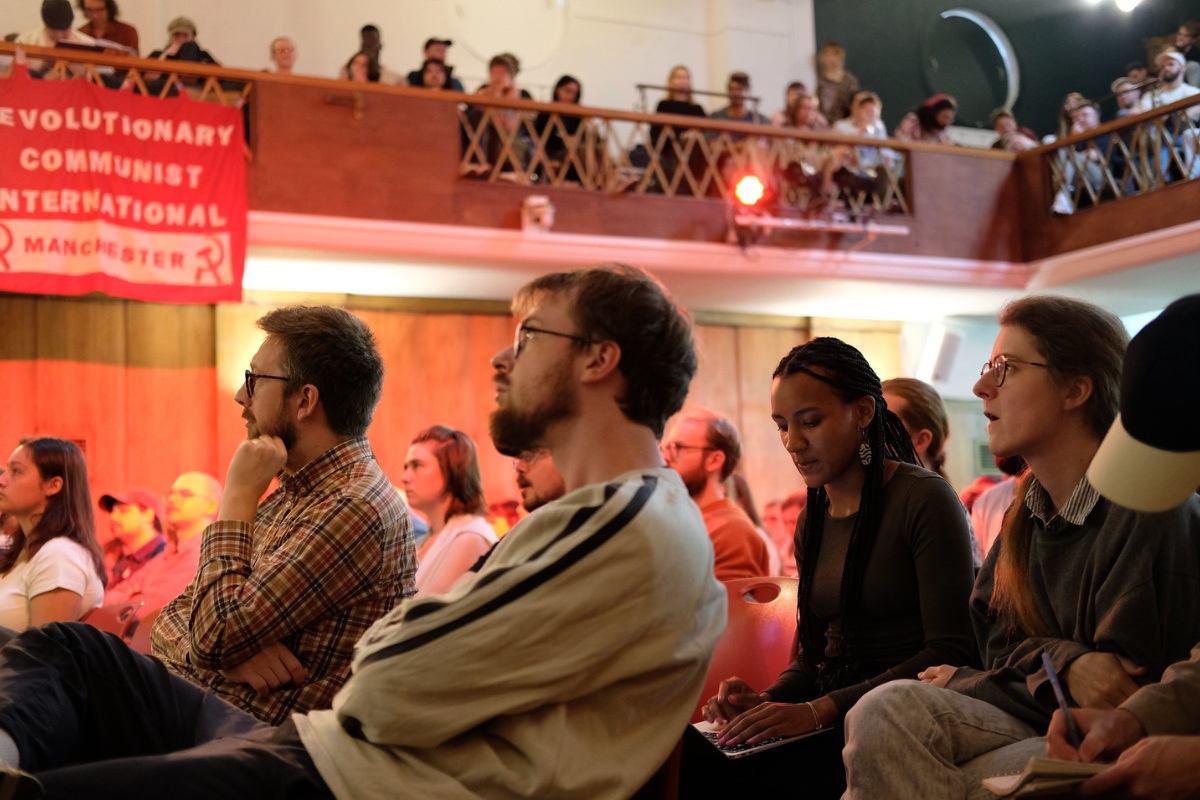
The Central Committee – the national leadership of the Revolutionary Communist Party – held its first meeting of the year from 24-25 January.
Planned as a Marxist school to further develop the entire party’s leadership politically, the main theoretical sessions were based on topics which Central Committee members requested to learn more about.
The meeting served as a launching salvo for the party’s education efforts in the coming months – including regional schools like the upcoming London Marxist School.
View this post on Instagram
Learning from our history
Saturday began with Jorge Martín, member of the RCI’s International Secretariat, speaking on a defining polemic in the history of our movement – between Ted Grant, theoretical leader of the Revolutionary Communist Party in the 1940s, and Tony Cliff.
The main document written by Grant in this discussion was Against the Theory of State Capitalism. As the name suggests, Cliff’s main idea – developed after the Second World War – was that the USSR had become capitalist in nature, and therefore did not deserve the support of the communists.
View this post on Instagram
Trotsky had dealt with similar views on the USSR – notably in the polemics later published under the title In Defence of Marxism. Then, as in the 1940s, the debate was not scholastic. Instead, it concerned a defence of the very ABCs of Marxism – that is, its scientific method.
All the attempts at painting the USSR as ‘state capitalist’ have always started with the ready-made conclusion – a conclusion which, furthermore, was attained under pressure from ‘public opinion’. Analysis was then constructed backwards, with isolated facts and quotes bent into rigid categories to prove the thesis.
This method is the opposite of what a serious Marxist analysis must be. Our task is to face the reality as it is and bring forth a real understanding of the processes at play, not muddling the waters and flinching due to pressures of alien classes.
Preparing for power
The discussion followed on to Daniel Morley, of the RCP’s Executive Committee, introducing the topic ‘1918: The first year of the Bolsheviks in power’.
The Russian Revolution took place in very unfavourable conditions. Unlike the earlier predictions of Marx and Engels – of the socialist revolution beginning in a developed capitalist economy – it broke out in Russia, a considerably backwards country.
Moreover, even if they had faced better conditions, the Bolsheviks would still have stood before an unprecedented task. Nobody, barring the brief episode of Paris Commune, had yet attempted to run society based on the working masses.
There was no blueprint to follow, and so the events of that first year after October provide us with a multitude of examples on how to apply the Marxist way of thinking in practice.
In fact, this was one of the motivations of Lenin and Trotsky in these first uncertain months of the revolution. They wanted to set the marker for the future generations – to prove that it could be done, and in doing so they also taught us how to navigate difficult decisions.
The future British revolution will likely face entirely different conditions. However, we must therefore expect that we will face a whole different set of problems.
Again, the method of going about these problems will be key to our success: holding on to the political and moral principles of the revolution, while showing a certain degree of necessary flexibility, but without bending into opportunism.
An explosive start to 2026
These lessons of the past illuminated our Sunday discussions on the present situation, with the session on world perspectives.
From Venezuela, to Iran, to Greenland… we have made it barely one month into 2026, and events did not wait for anybody to wake up from their festive stupor!
Fred Weston, member of the RCI’s International Secretariat, spoke in detail on these events, as well as the current unrest in the USA, and the catastrophic position of Europe in a world of tectonic shifts between the major powers.
Crucially, Fred underlined, we need to be able to zoom out and see the bigger picture. While it is necessary to take a close look at details, we must not get lost in them.
These individual events are expressions of the broader processes we identified in our previous analysis: the relative decline of US imperialism, the rise of China, as well as Russia and other regional powers, forcing a realignment of the spheres of influence, and the collapse of the post-Second World War status quo.
Peering even deeper into this process, we find an immense crisis of overproduction, which the serious economists are beginning to worry about. This explains, in the final analysis, the apparently irrational behaviours of all politicians.
Forward to 1,500 members!
RCP General Secretary Ben Gliniecki closed the weekend with the discussion on our future – the party’s plans for 2026. Last year, we made big leaps forward in our work to build the RCP, especially in improving our finances and the circulation of The Communist.
View this post on Instagram
Our successes demonstrate that the political level of our members and of leadership has been raised in the past twelve months. Now we must turn this qualitative growth into quantitative leaps. Having smashed the milestone of 1,300 members at the end of last year, we are setting our sights on reaching 1,500 as soon as we can.
The political maelstrom is not waiting for us to become bigger. We must with urgency recruit new members, and train them up as revolutionaries capable of participating in the struggles of the working class and the youth.
All our successes of the last decade can be traced back to our work on campuses. This is the key focus for our future growth.
At the same time, to continue to expand our ranks numerically we must continue the task of building cadres: trained Marxists who will be able to apply the method of Ted Grant and the Bolsheviks, in all fields of our daily work, and grasp what the next steps should be to prepare for revolutionary events in Britain.
The weekend helped in this task, with many visitors leaving the meeting filled with inspiration and a determination to build the party.
As one visitor from the North East said: “That was far and away my favourite Central Committee I ever attended. The more I learn, the more I understand, and the more I am convinced that this is how we change the world.”
The Central Committee was only the first of many regional cadre schools and day schools that the party will be holding nationally over the next months, including the upcoming London Marxist School on 21-22 February.
This education will be well-supplied with copies of Marxist texts, including the recently-released new editions of Ted Grant’s writings from our party bookshop, Wellred Books Britain.
It’s time to get ourselves educated! And it’s time to get out there and recruit hundreds of communists into our ranks!
View this post on Instagram