
Perseverance pays
Over the last couple of years I have regularly discussed revolutionary politics – using The Communist – with a handful of my co-workers.
Many would not have stopped at an RCP stall on the street, so I had to start from square one, translating Marxist terminology into plain speak.
I picked out three or four people who were sympathetic. I discussed with them regularly on a whole host of topics: Luigi Mangione, Palestine, Trump, Farage…
For a year or two, I’d been inviting two colleagues to public meetings, but they always fell on days they were busy. It took time. But when they finally agreed to attend one, they began to rearrange other commitments to attend more!
One colleague agreed to take a few copies of The Communist and sell them to her friends. We often worked in the same areas of the building, and went to the pub on Friday evenings, so opportunities to discuss came along.
Through her selling three copies to her friends, we then recruited someone – who has since moved to Aberystwyth to build his own branch of the party. He later told me:
“I think I was much more open to getting the paper off someone I trust, and I was impressed by the enthusiasm. I wouldn’t have called myself a communist at the time, but reading The Communist made me realise how much I agreed with.”
Another colleague said he told his friend about me and what I was about. His friend responded that what we were doing would “never go anywhere,” because we call ourselves “communists” and “comrades”… Turns out, a year later, that friend had joined the party in Sheffield.
Months later I told him about the bin strikes in Birmingham. He told me he had no idea what was going on, and I told him that was because he only got his news from outlets funded by billionaires.
He subscribed to The Communist and In Defence of Marxism magazine, with donations on top. He’s also recently attended our regional Lenin School, taking pages of notes, and was so impressed by Rob Sewell’s talk on Chartism that he bought his book, Chartist Revolution.
It’s not always easy to talk politics at work, especially on the job – but patient work pays off; and communist perspectives will sink in anywhere we can get them!
Lewis, Cardiff
Mitosis
My starting point was always what coworkers were already thinking – whether about current affairs, or workplace issues. From there, it was a matter of asking them questions so they would draw out connections between what they experienced and a broader, political perspective.
A key moment was a disagreement I had with one coworker on the meaning of Donald Trump: where I explained the contradictory, cross-class nature of his coalition – and therefore, its proneness to instability.
This discussion deepened his interest. He began reading RCP publications, attending meetings, and writing articles. He linked Marxist theory to workplace experiences, and quickly began applying it in conversations with others. Eventually, he joined our party.
The impact on the workplace was immediate and qualitative. With our new member confidently raising political ideas alongside me, discussions became more frequent, open, and collective.
Others began to take communist perspectives more seriously, recognising that this was not just my individual opinion, but something organised. Soon multiple coworkers started attending meetings, engaging in discussions, and approaching us with political questions.
Ultimately, the workplace is one of the central arenas of political life. People experience the horrors of capitalism every day. A communist perspective helps to make sense of these experiences, and offer a way forward.
Julia, Birmingham
Tapping into the mood
Seven years working in coffee has taught me one thing: young workers, shaped by low wages, long hours, and 101 daily pressures are forming radical baristas willing to fight.
In my latest job, I began discussing with coworkers on how to improve our working conditions. We started regular meetings, and called a meeting with the manager – on our own terms – to express both our concerns and our solutions.
We won real concessions: regular workers’ meetings, a redistribution of responsibilities, and space for broader discussion – for a brief moment, we experienced a sense of control over our work.
This did not last.
Head office intervened. The meeting and our demands were seen as a threat. They placed pressure on the manager to keep things under control – and when she failed to do so, she was swiftly removed.
HR introduced an anonymous survey to “listen to worker concerns.” Everyone raised issues around pay, staffing, and conditions – but, predictably, nothing came of it.
With lessons from this phase, we resumed informal meetings – now across six locations.
I tend to visit most of the shops weekly to stay connected with what is happening and to feel the mood on the floor. I began raising the idea of setting up a union branch to address the issues we face, and with two other colleagues we discussed the history of the labour movement and started planning an open meeting – which my RCP branch helped me build for and run.
Management reacted swiftly. Those involved were suddenly given shift patterns that made it impossible to meet in person.
Yet simultaneously, management began offering concessions: improvements to the holiday scheme; and a “town hall meeting” scheduled on the same day as our planned union meeting. Then came a 9 percent wage increase.
These measures were no doubt intended to break our momentum. Nonetheless, two workers joined the union; and others subscribed to The Communist. Most importantly, the company was forced to make concessions – not out of goodwill, but out of fear. This lesson will not be lost when their next offensive inevitably comes.
Leo, Crystal Palace
Industrial newsflash: Classroom struggle
[The following reports were first published in The Communist, 1 April]
UCU Sheffield shows the way forward
Staff at the outsourced University of Sheffield International College (USIC) recently went on their seventh day of ongoing strike action, demanding a 12 percent pay rise. It is one of the few unionised workplaces in the private sector of higher education.
The private company – Study Group (SG) – charges overseas students as much as £26,000 a year, resulting in a bumper 14 percent profit rate. But the company wants to see at least 20 percent profits, strikers told RCP members at the picket line.
This is why SG argues staff will face zero percent compensation for rising bills and inflation for a second year in a row – while announcing restructures with redundancies. Meanwhile, SG’s CEO Ian Crichton pockets over £600,000 a year!
Although they sport all the University of Sheffield (UoS) branding and teach in buildings owned by UoS, their arrangement means SG – and indirectly UoS – can circumvent national bargaining agreements, and cash in from international students twice.
Meanwhile UoS – which sits on millions of cash reserves, and is happy to pay millions to SG – is picking off one department after another in a vicious trade union victimisation campaign, following strike action earlier this year.
Staff at the USIC picket said they are resolved to notify further strike action targeting the assessment period, if necessary, meaning students may not be able to pass their degrees.
Still going strong on our 7th day of strike action!
Our CEO and senior directors earn hundreds of thousands every year.
We get 0% for the second year in a row.
Our employer wants us to call off strikes but will not offer anything.@BBCSheffield @SheffieldStar @ucu pic.twitter.com/ZOQZ0HrAEg
— USIC_UCU (@UcuUsic) March 24, 2026
Their militancy shows the way forward for the whole education sector. We need coordinated action, and a national campaign together with the other education unions to end university marketisation and kick capitalism out of education.
Elena Simon, Sheffield
School’s out!
University workers across Britain have been out on strike.
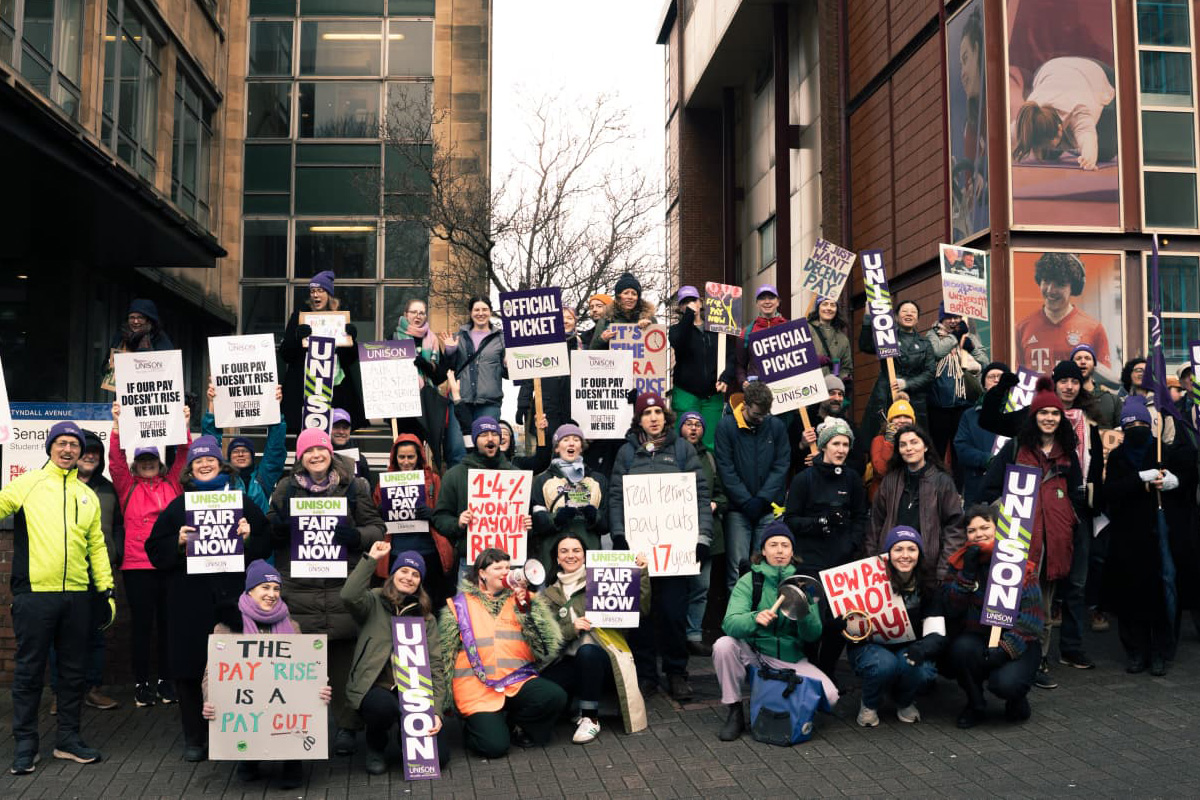
In March, Unison members from London to Bristol fought against the bosses’ collective UCEA’s insulting offer of a 1.4 percent pay rise.
Voir cette publication sur Instagram
Meanwhile in Scotland, UCU members at Aberdeen, Dundee, and Strathclyde went on strike demanding that universities back down from threats of mass layoffs and redundancies.
RCP members in Manchester visited their local picket line in solidarity with striking Unison members at Manchester Metropolitan University and Royal Northern College of Music.
As one worker told us, the struggles against the “marketisation of higher education” and against “pay cuts year on year” are one and the same.
Many of the workers we talked to were in fact looking for broader solutions. One Manchester Met striker, for instance, proposed mass direct political pressure: “Because,” he said, “this needs a political solution.”
Unfortunately, many of these battles remain isolated from one another, following the defeat of the national UCU ballot last year. Yet the fact that they are spreading – and that workers are discussing increasingly political solutions on the picket line – shows that the appetite for militant industrial action is there.
Will Fisher and Ben Cownley, Manchester
‘British values’
Two weeks ago, I took a bus from the temporary building of an inner city post-16 that I teach in, to the prestigious Clifton College.
In their generosity, they gave me the wonderful privilege of a tour of their campus. Between two massive rugby fields, on the way to the maths building (10 mins away!) I saw a six-foot bronze statue of Field Marshall Haig.
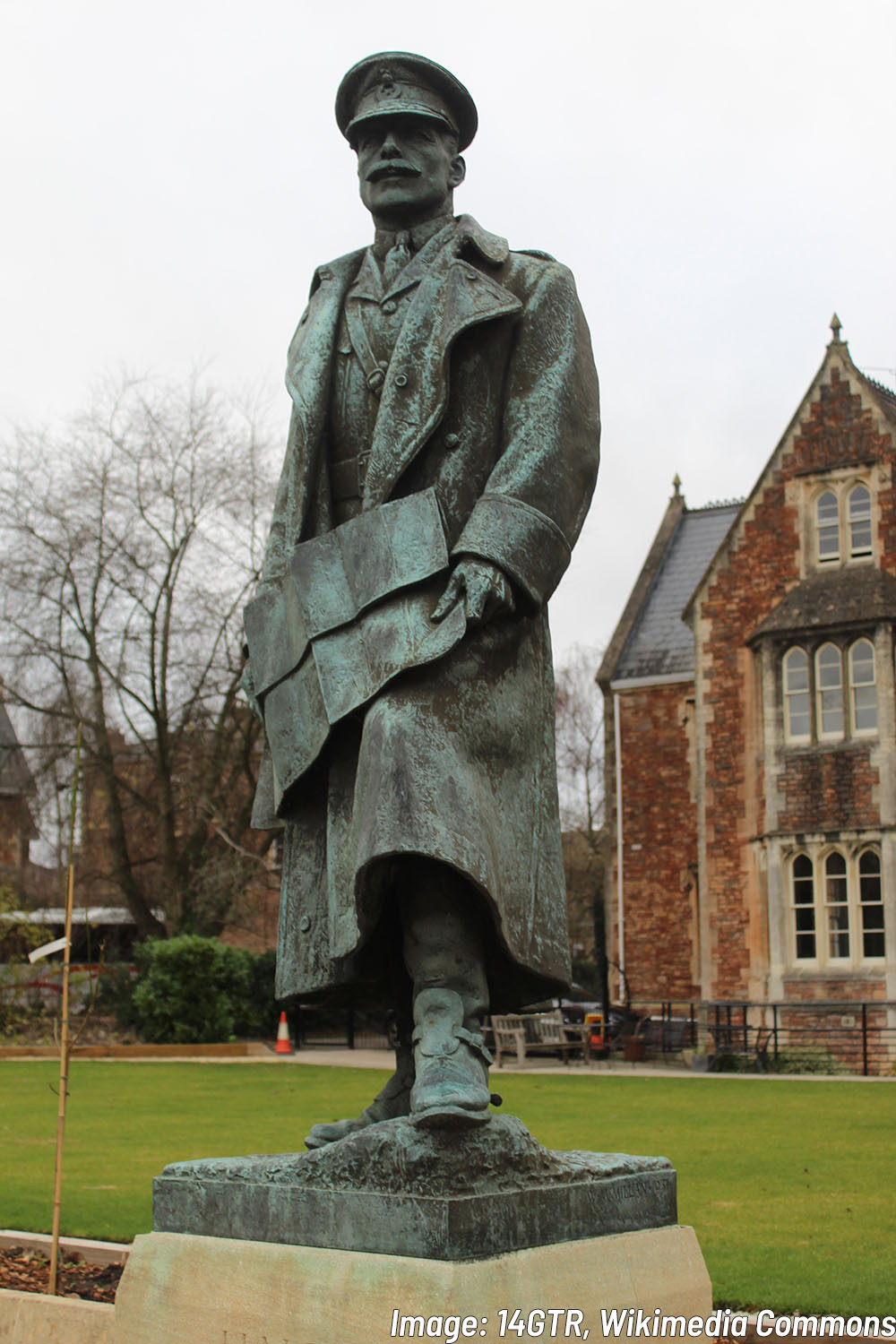
Butcher Haig, as he is better known, was responsible for sending two million British soldiers, ordinary working men, to their deaths in the chaos and barbarity of the trenches of the First World War.
He is also a celebrated alumnus of Clifton College. Children of the bosses and banking elite debate the ethics of this man in their history classrooms, just metres from the statue – while millions of ordinary workers lie in unmarked graves as a result of his incompetence.
Sadly, this exemplifies one of the main purposes of the British education system, especially for lack of actual education: an ideological front for the class struggle.
In schools today, ‘British values’ are taught to children as young as two. Despite the suggestion that these values are ‘natural’ and fundamental to British society, they are still hamfisted into our education system and force fed to our youth.
It makes clear where the real priorities of the ruling class are.
They tell us we need to ‘tighten our belts’ as they shrink school budgets, implement unfunded pay rises for teachers, make no inroads on the teacher retention crisis, shut down alternative schools, and deepen the marketisation of education.
Meanwhile, if students express pro-Palestine sentiment, they are referred to Prevent, and if teachers do, they are clamped down on with the full force of the Ofsted bureaucracy.
Sanmay, Bristol