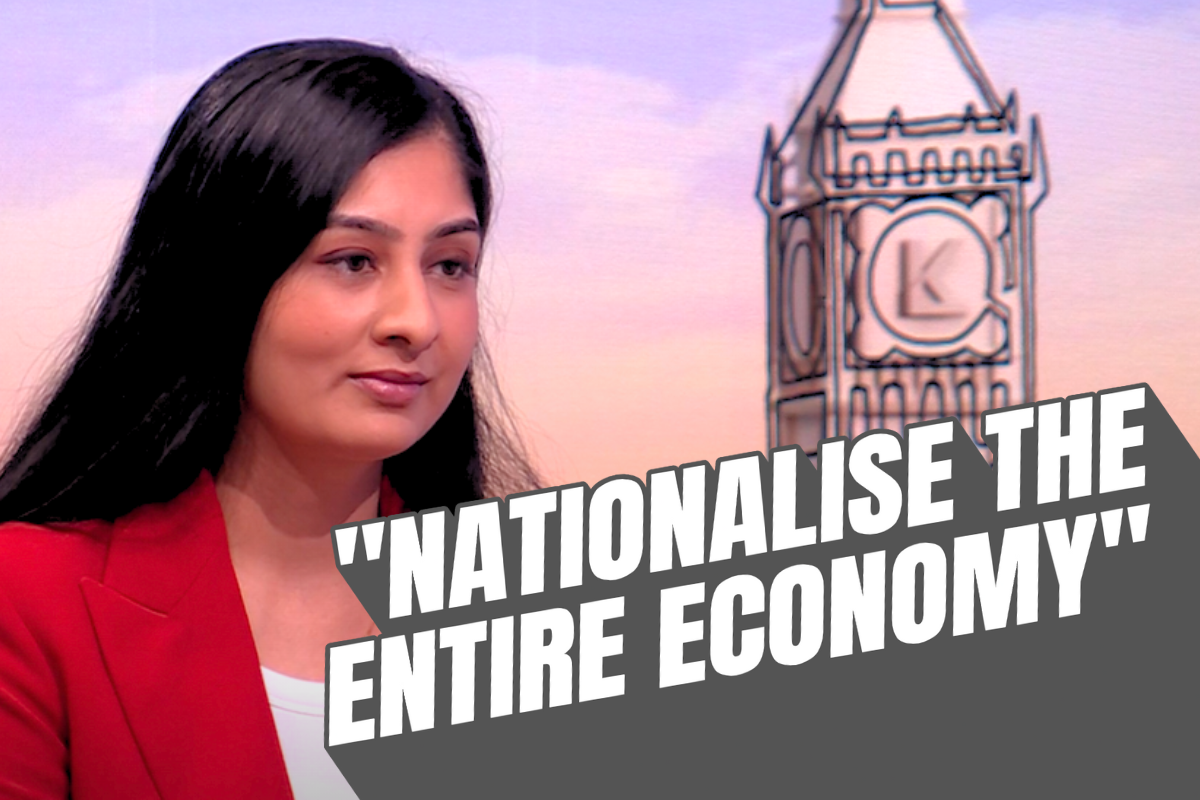

“We have 50 rich families who hold more wealth than half of the country, so we need a wealth tax. But we also need to nationalise the entire economy. Obviously like I said, utilities, transport, and energy are important, but we need to look beyond that. We need to look at the banks, we need to look at the construction, we need to look at the entire economy.”
These were Zarah Sultana’s words at a fringe meeting held on the eve of the Your Party conference last November.
She later repeated these calls for nationalisation of the economy in a speech during the founding conference itself. And she has since reiterated and expanded on this demand in various media interviews.
Such calls for nationalisation of the banks and for an economy run by workers, not billionaires, is something that should be welcomed by any socialist.
In an interview with Sultana that went viral, however, journalist and self-proclaimed socialist Owen Jones insolently asked the left-wing MP how nationalising the entire economy would work in practice.
Zarah Sultana says we should “nationalise the entire economy.”
I asked her what meant in practise. pic.twitter.com/gtAhZ9Wu5k
— Owen Jones (@owenjonesjourno) December 1, 2025
Sultana answered by explaining that she would like to see a “socialist transformation” of the country. But before she had the time to go into this any further, Jones interrupted her and asked: “But not the entire economy, though?”
Jones then claimed he was “fascinated” by Sultana’s demand, and wanted to know if she was planning to nationalise all of the country’s kiosks.
This clip has since been shared by many right-wingers, including Piers Morgan, who commented: “Imagine being so far loony left that even Owen thinks it’s bonkers.”
Unsurprisingly, Labour right-wingers have also ridiculed Sultana. Labour councillor David Mcgregor, for example, stated that: “While Sultana tries to nationalise the internet, Labour is about to lift 450,000 children out of poverty.”
Or take the independent MP, landlord, and director of two real-estate companies, Adnan Hussain, who recently broke with Your Party. In response to Sultana’s comments, he tweeted: “I don’t think we want to be North Korea.”
Of course such figures are going to attack and make fun of radical rhetoric like that being put forward by Sultana. After all, nationalisation of the economy would threaten their privileges, positions, and profits.
Sneering ‘lefts’
But it is not only right-wingers who have criticised Sultana.
In response to Sultana’s Your Party conference speech, commenting on her demand for nationalisation, Jeremy Corbyn said that he did “not even know what that means”.
Instead, Corbyn suggested that he wanted to see economic measures like public ownership of key industries – such as water, energy, rail, and mail – and the reversal of the privatisation of healthcare and social services.
He then emphasised that the main priority should be tackling homelessness and poverty within the confines of the capitalist system, by taxing the rich.
Other figures on the ‘left’ have also chipped in to admonish Sultana.
‘Left intellectual’ Tariq Ali, for example, who once wrote an introduction to the Communist Manifesto, said that he groaned when he saw the video of Sultana calling for nationalisation. He dismissively claimed that such “maximalism” does not work in practice, pointing towards the Soviet Union and Cuba as proof.
“It’s more radical than Lenin in the mid-1920s!” @AaronBastani and author @TariqAli_News discuss Zarah Sultana’s promise to ‘nationalise everything’ if Your Party wins power.
Tariq Ali is the co-founder of @VersoBooks.
Watch the full episode of Downstream on our YouTube… pic.twitter.com/29wIplOA7W
— Novara Media (@novaramedia) January 20, 2026
Instead, Ali suggested that Sultana should seek advice from people like him, in order to come up more “credible plans”, like those supposedly advocated by Tony Benn and Ken Livingstone.
Or take Micheal Walker from Novara Media. Commenting on Sultana’s demand, the podcast host asked: “Where has it worked?” Showing his true colours, he then asserted that: “Every socialist project that is able to provide a decent standard of living for people has a significant role for private firms driven by profit motive.”
George Galloway, meanwhile, called Sultana childish. He said he wants an economy like China, where the state plays a decisive role in a mixed economy and “where the people come first”.
According to all these snide, demoralised ‘lefts’, it is completely utopian to think that society can be run by the working class, without capitalists, bankers, and landlords. Rather, they say that we need to be ‘realistic’ and focus on ‘what is possible’ today.
In short, instead of breaking with the capitalist system that is at the root of all the ills in society, their only ambition is to patch it up.
We wish them well in this endeavour. Meanwhile, in the words of The Red Flag, the socialist anthem: “Though cowards flinch and traitors sneer, we’ll keep the red flag flying here.”
Market disasters

The ironic thing is that these ‘left’ figures end up being the biggest utopians of them all, in their reformist belief that capitalism can be made nicer and kinder, so as to ‘put people first’.
What they forget – or willfully ignore – is that, at its very core, capitalism is a system based on the exploitation of the working class and the maximisation of profits.
The pressures of market competition force every business owner to abide by capitalism’s cold, callous logic. Those who don’t will not survive, and are gobbled up by the most ruthless.
It is therefore reformist hopes of bringing about a softer version of capitalism that are utopian and naive. The bosses will always put profit above everything else.
Look at what years of privatisation and outsourcing have brought about in Britain’s public services: higher prices; worsening quality and working conditions; high staff turnover and job losses.
A study in The Lancet, for example, revealed that the outsourcing of NHS services has led to a higher mortality rate amongst patients.
The country’s care homes provide another grim example of the impact of privatisation, with hundreds of beds lying empty because of staff shortages and financial pressures.
Elsewhere, there are regular headlines of private nurseries going bust, having to close from one day to the next. Others hike their fees. Last year, for example, Leeds City Council privatised two of its nurseries, leading to a 25 percent increase in the price paid by parents.
Or take Britain’s utilities. Rail, mail, water, and energy have all been devastated by private profiteering. In every instance, the market has been a disaster.
Royal Mail, for example, has carried out thousands of redundancies since being privatised over a decade ago. This has forced the remaining workforce to work even harder, with longer rounds – with intrusive scanners even introduced to track posties’ productivity.
Then there is Thames Water, a completely parasitic company that has been on the brink of collapse for some time, due to the billions siphoned off to shareholders in the years since privatisation.
Decades of underinvestment, cost-cutting, and huge dividend payments have resulted in a massive increase in sewage discharges and record levels of leakage from pipes. To deal with its debt crisis, meanwhile, Thames Water raised its bills by an eye-watering 40 percent last April.
The same can be said about the steel industry. Unable to compete on the world market, fat-cat steel bosses have shut down plants across the UK, leading to job massacres and deindustrialised ghost-towns.
Of course, whenever they face financial difficulties, these very same bosses gladly turn to the government for bailouts – presenting the working class with the bill for the capitalists’ crises.
In other words, the only kind of nationalisation they want is of their losses. Since April, for example, Starmer’s government has spent an average of £1 million per day to keep British Steel afloat.
This is all that privatisation and the market has to offer. Workers see attacks on their jobs, pay, and conditions; users pay more for worse services. Meanwhile, the bosses and shareholders are laughing all the way to the bank, gouging on juicy profits and bonuses at our expense.
Popular demand
Sultana is completely correct to say that we need to look beyond just the utilities – at the banks, the construction sector, and ultimately the entire economy.
Take the 2008 financial crisis – in reality, a crisis of capitalism. Across the world, the big banks were bailed out by the state. The biggest advocates of the ‘free market’ now came cap in hand to the government, demanding that taxpayers take on the burden of their bad debts.
Once again, all the losses were nationalised while the profits remained in private hands.
There is perhaps no better example of the anarchy of the market than the housing sector. Private property developers and construction monopolies have been completely incapable of reaching the government’s relatively modest home-building targets.
Yet whilst they and the big landlords make a killing, the rest of us suffer the consequences in terms of severe housing shortages and ever-rising rents. And all of this whilst speculators sit on thousands of empty properties, treated as investment opportunities, not homes.
There are countless more examples that could be added to this rap sheet. But the conclusion is clear: far from being ‘efficient’, the capitalist market is a catastrophe for ordinary people.
No wonder the demand for nationalisation has become more and more popular in recent years.
Share of voters who support nationalising…
🚅 Rail 60%
💡 Energy 60%
🚰 Water 63%Via @YouGov, 12 May 2022 and 11-12 Dec 2019 https://t.co/uQXbTVLNqL pic.twitter.com/SLNZUSOvaN
— Stats for Lefties 🍉🏳️⚧️ (@LeftieStats) July 25, 2022
In 2017, for example, 59 percent of Britons said that they wanted to see the water industry nationalised. Today, that figure has increased by 23 percentage points to 82 percent.
Likewise, support for the nationalisation of the rail, energy, and bus companies has respectively risen by 16, 18, and 16 percentage points, to 76, 71, and 66 percent.
Sultana’s call for sweeping nationalisation is therefore falling on fertile ground.
Planning vs profit
Many across the left talk vaguely about taking the key utilities into public ownership. Often, however, this simply means introducing a bit more state control or regulation into this or that sector.
Even Starmer’s Labour have talked about bringing back public ownership in relation to Britain’s railways and energy industry. Yet, when pushed for details, it transpires that all they would do is implement minor tweaks, whilst leaving the market and the profit motive in place.
For communists, the demand for nationalisation does not mean bringing in state capitalism: that is, having the government run certain strategic businesses, or nationalising the loss-making parts of the economy, but leaving the capitalist market intact.
Rather, we call for nationalisation of the key levers of the economy, in order to plan production according to society’s needs, not the bosses’ profits.
This means going much further than nationalising just the main utilities, or the idea of a wealth tax, as Sultana suggests.
We have to expropriate the big banks and major monopolies, without any compensation to their current profiteering owners, and put the economy under democratic workers’ control.
In its essence, capitalism is a system based on production for profit. On this basis arise certain economic dynamics: objective laws and pressures that govern the movement of the capitalist economy, and in turn of society.
It was these laws that Marx uncovered with his economic writings, including his magnum opus Das Kapital. It is these laws that inherently give rise to inequality and exploitation; to capitalist chaos and crisis. And it is these laws that we, as communists, fight to overthrow and replace, through socialist revolution.
‘Left’ critics like Tariq Ali may dismiss this as ‘maximalist’. But the truth is that demands for nationalisation of the ‘commanding heights’ of the economy are a necessity – the only way that we can genuinely put an end to all the miseries of capitalism.
Workers’ control
Ali holds up the examples of the Soviet Union and Cuba to say that wholesale nationalisation and economic planning do not – and cannot – work.
By contrast, we look to these cases to show the enormous potential of socialist planning.
In spite of all the barriers placed in their way – imperialist intervention, on the one hand; and a starting point of economic backwardness and isolation, on the other – the Russian and Cuban revolutions brought about huge progress for the masses, by abolishing capitalism and beginning to plan production.
The problem was that this planning was done in a bureaucratic, purely top-down manner, without the mass involvement and democratic participation of the working class. The same can also be said of the nationalised industries in Britain in the postwar period.
Effective economic planning is impossible, however, without workers’ control and management. In the absence of this, all manner of distortions and waste will necessarily arise, as was seen in the Soviet economy.
Just as a capitalist economy needs the information provided by market forces and price signals in order to efficiently operate, so too does a proper socialist economy require the knowledge and feedback of the organised working class in order to rationally allocate society’s resources.
The difference is, in the former instance, under capitalism, the economy is governed by blind and anarchic forces; by the ‘invisible hand’ of the market. In the latter case, under socialism, the economy is consciously organised, on the basis of need.
That is why genuine communists call not only for nationalisation, but for workers’ control and democratic socialist planning.
Reformism vs revolution
Unlike all the aforementioned ‘left’ naysayers and cynics, we welcome Zarah Sultana’s bold calls for nationalisation.
Such demands already put her to the left of many of her peers and ‘comrades’: not only other – more tepid – reformists, like Corbyn; but also so-called ‘Marxist’ groups like the Socialist Workers’ Party, who largely limit themselves to liberal and moralistic appeals to ‘stand up to racism’ and so on, devoid of any class content.
At the same time, we must be honest in highlighting the limitations of Sultana’s programme and approach.
The problem is not that Sultana’s demands are ‘too much’, as Owen Jones, Tariq Ali, and other ‘lefts’ suggest. Rather, the issue is that she does not go far enough: that she does not flesh out her calls for nationalisation by clearly explaining the need for socialist planning and proper workers’ control.
As with other militant demands – like her calls for Britain to withdraw from the “imperialist war machine” that is NATO – Sultana often arrives at correct conclusions, but without a full understanding of the problem at hand, or of what the actual alternative is.
Such ‘vibes-based politics’ may work in terms of coming up with catchy social media slogans. But its shortcomings are quickly revealed upon closer examination, especially in the face of hostile pressures.
Sultana has found this out for herself, sometimes struggling to defend and explain her policies under interrogation – for example, when interviewed by BBC establishment hacks.
In these instances, the Coventry South MP has generally answered by providing vague, woolly, and confused elaborations of her demands. Often, she has backtracked and found herself putting forward fairly mild, milk-and-water, reformist suggestions.
When quizzed about her economic proposals, for example, Sultana has expanded upon her demand for nationalisation by talking about the idea of scattered workers’ councils and cooperatives, rather than stressing the need for socialist planning of the economy under democratic workers’ control – that is, the need to overthrow capitalism.
Importantly, another key question has been left hanging: who is to bring about the “socialist transformation” of the economy that Sultana talks about? Do we expect such radical change to be brought in gradually, through piecemeal parliamentary reforms? Or do we need to mobilise and organise workers and youth in a struggle for revolution?
All these questions, and more, need to be discussed, debated, and clarified throughout the left and the labour movement. And it is to Zarah Sultana’s credit that she has raised these ideas, in the face of opposition from both the right and the ‘left’.
The communists of the RCP welcome the discussion around nationalisation and economic alternatives to the broken status quo.
We will participate in these debates, taking every opportunity to patiently raise and explain our revolutionary programme: the unequivocal defence of socialist planning over market anarchy; nationalisation and workers’ control over private profit; communism over capitalism; revolution over reformism.