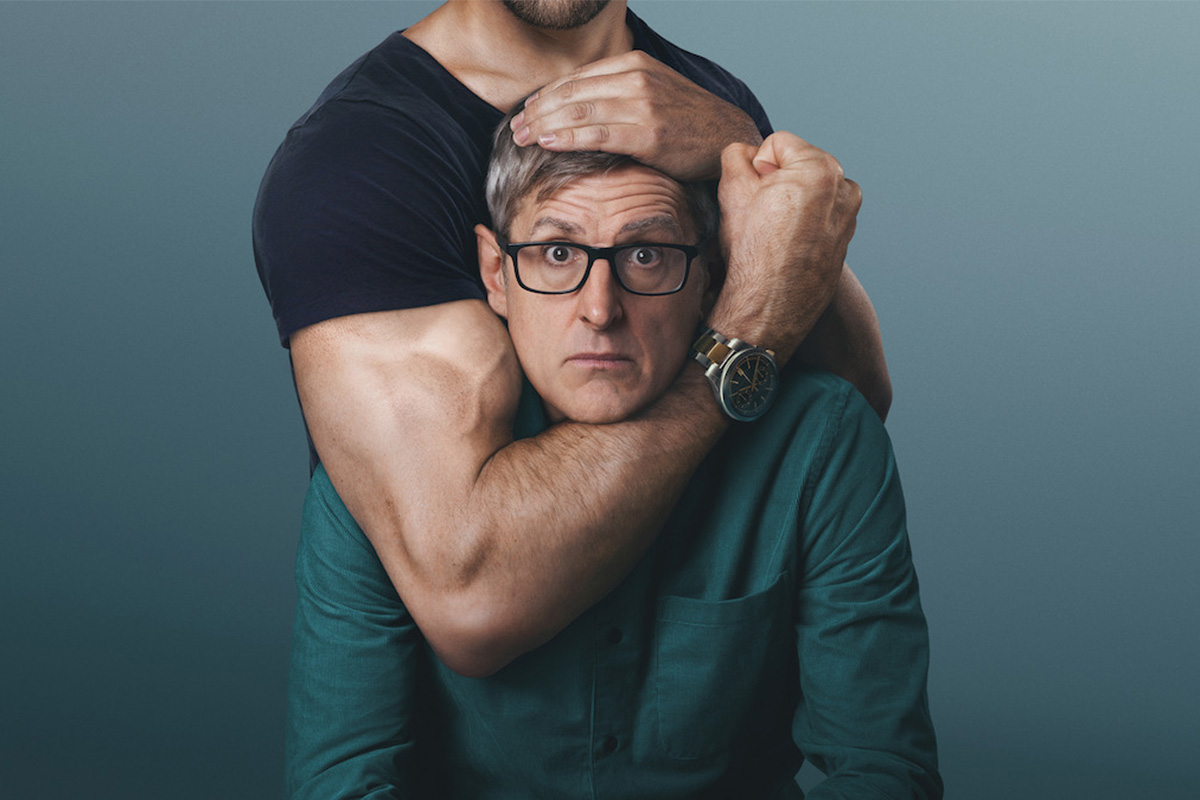

Louis Theroux’s documentaries often deal with people on the fringes of society, interrogating their extreme lifestyles and beliefs.
The long-term decline of British capitalism has shattered all semblance of social and economic stability in the country. As all of the hallmarks of a civilised existence are clawed back by the capitalists, irrational and fringe ideas have become mainstream.
Enter the influencers of the so-called ‘manosphere’, who combine marketing and sales with a poisonous mix of misogyny, racism, and conspiracy theories.
Their truly backwards views on women – whilst always being a part of capitalist society – were once confined to the fringes. Now, virulent, naked misogyny is par for course on all social media platforms, amplified by algorithms that reward outrage.
Their ideology (which feels like a generous term for a collection of loosely-held and contradictory beliefs) has infiltrated schools, universities, social media platforms, and wider society. One of the figures in this documentary even boasts to Theroux about having dinner with the Trumps at Mar-a-Lago resort.
View this post on Instagram
The manosphere grift
One thing the documentary does well is explain the manosphere grift in ordinary language. Theroux lays out the ecosystem clearly: the podcasts, the livestreams, the monetisation strategies, the endless churn of content. These individuals exist primarily to enrich themselves off the back of their gullible following.
It produces an interesting meditation on traditional media versus new media. Harrison Sullivan, an influencer who goes by the name HSTikkyTokky, has to be reminded not to speak directly to the camera, as he would when producing social media content. This alights on the unspoken conceit of documentary filmmaking.
Louis Theroux, who is less wry and unflappable than we’ve seen him otherwise, tries to get under the influencers’ skin with a more direct line of questioning – apparently attempting to make his interviewees contradict themselves.
Theroux clearly resents having the camera turned back on him, being livestreamed, and focuses on how the drive to produce monetised content – more clicks, more views, more revenue streams – incentivises extreme behaviour. And he’s not wrong – big tech companies do want us angry and alienated as it boosts their profits and prevents ordinary people concluding that the system itself is to blame.
It is less entertaining to watch Theroux probe these men than it is frustrating. They are provocateurs to the bone, almost always performing for the camera, cynical grifters seemingly solely motivated by money. Sullivan tells Theroux that chanting “fuck the Jews” is “not antisemitism, it’s click farming.”
But it is a mistake to suggest that social media is solely responsible for this phenomenon – a message which Inside the Manosphere is not alone in amplifying.
Half truths
Even amongst the influencers, the documentary shows that their views are contradictory; while the origins of their misogyny are often rooted in more than simple idiocy or maleness.
When pushed, Sullivan gestures towards a worldview in which a cabal of ruling elites secretly dominates society. And that cannot be outright dismissed as conspiracy theory.
The release of the Epstein files showed us the most in-depth glance we’ve ever had of how our ruling class operates behind closed doors. And it’s not dissimilar to what the manosphere influencers are describing.
They commit depraved acts of sexual abuse while simultaneously manipulating financial markets and engaging in insider trading.
They share privileged information about national security and state affairs among themselves to secure economic advantage; while the working class foots the bill for their adventures. And the vast majority of the individuals implicated in the scandal appear to be getting away with it!
The influencers in the documentary clearly recognise a profound sickness in society. They just cynically misdiagnose the cause, quickly devolving into antisemitism. This leads Theroux to outright dismiss them as conspiracy theorists.
But what is really being expressed is a (very) distorted reflection of class anger. This isn’t to excuse their vile misogyny or racism, but it is essential to understand why their ideas have found an echo amongst young boys and men.
Young people have no economic security, are burdened by debt, and feel increasingly alienated and isolated by the conditions of modern society.
The young boys who make up the target audience of the manosphere have very little to look forward to in a world marred by war and climate collapse, while the ruling class enriches itself astronomically, simultaneously acting in the most depraved manner imaginable.
Misogyny
Class society perpetuates the idea that women are the property of men, and encourages sexist abuse. The manosphere is simply bringing these reactionary ideas into public view, in an intentionally provocative way.
These get-rich-quick, snake-oil salesmen are able to target vulnerable men precisely because they sense that the future is uncertain, and offer easy scapegoats in the form of ‘emancipated’ women and ethnic minorities.
They present a reactionary solution: that society could be restored by returning to a so-called ‘natural order’, in which women remain confined to the home and men resume their position as head of the nuclear family.
The claim that men “build, invent, and maintain society” – as one influencer puts it in the documentary – has roots in class society. It was once considered ‘natural’ because women were systematically excluded from social production for thousands of years, and confined to the domestic sphere, where they lacked independent economic viability.
Similarly, the average viewer might be shocked that the influencer Justin Waller advocates for “one-sided monogamy”. But such uneven expectations have existed since the emergence of class society.
The shift away from earlier matrilineal forms of social organisation, with its open sexual networks, towards the enshrinement of private property, and therefore patrilinearity, fundamentally reshaped family relations, subordinating women within a structure designed to secure property inheritance.
The influencers themselves are deeply insecure, their repugnant machismo masking profound instability and emotional problems. It is not a coincidence that all of the men in the documentary come from fractured or violent homes.
The oppression of women is not an inherent feature of human society, nor is it reducible to the psychology of individual men. It arose historically with the division of society into classes and the emergence of private property. Ideas do not fall from the sky; they are produced by material conditions, and they change as those conditions change.
If we are serious about confronting misogyny, we must address its root: capitalism and class society itself. The struggle for women’s liberation cannot be separated from the struggle to transform society as a whole. If we want to draw young men away from these ideas, we must offer a viable alternative, and not simply patronise them as stupid or ignorant.
Political vacuum
The manosphere is partially filling a political vacuum, one opened in part by the discrediting of bourgeois establishment at every level.
In fact, the documentary itself demonstrates Louis Theroux’s limitations as a figurehead of the BBC establishment.
Normally, he gives people the rope with which to hang themselves. But clearly, he feels the need to take a more combative approach with the men of the manosphere – especially against their “conspiracy theories”, but also by taking one side in a culture war that is actively promoted by the British, bourgeois establishment.
In Inside the Manosphere, he is particularly keen on making a fool out of whichever influencer he is interviewing. In the context of the culture war, this liberal haughtiness extends to the influencer’s followers.
Eventually, the tables are turned on Theroux himself, as an influencer livestreams the documentary filmmaker, challenging him to answer whether or not Israel is committing genocide in Gaza. It is, in the end, Theroux who is made to look foolish.
To the influencer, this shows that he is a paid puppet of “the Jews”. In reality, Theroux – despite his attempts to hold up a mirror to society – is, in the last analysis, a paid puppet of British imperialism.
And it is the same glaring media hypocrisy that is exposed in this scene that more generally fuels hatred and distrust of the establishment, some of which is channeled into the manosphere.
The rise of the manosphere is an expression of a sick society. These conditions are producing deep political polarisation and fuelling violence against women.
Like all social media trends, however, these ideas are not deeply rooted. They are a shallow, fleeting expression of the deep alienation in society, searching for an outlet.
These reactionary ideas can only be confronted along class lines. Capitalism depends upon and reproduces the oppression of women.
Only a socialist transformation of society can provide the material basis for the genuine emancipation of women, and begin the process of breaking down thousands of years of prejudice and ignorance.