

We are now over a year into Keir Starmer’s promise to build 1.5 million homes by the 2029 general election.
Time is ticking for this ambitious promise to be fulfilled, with little to show for it so far. Meanwhile, the UK is being plunged ever-deeper into one of the worst housing crises in generations.
Whilst plans for ‘new towns’ are promised way off into the future, Labour’s housing secretary Steve Reed – sporting a MAGA-inspired hat engraved with the words “Build Baby Build” – has hit the (in this case metaphorical) brick wall of the housing market coupled with a rotten planning system.
Decades away
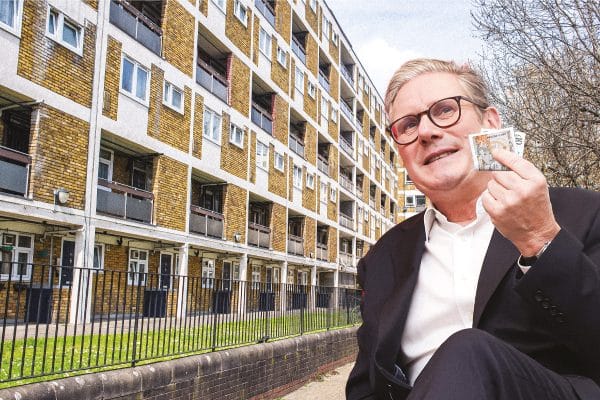
In September 2025 a proposal for 12 new towns was announced. This plan was inspired by the post-war new town development schemes, which saw the creation of places like Milton Keynes and Skelmersdale, and the expansion of towns like Washington and Warrington.
Most of Labour’s proposed new towns would be built in already established towns and cities, for example around Manchester.
A few new towns have also been suggested near military bases, such as one in Plymouth tied with a £4.4 billion investment in a Devonport naval base, and one in South Gloucestershire, chosen for its proximity to defence research, development, and manufacturing.
Each of Labour’s proposed new towns would be set to contain a minimum of 10,000 homes. Collectively, if this programme was successful, it would contribute up to 300,000 new homes in England.
But anyone who is excited by the prospect of embarking upon a new life in a shiny new town will be sorely disappointed. These building schemes are being proposed with a 30-40 year timeline in mind.
Only three of the town schemes have the possibility of having “spades in the ground” by 2029. And even then, only 40 percent of houses in these new towns are set to be counted as ‘affordable’ housing.
The 1.3 million people on Local Authority housing waiting lists and the 164,000 children living in temporary accommodation will be justified in arguing, “I don’t have 30-40 years to wait – I need housing now!”
Planning chaos

For Labour to reach its pledge of 1.5 million homes, an estimated total of 370,408 would need to be built each year.
But with only 231,000 homes being built so far this past year, coming anywhere near this target is looking increasingly unlikely.
Starmer has a cunning plan, however: blame everyone else! In this case, the government has shoved the blame firmly onto the shoulders of local councils delaying planning permissions – as if local councils haven’t got it bad enough!
It is true that planning permission approvals in England have fallen by 17 percent, the lowest since 2012. But what is behind this?
Two-thirds of councils report lacking the planning capacity to meet demand. One in five planners intends to leave or retire in the next three years, which is intensifying already existing staff shortages.
Workers are often leaving for the private sector, where they can earn £80,000 per year. Public-sector council workers earn roughly half of that.
Likewise, austerity has broken council planning departments, causing a drop in expenditure of 16.6 percent since 2010, and a reduction in apprentice schemes.
Is it any wonder, then, that councils in England are finding it tough to deal with the 900 current large-scale housing schemes that are awaiting permission?
Cutting red tape?
In an attempt to overcome this, Steve Reed has announced that Local Authorities can no longer veto housing plans. The government will instead pass permissions onto an ‘independent’ (read: ‘private sector’) investigator, who will then review cases and presumably give permission, going over the heads of councils.
This tacitly implies that independent bodies could override any opposition from councils and local residents over issues spanning from environmental issues, to whether service infrastructure is in place, to the quality of the new-builds and what material they are using.
You only have to look at the Grenfell Tower tragedy to understand why the consultation and input of local residents is crucial. Cutting corners costs lives.
But it is no wonder that private-sector solutions are coming from Reed, who in an interview recently denounced the Green Party’s bold words about abolishing landlords as ‘wacky’.
View this post on Instagram
“If you abolish landlords, then where are you going to get the homes from?” he asked, looking perplexed.
How deeply Starmer’s Labour has become wedded to capitalism, that his own ministers can’t even imagine a world without private landlords – or recall their own party’s legacy of providing public housing for the working class!
Limits of the market
Although Reed would certainly like to overcome the crisis with an administrative flick of the pen, the long delays in the planning system are a symptom of the limits of the housing market itself.
Earlier this year, Neil Jefferson, Chief Executive of the Home Builders Federation stated: “Without any government support for first-time buyers for the first time in decades, the potential market for new homes is being limited”.
In other words, housing is only being built for the affluent, not the millions of workers and youth that desperately need affordable housing. Private developers would rather not build at all than build anything less profitable than luxury properties.
This has led to the current situation of delays in new affordable housing being built, and job losses in the construction sector as a whole.
To try and spur on housing development, Reed and the Greater London Authority have this past week changed rules to drop new affordable homes in the capital from 35 percent to 20 percent.
To justify this, Reed argued: “We are increasing the number of social and affordable homes being built by changing those rules, because 35 percent of nothing is nothing.” But this raises the question, who are the other 80 percent of the new developments for, if not the millions of people who desperately need good-quality, affordable housing?
Profit is the problem

In reality, developers are not holding back because of an excess of affordable housing requirements, or because councils are too slow – they are holding back because they do not believe they can make a profit by building homes for the working class.
Despite promising to deliver the “biggest boost in social and affordable housing in a generation”, the Labour government’s pledge is already slipping out of reach – not because it is technically impossible, but because it is politically and economically incompatible with a profit-driven housing market in deep crisis.
As long as housing is left to developers who build only when it is profitable to do so, and to planning regimes designed to appease investors rather than meet workers’ needs, no amount of tinkering will resolve the shortage.
We should remember that the last time Britain built new towns on a serious scale – in the 1940s and 50s – it was not thanks to speculative developers or market incentives, but through state-owned industries and council-led planning.
All of this was carried out under the enormous pressure of a militant, well-organised, and confident working class emerging from the Second World War.
Most crucially of all, back then capitalism was going through a ‘golden era’ of growth. Now, British capitalism is stagnant and diseased. We need to go much further than the examples of the past.
What is needed is not 40-year visions, investor-friendly “new towns”, or gimmicky baseball caps – but a massive programme of publicly-owned and publicly-controlled social housing. That means breaking with capitalism altogether.