

Former Tory minister Robert Jenrick is one of the latest rats to flee the sinking ship of the Tory party, alongside fellow rodents Nadhim Zahawi and Andrew Rosindell.
Although he was going to make the jump himself, the Newark MP was robbed of that dignity by being pushed by Tory leader Kemi Badenoch instead.
This was after she participated in a veritable Westminster spy thriller, having been sent a copy of his secret defection speech when her mole in his team found it on top of a printer.
She then moved fast to break the story before he or Nigel Farage had a chance to, even going as far as timing the release of her video announcing Jenrick’s sacking to coincide with Nigel Farage’s appearance on TV. Tom Cruise, eat your heart out.
I have sacked Robert Jenrick from the Shadow Cabinet, removed the whip and suspended his party membership with immediate effect.
I was presented with clear, irrefutable evidence that he was plotting in secret to defect in a way designed to be as damaging as possible to his… pic.twitter.com/zoSzFp0cKq
— Kemi Badenoch (@KemiBadenoch) January 15, 2026
Only, when Tom Cruise does this kind of thing in Mission Impossible, it has a devastating effect, and scuppers the best laid plans of his enemies. In this case, Badenoch’s finest hour merely resulted in what was going to happen anyway.
See also: Farage, populism, and the crisis in Britain: Where is Reform going?
Where does this leave the Tories?
Nevertheless, Badenoch and the ruling class are determined to clutch at straws, for they have nothing else.
Badenoch’s supporters in the Tory party, and the likes of the Financial Times, are painting her decisiveness as a sign of great leadership. This is an opportunity, they say, to begin rebuilding the Tories – currently languishing in the polls – as a sensible, broadchurch, centre-right party.
The Guardian quotes one Tory MP as saying “people need to realise that she’s serious, has the guts to sack people when they deserve it, that we have standards, that people who go that way can’t come back, and that we are not a populist Reform-lite party” (our emphasis).
According to the Financial Times, the real reason the Tories lost the election is that they were incompetent, not because the political centre-ground is unpopular.
A competent centre-right party can win elections, and is vital for the future of British capitalism, they opine. Clearly, the British ruling class wants and needs a party that can reliably rule in its interests: one that can balance the books, grow the economy, and get profits flowing again.
But competency is precisely what is so hard to achieve when the entire system of British capitalism is in crisis. That is why Starmer’s government is – despite how it advertises itself – both deeply incompetent and deeply unpopular. And for the same reason, any Reform UK government will suffer the same fate.
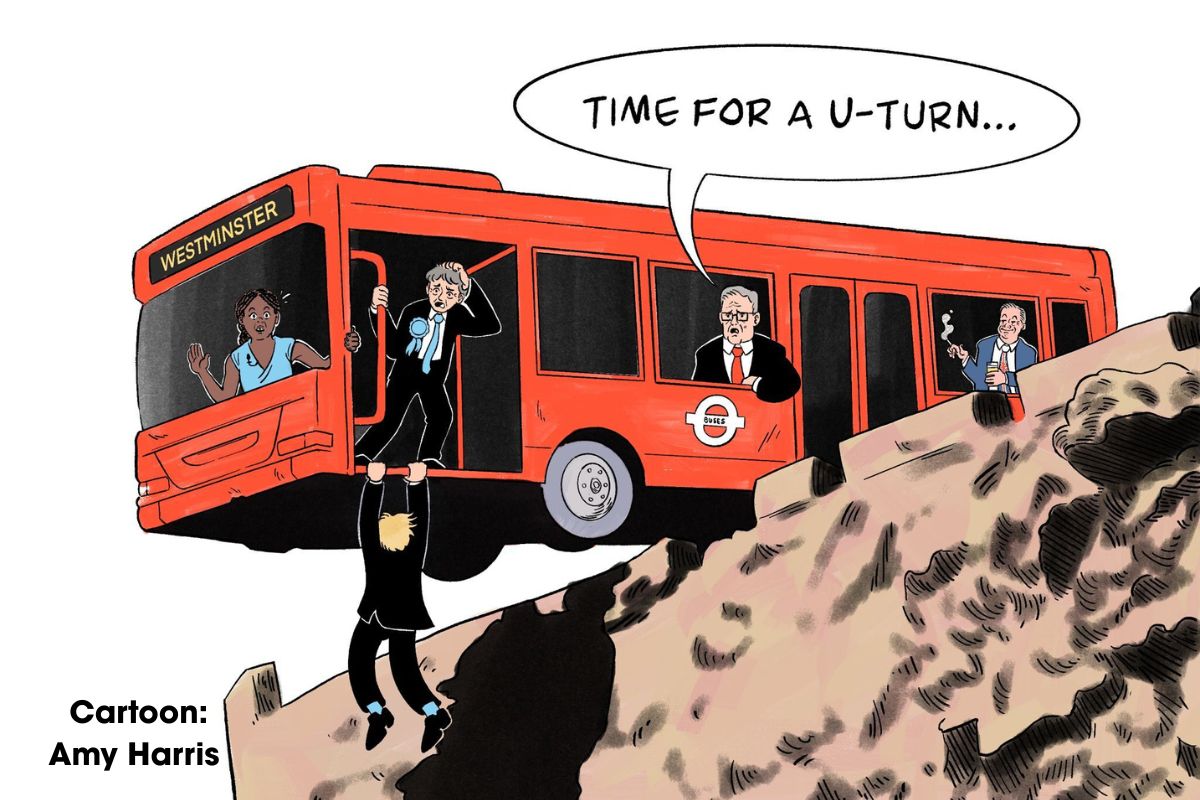
And despite what liberal commentators say, the political centre-ground is collapsing, in a drastic fashion. How else can you explain the massive polarisation of society, both to left and right, and the rise of anti-establishment populist movements across the world?
Even if the Tory party were to reinvent itself as a ‘socially liberal, economically conservative’ party – purging itself of the demagogic culture-war politics that characterises Reform – it would achieve precisely nothing. People hate the pro-business establishment, no matter the branding.
Those who hope for the return of the moderate, sensible Tory party of yesteryear are utopians in the fullest sense. They want to turn back the wheel of history to a time when capitalism could afford stable, liberal democracy – shutting their eyes to the reality of Britain’s social and political crisis.
Big win for Reform?
The refugee from Bedenoch’s tyrannical regime, Jenrick, was welcomed with open arms and a big grin by Nigel Farage. It turns out he does welcome some asylum seekers.
At his great unveiling press conference, Jenrick laid it on thick. The Tories, he said, are “rotten” and a “failed party” which had “broken Britain”. He’s not wrong! Conveniently, however, he overlooked the awkward little detail that he was a minister in four different posts in the very Tory government that had “broken Britain”.
Britain is broken.
Britain needs Reform.
And Reform needs you. pic.twitter.com/hkhcH2V4gB
— Robert Jenrick (@RobertJenrick) January 16, 2026
Not only that, but he actually gave details on exactly what the Tories had done to “break Britain”. Unsurprisingly, he said it was the surge in legal migration that happened under their watch. He neglected to mention that he himself held the post of Minister of State for Immigration under Sunak!
What does this mean? At first glance, it is a big win for Reform and Nigel Farage. People generally only defect for careerist reasons when they feel like the party they are defecting to has a likely chance of forming the next government.
Jenrick’s move also, in one way, helps lay the basis for that, by making the party seem more ‘credible’ and experienced.
Credible and experienced in whose eyes? Big business. That is who Nigel Farage is now trying to court, just as Jordan Bardella, leader of Le Pen’s party in France, is doing. If he is to be Prime Minister, he will have to manage decrepit and indebted British capitalism.
As a reactionary, he has no intentions whatsoever of challenging capitalism. Having largely won a big enough base of support with his anti-establishment populist rhetoric, he now needs to establish good relations with the people who really call the shots: the capitalists.
Pressures mounting on Farage
There are many other signs of this, such as his recent speech in the City of London emphasising the need for fiscal responsibility. Another is that he now intends on attending the World Economic Forum (WEF) in Davos.
Previously, Farage claimed that “what’s happened to us over the course of the last 50 years is we’ve decided nation-states don’t matter. We’ve decided national democracy doesn’t matter, because we can decide all of this in ski resorts in Switzerland. Isn’t it wonderful?”.
He even attacked Starmer as a “full-on globalist, hanging out with his mates at the WEF”. But now, it seems, the ski boot is on the other foot…
Many in the ranks of his party – who are a confused and motley bunch – have noticed this backsliding, and are not happy. Many Reform supporters have bought into the fiction that Farage is an anti-establishment crusader who will somehow fix Britain.
They don’t want the likes of ‘Robert Generic’ – establishment hacks and Conservative rejects – worming their way into the movement.
The Guardian quoted a couple of comments from Reform party members in Reform forums to this effect. One said “Enough already! Reform uk please take note, you are going to lose members and voters if you don’t cap this craziness … We don’t want a Tory party Pt II.” And another: “Don’t do it, Nigel. If Jenrick joins Reform I’m done. I am a member of the party but will leave immediately.”
That is why the Reform leader was keen to tell everyone that after the coming local elections in May, there will be no more Tory defections, and that any attempts to do so would be rejected. He even said that Jenrick was “in sackcloth and ashes” for the things he did as a minister.
This is a little preview of the splits and turmoil a Reform government will face. Like all other governments in Britain these days, it will rapidly be discredited by the fact it must manage the crisis of British capitalism.
It will not manage to fix the economy, far from it, and will attempt to do so by making the working class pay – just like the Tories, and just like Starmer.
It will also totally fail to end immigration, which the British capitalists rely upon – not that that would do anything to fix the country anyway. As we can currently see in the US, any efforts to carry out serious anti-migrant measures carry the risk of sparking explosive mass anger.
With its further rise in British politics, therefore, Reform will inevitably fracture along class lines. Those who think Farage is anti-establishment and pro-worker will be bitterly disappointed. If a Reform government is formed, it will usher in a period of immense class struggle, political polarisation, and turmoil.
Reform mavericks ripping Warwickshire apart
The Reform-led Warwickshire Council is unleashing attacks on the most poor and vulnerable.
The council plans to fully axe school transport for over 1,100 children and 300 post-16 learners, many of whom are entitled to it due to having special educational needs and disabilities (SEND).
The council claims that they must desperately do this, as transport costs have gone up. Yet this same council has sought to appoint political advisors worth £190,000 a year!
19-year-old council leader George Finch promises that these cuts won’t affect SEND students. But I work in a SEND school myself, and I have seen first-hand the financial and emotional distress that these austerity policies cause.
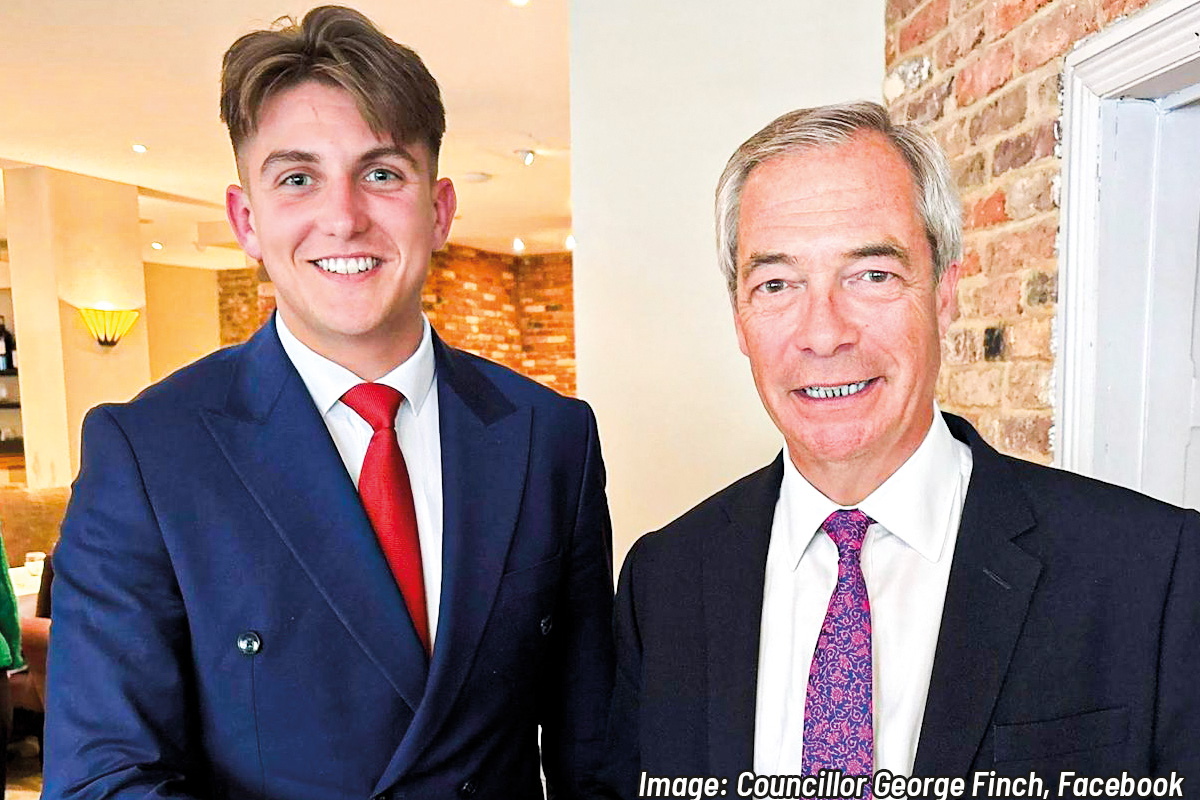
One coworker told me, “I have a son with cerebral palsy. The council provided an accessible vehicle for him, as it’s practically impossible for him to use public transport. After two good years, the council decided to withdraw funding, and have literally seized the vehicle from him. His independence has been completely stripped away. The council is never on your side!”
To distract residents from such hated austerity measures, Finch has whipped up a culture war over whether the LGBT flag should be flown at the council headquarters, and a row over a school student wearing the Union Jack.
The council leader tried to portray these cuts as the democratic choice of locals, by using a consultation of 554 residents (of a population of 600,000!) where 16-39-year-olds were largely underrepresented.
Reform councillors promised the world to Warwickshire residents, but now they are playing a more ‘sensible’ tune.
Jazir Mohammed, Coventry
Lancashire Reform slash elderly care
In Lancashire, Reform wiped out both the Tories and Labour, when Farage’s party won almost two-thirds of the available seats on the County Council.
Riding a wave of anti-establishment sentiment, they promised to fight inefficiency and waste, freeze council tax, fix potholes, and end “woke spending” to deliver on basic services. But managing the council’s more than £2 billion budget is proving more difficult than expected.

£303 million in ‘savings’ (cuts) are required by 2029. The council leader says council tax rises cannot be ruled out. And the party is coming under massive pressure over the potential closure of ten care homes and day centres.
The proposal to move elderly residents into the private sector is overseen by Graham Dalton, who just so happens to run a private care company with his wife!
One Reform voter expressed his frustration: “I’m disgusted with him. I wrote to him, I wrote to Nigel Farage, because I thought they were going to come and change everything. And all they’re doing is coming in and tearing people’s lives apart.”
The party has immediately resorted to culture-war distractions. But singing the national anthem before council meetings and railing against diversity programmes won’t cut it.
Meanwhile, Labour councillors have waded into the swamp of identity politics, decrying Reform’s cabinet of “all white men”. Never mind the fact that Starmer’s government is waging war on public services!
Unison rallied against the closures on 17 January, and Preston Communists mobilised in support. Neither Starmer nor Farage have any solutions – we need workers’ control!
Callum Parkison, University of Lancashire
Reform’s “flagship” Kent council in choppy waters
To foresee how a Reform government would run, we need only look at their “flagship council” in Kent.
Prior to election, Kent Reform campaigned to “get the books under control” and lower council tax.
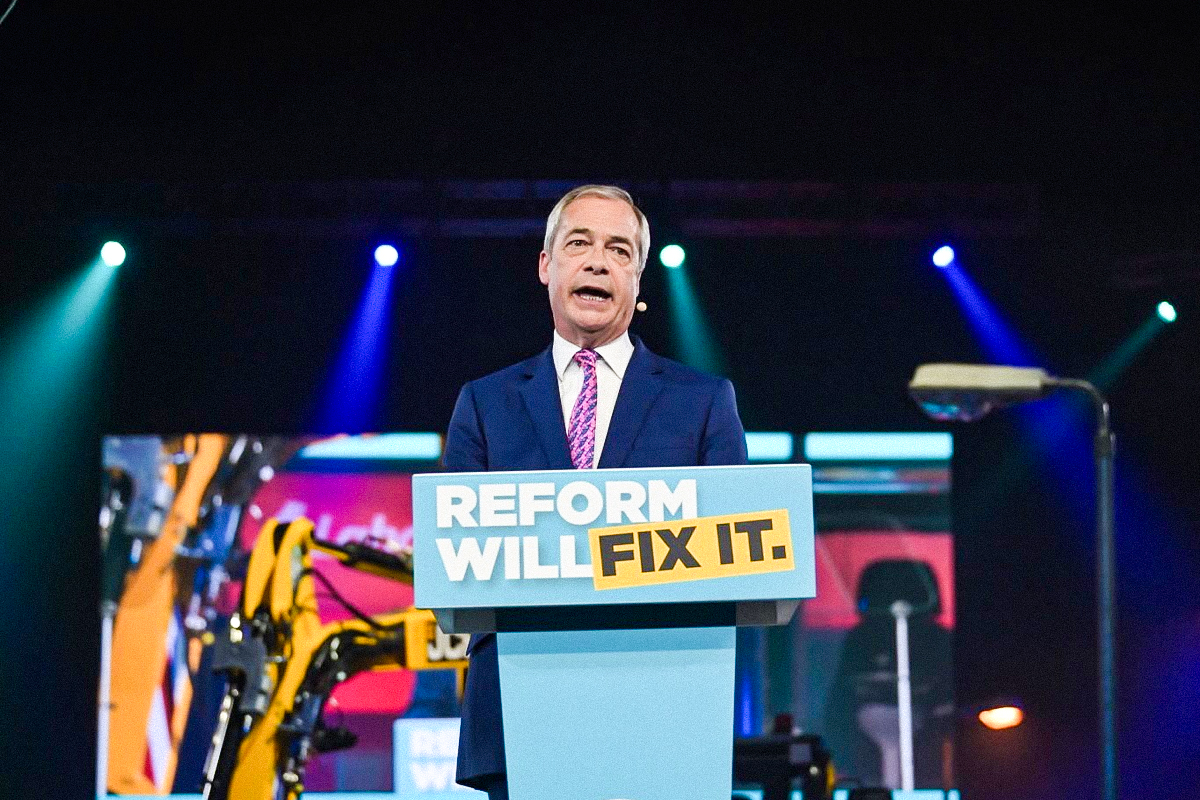
What they inherited instead was a council hollowed out by years of austerity and debt. Kent County Council (KCC) carried £700 million in debt, with £84,000 a day spent servicing interest alone.
Inspired by Elon Musk’s DOGE, they have established the, less snappily named, “Department of Local Government Efficiency” (DOLGE), tasked with delivering ‘value for money’. DOLGE has looked to cut committees, close rubbish tips, and threatened to shut the book on libraries, in the hope of making savings.
Despite all the cuts, only £67 million has been shaved off debt, while a leaked presentation shows KCC £60 million over budget for 2026–27.
But now the mask has slipped. Reform are proposing a near 4 percent council tax rise, with Adult Social Care and support for disabled children next on the chopping block.
The blame doesn’t lie solely at the feet of Reform, but shows the immense pressure local councils are under – with no option but to cut spending and increase taxes. This is reflected in the local party, with nine councillors having defected, expelled or resigned since coming to power in May.
To distract from cuts, Kent Reform has leaned on culture-war stunts: removing Ukrainian flags, banning displays of trans literature, and scrapping ‘climate emergency’ declarations.
Kent shows in miniature what Reform would look like in government: inheriting a debt-ridden state, forced to continue the same austerity – papering over with culture-war theatrics, while public services crumble. The same rotten system in a different coloured tie.
Sam Spencer and Joseph Corps, Kent