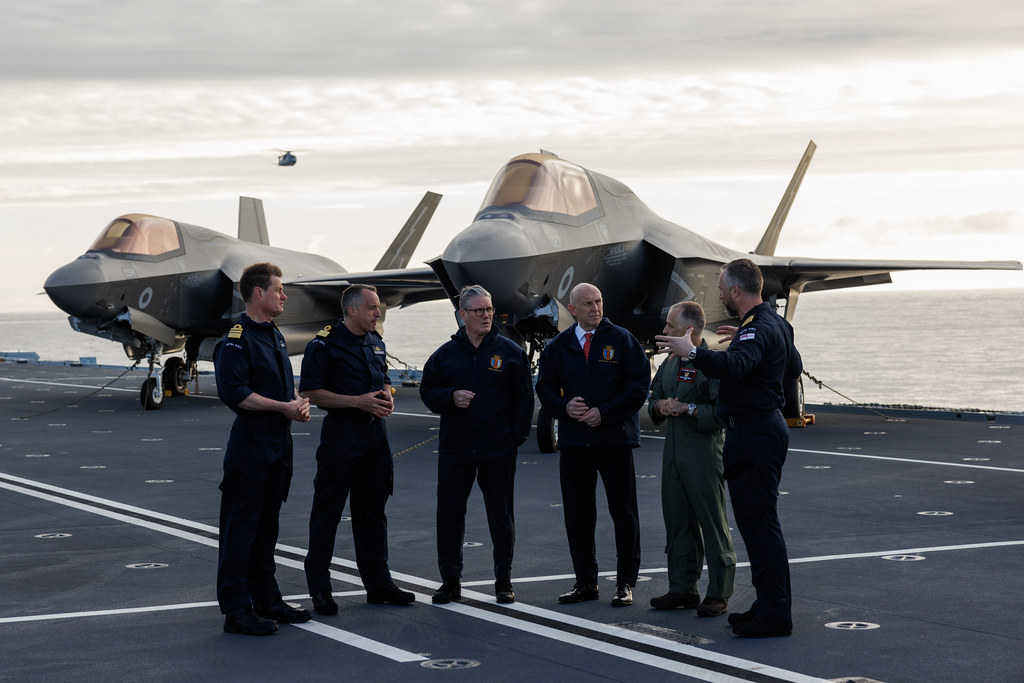

The ‘special relationship’ between the US and Britain is one of a master and his butler.
This is something that Keir Starmer has been brutally reminded of by Donald Trump after hesitating to support his imperialist war on Iran. Starmer is a “loser” and “no Winston Churchill”, according to a “very disappointed” President Trump.
This hesitation wasn’t Starmer taking a stand, but an attempt to maintain an impossible balancing act between Washington’s expectations that the UK aligns itself unconditionally with US imperialism, and the fury of the working class towards war, genocide, and foreign intervention in their name.
All of this has exposed a deeper underlying weakness within Britain: that it can no longer chart its own course on the world stage. This applies acutely to the question of military intervention.
Despite all the bellicose rhetoric, warmongering, and sabre rattling we’ve heard from Starmer, the reality is that Britain is no longer a global power, and has nowhere near the military capability to be one.
Toothless Dragon
Whereas the US deployed an ‘armada’ to attack Iran, Britain has struggled to send a single ship to defend its bases in Cyprus from Iranian missile attacks.
The HMS Dragon destroyer took three weeks to arrive due to delays finishing welding work on the vessel. One defence official claimed that Iran’s ballistic missile arsenal was likely to have run out by the time it arrived!
On top of this, a slew of issues meant that not a single destroyer in the Royal Navy was ready for immediate deployment when the Iran conflict broke out.
The whole process has exposed how deeply hollowed out British armed forces are.
At the end of the Cold War, Britain had 51 frigates and destroyers. By 2007 it had 25, and today it has an aging fleet of just 13.
During this period, military spending fell from 3.2 percent of GDP, to 2.4 percent. Decades of spending constraints have led to numbers and capacity being cut, as well as delivery times for modernisation and maintenance suffering from prolonged delays.
The naval base where HMS Dragon was docked is one such example of this. Last May, the Ministry of Defence (MoD), signed a new contract for in-port services with Serco Marine Services.
As a Type 45 destroyer, @HMSDragon will bring world-class air defence capability to the region, strengthening our response to counter threats directed to our allies and interests.
To every sailor, marine, civil servant and contractor who helped get her ready — thank you. pic.twitter.com/sGG2bmkgBv
— First Sea Lord and Chief of Naval Staff (@GenGJenkinsRM) March 13, 2026
The main purpose of this was for the MoD to save £250 million from its previous contract. Serco accepted it, but in order to cut costs they ended the port’s around-the-clock staffing, and carried out redundancies.
As a result of these cut backs, HMS Dragon took a week to prepare, with the ability to get the ship battle ready dependent on the good will of workers coming in out-of-hours and on weekends.
Even if Starmer had been able to immediately jump into the war on Iran, he had very little to offer. HMS Middleton, Britain’s only minehunter in the Gulf, departed the region days before the war on Iran, in order to save money and amid a shortage of sailors. This means that for the first time in nearly half a century, Britain doesn’t have a single ship in the Middle East!
How many frigates and destroyers does the UK have at its disposal?
Defence Secretary John Healey can’t seem to tell @NickFerrariLBC with any certainty. pic.twitter.com/h6oigoOff5
— LBC (@LBC) March 26, 2026
Just like every other industry in Britain, decades of privatisation, asset stripping, and underinvestment have hollowed out Britain’s military capabilities – something that’s causing increasing tensions between the government and military chiefs.
So long as Britain could huddle beneath the NATO security umbrella – backed and funded by US imperialism – her military decline was masked. But now that the western alliance is being torn to shreds by the Trump administration, Britain’s – and Europe’s – weakness is being exposed for all to see.
Prestige and power
In the Wizard of Oz, the Wizard is seen as powerful and all-knowing, but is ultimately exposed to be an ordinary man using illusions and performance to project his authority. One can’t help but see Britain in the same light: as its influence on the world stage has declined it has become increasingly braggadocious to cover its inadequacies.
It seems mad that so much would be spent on the armed forces, at a time when public services and infrastructure are starved of investment. But not doing so would be an admission to the world that Britain does not have the military capability to play a global role.
No wonder, then, that Starmer places so much emphasis on Britain’s “world-class” nuclear submarines.
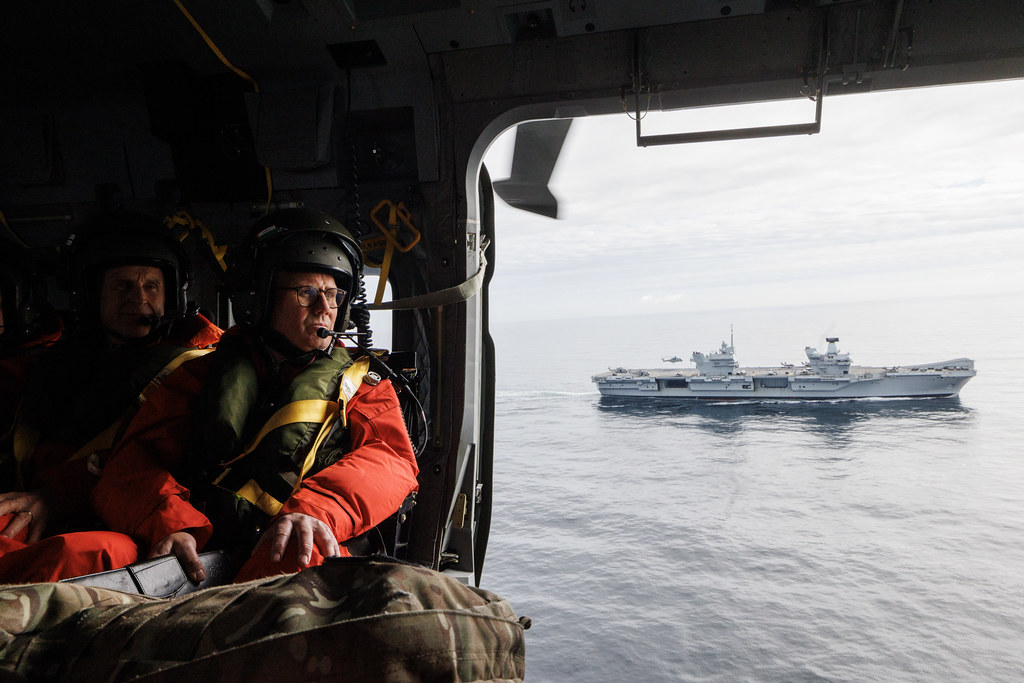
But pulling back the curtain, you find that such a claim couldn’t be further from the truth. One former Navy chief went as far as saying Britain is “no longer capable” of running a nuclear submarine programme. What an extraordinary and damning statement – one that, unlike Starmer’s, is based upon reality.
Take operational capacity for instance. Patrols of the UK’s nuclear-armed submarines are supposed to last no longer than three months. During the Cold War, the average deployment time for a nuclear submarine was 70 days.
But last year, one returned after a record-breaking 204 days underwater, which has raised concerns about the psychological impacts of crew members.
This strain is in large part a result of maintenance, refitting, and the delivery of new vessels being way behind schedule.
The most recent build took 13 years to complete – the longest ever construction time for a submarine to be built for the Navy. When it comes to maintenance, HMS Ambush has spent 1,222 days in port, with Artful and Audacious both spending 950 days in maintenance programmes.
And the price for all of the chaos and mismanagement of Britain’s submarine programme is a whopping £41 billion, with the bulk of this going to private defence companies such as BAE Systems and Rolls Royce.
This highlights a deeply uncomfortable truth for the British ruling class: decades of deindustrialisation and deskilling have left Britain incapable of maintaining its own nuclear fleet.
The money it would take to turn around decades of decline is completely out of the realm of possibility. This couldn’t be made clearer by the fact the last successful Trident missile launch was over a decade ago in 2012.
Britain’s military is in a perilous state. The actual deployable strength of the British Army, could be as low as 54,000, which is less than the average number of casualties Russia takes in two months in Ukraine. Troop numbers are in a long-term decline – down 7 percent since 2020 – and morale is at its lowest since records began.
Ajax chaos
Another egregious example of the parasitism, mismanagement, and waste in Britain’s military-industrial complex is the Ajax Armoured Vehicle debacle.
In 2014 General Dynamics won a £5 billion contract from the MoD to produce 589 Ajax Armoured Vehicles (AFVs). The vehicles were intended to be delivered starting in 2017, with the programme originally expecting full operating capability by 2025.
Things did not go to plan: the programme had eight years of delays and setbacks, before the AFVs started rolling out in November 2025. But disaster struck during testing, the vehicles caused soldiers to “literally shake to the point of vomiting”.
Ajax is the @britisharmy‘s new armoured fighting vehicle (AFV) and it’s just achieved Initial Operating Capability. It is the most advanced medium weight AFV in the world.
On a visit to @gduknews in Wales yesterday, @lukepollard explained how important this milestone is 👇 pic.twitter.com/ClOPq8QzVV
— Ministry of Defence 🇬🇧 (@DefenceHQ) November 6, 2025
31 soldiers became ill, over 300 soldiers needed hearing assessments, and 17 had to undergo treatment for hearing loss. After spending £5 billion, the government has nothing to show for it and there’s now talk of the programme being cancelled altogether!
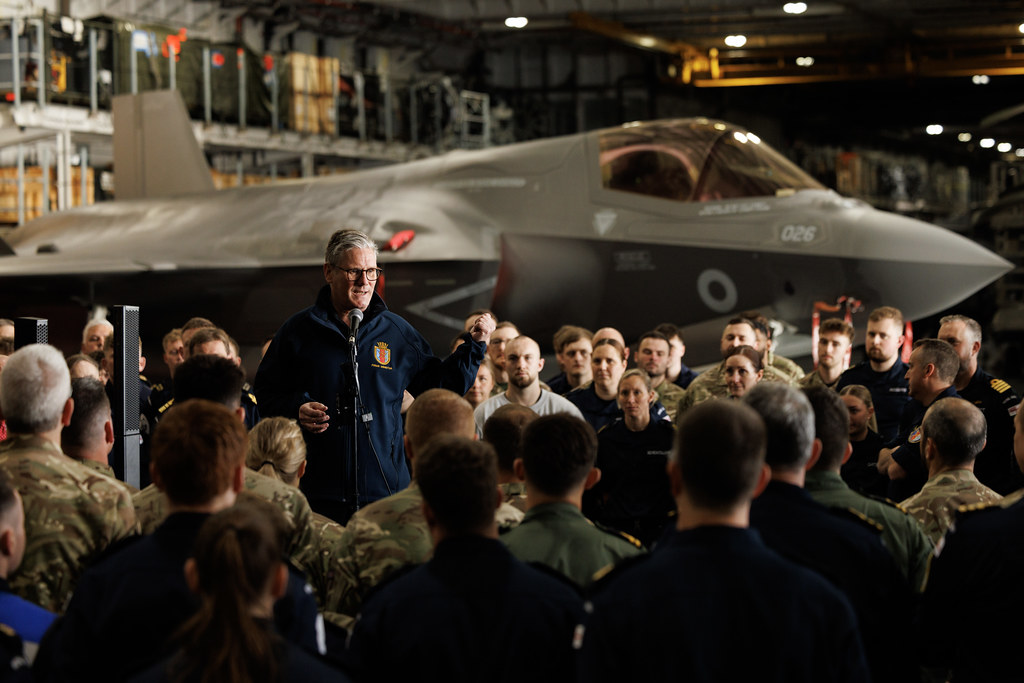
The government claims they were misled about the safety of the programme by the senior officials in the MoD. These same officials were alleged back in 2023 to be trying to force through programmes, even if they were riddled with technical problems.
We can only speculate as to the intentions of the senior officials. But it’s well known that a revolving door exists between top military officials and the defence companies.
Take ex-Chief of the General Staff Sir Peter Wall, who held the top position in the Army from 2010-2014. In 2016, he was elected onto the board of directors of… you guessed it: General Dynamics.
It’s worth remembering Starmer attempted to cut £5 billion from the welfare budget last year, claiming the welfare system was “broken, unsustainable and indefensible”.
Yet here we have a private defence company being handed the exact same amount of money, with nothing to show for it other than useless vehicles and vomiting soldiers. Is this not the very definition of parasitism? Does this not demonstrate a system that’s broken, unsustainable, and indefensible? In the minds of government ministers and military chiefs, Britain is still a world power, capable of ruling the waves and facing down its adversaries. But in reality, even Britain’s slimmed-down armed forces are living beyond their means.
And in their desperation to protect their prestige and remain relevant, they’ll continue to hand over billions to private defence companies, whilst snatching billions from workers and the most vulnerable in society.
Spending Defence Review
Back in November there was an extraordinary meeting of Britain’s top military chiefs. The purpose of this meeting was to discuss how to fund plans to rebuild the armed forces, amid fears of further cuts.
Understandably, readers may be confused and ask, aren’t we in the midst of ramping up military spending?
It’s true that last year Starmer’s Labour released the Spending Defence Review (SDR), the intended aim of which was to carry out “the biggest sustained investment in defence since the Cold War”.
This came after Trump said he was pulling out of Ukraine, and that the rest of the NATO powers needed to pull their own weight and raise defence spending to 5 percent of GDP.
Panicked by the sudden potential loss of their US military blanket, Starmer and his partners in the so-called ‘Coalition of the Willing’ have done everything they can to stifle Trump’s attempts to abandon Ukraine.
At the same time, due to their weak position, the European leaders have had no choice but to accept his demands.
The Trump administration’s recently-released US National Security Strategy states that “it is far from obvious whether certain European countries will have economies and militaries strong enough to remain reliable allies.”
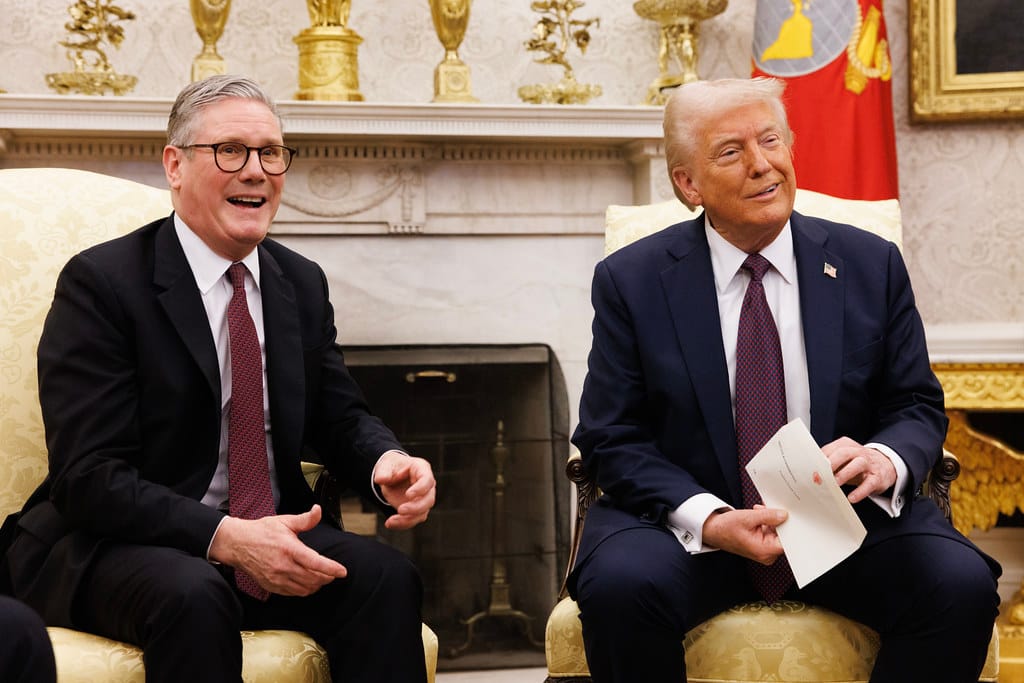
Starmer knows that the so-called ‘special relationship’ is one of UK dependency on the US, therefore he must find a way to increase military spending, for fear of jeopardising it further.
Unfortunately for Starmer, this is not as simple as breaking the piggy bank or taking out a Klarna loan. The deep, long-term crisis of British capitalism and the threat of backlash from the working class have meant that rather than increase military spending, the Ministry of Defence (MoD) was actually told back in October to find £2 billion in cuts!
This prompted the military chiefs at their meeting in November to reportedly write a letter to the defence secretary. In it they told him they’re concerned about the gap between the promises made by Starmer to fix the UK’s hollowed-out armed forces, and the reality of the size of the defence budget. The MoD believes the spending gap could be as big as £28 billion.
Starmer is now gathering officials to find ‘creative solutions’ to the problem. Public-private partnerships, defence banks and easing Rachel Reeves’ fiscal rules have all been floated. All of these are characteristic attempts by Starmer to maintain his balancing act with clever tweaks and fiscal tricks.
But the cold, hard truth is unavoidable: the only way forward for British imperialism is to slash social spending; to wage class war on workers and the poor.
For the military chiefs, the question appears a lot more simple. They don’t have to deal with the same multitude of pressures that Starmer does.
As has been explained, Britain’s armed forces are in a desperate state. Dilapidated equipment, falling troop numbers and a complete lack of capability, means the military wing of the British state is in a battle for its very survival. Britain’s military is full of history, pomp, and prestige – and its chiefs want to restore its former imperial glory.
This is what’s driving the tensions between the military chiefs and government. The SDR is a promise they can’t allow any backsliding on. Their aim is clear and single-minded, to continue ratcheting up the pressure on Starmer’s government to make good on their promise, no matter the cost elsewhere.
That promise doesn’t look like it will be fulfilled anytime soon though. Back in December, Starmer pulled the release of the Defence Investment Plan (DIP) – the proposal for how the government will pay for the SDR – and ordered it to be rewritten due to concerns about its affordability. Its release date is still not confirmed. Perhaps one more abbreviated government paper will do the trick…
One way out
The drive towards militarism has the potential to be a real flash point for struggles between different wings of the state, and the class struggle more broadly.
The government’s inability to fulfil the funding promises made to military chiefs will continue to cause cracks to open at the top. Funding the armed forces will mean massive cuts, and the working class will not take that lying down.
These attacks are exactly what the leaders of the workers’ movement should be exposing. Instead, however, we see Unite’s leader Sharon Graham tailending the warmongers, and demanding that “the prime minister delivers on his promise that increased defence spending will benefit UK workers”.
We must say clearly: militarism and arms spending can only come at the expense of workers’ interests: through austerity and cuts taking resources away from public services; and through strengthening our class enemies, the British imperialists.

This whole situation is indicative of Britain’s position in the world today. No longer can the UK chart an independent course. 15 years of austerity, decades of privatisation, and a century of decline have led it to this point.
The NHS is on its knees and schools are crumbling. 4.5 million children, 8 million working age adults, and 2 million pensioners live in poverty – over 20 percent of the population, in the 6th richest country in the world. This is where the money should be spent.
It’s the duty of revolutionaries to expose the hypocrisy, cost, and extreme waste of increased military spending.
There’s only one way out for the working class. It isn’t to side with our class enemies and prepare for war, but to fight our class enemies, and prepare for class war – to overthrow this warmongering ruling class and their system.
Present arms… anyone?
The army is running ‘Project Grayburn’ to select a new rifle for its ever-shrinking pool of willing recruits. Grayburn hopes to replace the L85, best described by its nickname upon adoption of ‘the civil servant’ – it didn’t work, and you couldn’t fire it.
The L85 was adopted during the death throes of British industry in the 80s. The Enfield factory, where the weapons were produced, was privatised in ‘84 and closed in ‘88, with the skilled workers there being thrown on the scrapheap.
The lack of investment in production led to serious issues (a later report found more than fifty), and the soon-to-be-fired workers weren’t in any mood to fix them. Exports were basically nil, and soldiers had little faith in the weapon.
Now, the Grayburn rifle: specifics of calibre, colour and flavour aside, the key requirement is that it must be made in Britain. But the industry isn’t here.
Setting up a factory to deliver the 170,000 rifle contract would require huge capital investment, which is exactly what the government hopes for. In line with its policy of ‘military Keynesianism’, the government is using army contracts as bait to attract investment from war profiteers.
Nobody’s biting very enthusiastically. A factory in broken Britain won’t be profitable on the world market, compared with the likes of the US, Russia, China, or Israel. All Starmer can offer is contracts to supply the meagre British army. And to fund all this, he must cut welfare: stealing from the workers to appease the warmongers.
Our real enemies are the Epstein class, who have looted this country for all it’s worth. That’s who the workers – whether armed with rifles or broken bottles – must defeat.
Lexi Sharratt, Sheffield
‘Military gap year’ – But no one wants to fight!
As we face soaring costs of living and a collapsing job market, Starmer’s government has invoked the spectre of Russia and revealed its latest plan – borrowed from the Tories – to send young people off to die ‘For King and Country’, for ‘Liberty’ and ‘Democracy’… or rather, so the rich can keep getting richer.
A ‘military gap year’ scheme has been launched this month, to train and indoctrinate a select group of school leavers and desperate young people – to fight and die for British imperialism..
But 15 years of austerity have sapped the willingness of the British workers to sacrifice ourselves for these parasites. 64 percent of the public say they wouldn’t join the Army in the event of war. And 48 percent say they would refuse to sign up under any circumstances.
In continuing to squeeze us for every penny we have, the parasitism of the ruling class has also sapped the strength of the state that was meant to protect their interests. As the billionaires line their pockets, the armed forces can barely provide weapons and equipment to the personnel it has.
This programme means only one thing to us: more attacks on the working class, at a time where costs have never been higher.
NHS waiting lists have never been longer. Owning a home or having a stable future is increasingly out of reach for many. These are not separate issues; they are symptoms of the great crisis of our time. And people aren’t going to shed their blood for a system that offers nothing for them.
War and militarism is a natural consequence of capitalism in crisis. None of this will end until we can smash this rotting system, and the working class takes control of society. Only then, can we have peace, freedom and stability.
Joseph Allen, Cambridge