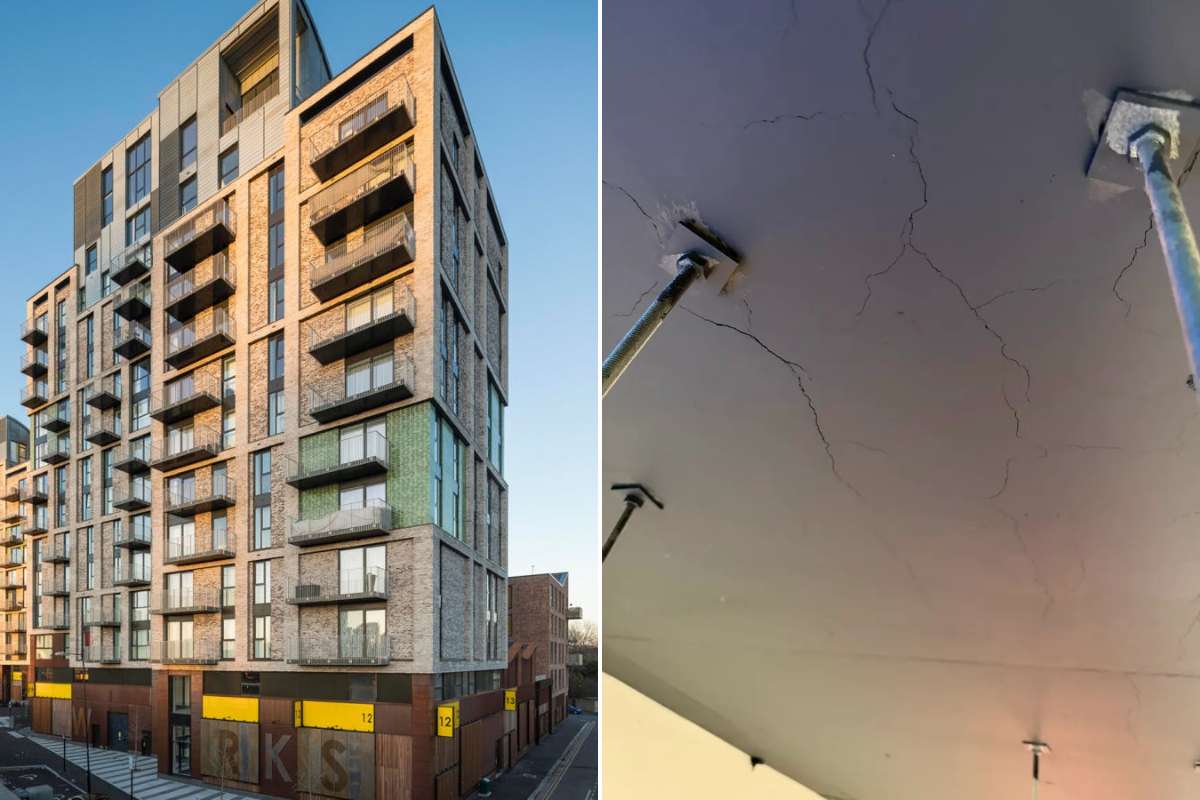

On 22 October, around 210 households in three Canning Town tower blocks were ordered out of their homes in the middle of the night.
A week later, residents of two more blocks in the same East London development got the same notice.
As things stand, close to one thousand homeowners and renters are now out of their homes with no return date in sight. In addition, several local businesses on the ground-floor commercial units, including a nursery, have been closed.
The issue that made the evacuation of the Royal Gateway development necessary was that the transfer slabs holding up the towers – thick concrete platforms where the column layout changes between floors – were found to be “undersized and significantly overstressed”.
Residents were told that the high-rise buildings could potentially collapse at any moment, and pose an “imminent risk to life”.
This is not the first complex that has had to be evacuated because of this same problem – a development down the road in Stratford was evacuated last year, and people have still not been able to return.
Who has stepped up to help the residents? Newham Council ran an emergency rest centre for a few days (which amounted to inflatable mattresses in a learning centre), and then effectively told residents to sort themselves out going forward!
The developer, Galliard Homes, promised to reimburse “reasonable” temporary accommodation costs, but residents say they have still seen no money a month into the debacle.
Residents are still paying mortgages and rent – on top of hotel bills. One resident said that people are under immense stress, with some having suicidal thoughts. In desperation, some have been forced to stay put, in a building at risk of collapse, because they have nowhere else to go.
“Newham Council made us feel forgotten”, wrote one resident, “the developer, Galliard Homes, made us feel invisible”.
Meanwhile, it has just been revealed in the past few days that the CEO of Galliard Homes, Eli Dias, managed to sell his £780,000 penthouse flat in the development shortly before the evacuation was ordered. At the time of that the sale took place, Dias was fully aware of the government’s regulatory notice about the safety risk of transfer slabs.
View this post on Instagram
We’ve seen this before
We’ve seen this before. Almost a decade ago, the Grenfell tragedy exposed the issues rife in the building industry, which has become full of profiteering private developers, corner-cutting construction companies, and private safety bodies that have no broader accountability.
To this day, thousands of leaseholders remain trapped in flats with high-risk flammable cladding, and only a fraction of at-risk buildings have been made safe.
Similarly, the RAAC crisis in 2023 forced over a hundred schools to temporarily close, with hundreds more public buildings still at risk from the deterioration of dodgy aerated concrete.
Transfer slabs could become the new cladding, as building managers retroactively discover issues that could have been prevented if cost-cutting and profiteering weren’t the name of the game.
Galliard Homes does not consider itself at fault. In fact, no one does. In this case, as in many others, what we have is a whole trail of sister firms, contractors, local councils, and managing agents all blaming each other.
The truth is – they are all guilty! Each individual profiteer and their whole system is to blame. They should all be made to pay for this mess.
Residents have now formed a campaign called ‘Justice for Royal Gateway’, and are petitioning the Newham council and the Labour government to step in and provide support for those evacuated.
The petition calls upon the council and the government to engage with Galliard Homes. We say: these criminals should be expropriated, without compensation, for endangering hundreds of households with their unsafe buildings.
To get real and lasting justice for renters and leaseholders, and to prevent potentially fatal disasters from befalling residents, we need to nationalise all the developers and construction companies; use their enormous profits to inspect and renovate at-risk buildings; and build high-quality housing for need, and not profit.
View this post on Instagram