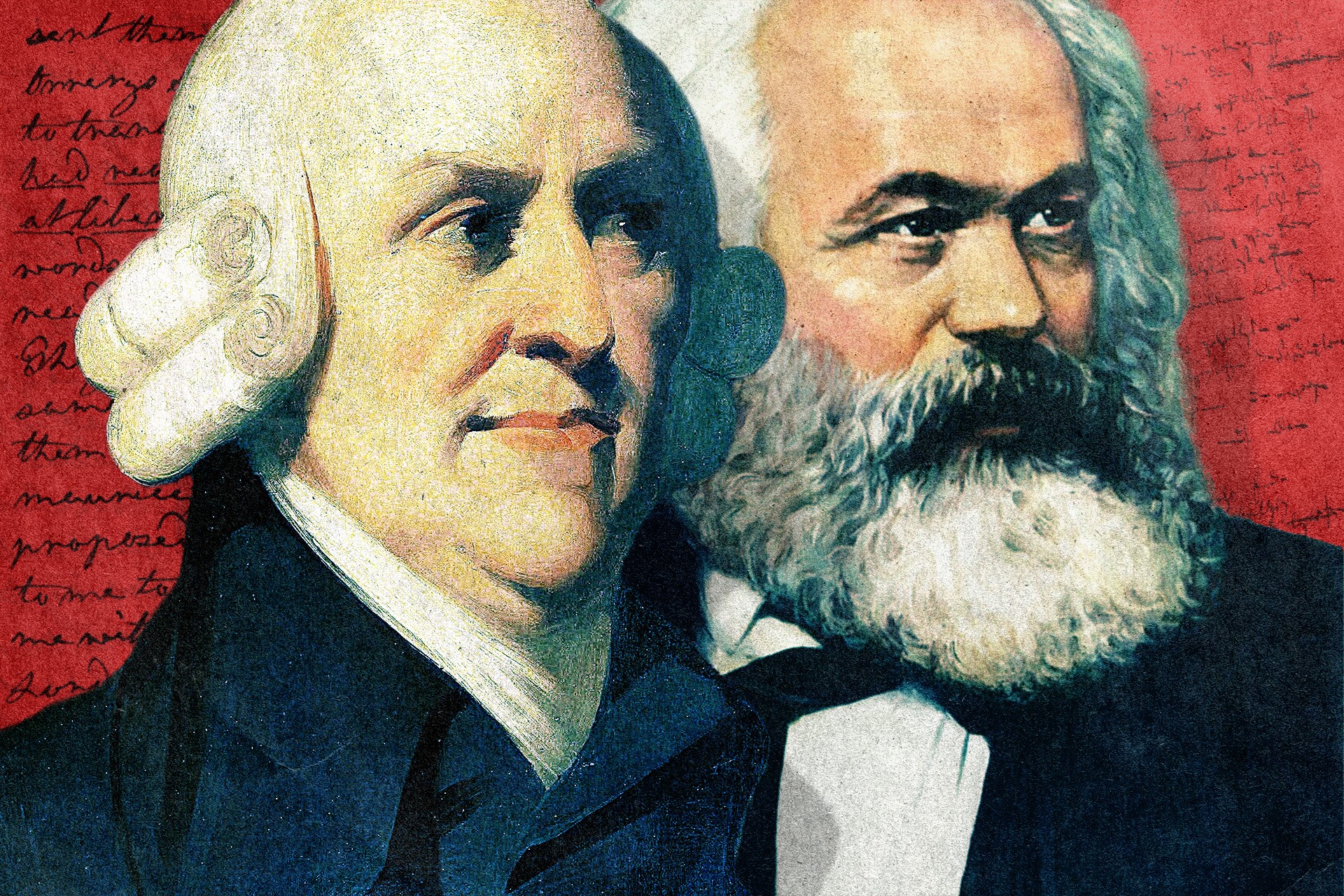

If asked to name two famous economists, it is likely that the top answers given by the general public would be Adam Smith and Karl Marx (possibly followed by John Maynard Keynes and Friedrich Hayek).
The former is associated today with being the father of free-market capitalism; the latter, the founder of communism. In turn, bourgeois commentators are generally full of praise for Smith and scorn for Marx.
One might think, therefore, that an ideological ocean separates these influential giants of social science. In fact, however, they are part of the same theoretical lineage: that of ‘political economy’.
When pushed, even the most ardent proponents of the free market are forced to acknowledge this fact; this common ancestry between seemingly unrelated – and apparently diametrically opposed – thinkers.
According to liberal outlet The Economist, for example, Smith’s ideas “distracted economists for decades and laid the groundwork for Marxism”.
“Without Smith, there could have been no Marx,” the journal’s authors critically conclude.
But how can this be? Did a name synonymous with the ‘invisible hand’ of the capitalist market really pave the way for the revolutionary ideas of Marxism?
This month marks the 250th anniversary of Adam Smith’s most celebrated work, The Wealth of Nations, which was first published on 9 March 1776.
At the same time, the capitalist system is plunging deeper and deeper into an insoluble crisis, with bubbles, debt, and war all wreaking havoc on the world economy.
There has never been a more appropriate time, therefore, to examine these questions, and to explore the origins, developments, and relevance of Marxist economics – from Adam Smith to Das Kapital.
Voir cette publication sur Instagram
Political economy
Karl Marx and Friedrich Engels did not develop their ideas – the ideas of scientific socialism – in a vacuum. Rather, their theoretical conclusions were a synthesis of the most advanced ideas of their time, the mid-19th century.
This included the revolutionary kernel contained within Hegel’s dialectical philosophy; the bold visions of the French socialists; and the scientific approach of the ‘classical’ economists – including, first and foremost, figures like Adam Smith and David Ricardo in Britain.
Economics had evolved as its own distinct discipline with the rise of capitalism. This was known at the time as ‘political economy’.
Just as scientists in other fields sought to discover the laws of physics, chemistry, and biology, and explain phenomena in the natural world, so too did these economists attempt to uncover the inner workings and underlying dynamics of the capitalist system, through study and investigation.
Scotsman Adam Smith (1723-1790), a child of the Enlightenment, represented the pinnacle of this tradition in his day. He was a pioneer of political economy in the 18th century: a period when capitalist society was undergoing a dramatic transformation, with the Industrial Revolution.
It was thanks to these changing conditions that Smith was able to go further than his predecessors. Importantly, he was the first to formulate a coherent, comprehensive “system of political economy”, as Marx put it, giving credit where credit was due.
By the time Smith was writing, capitalism had grown and matured. In Britain, industry and the town had come to dominate over agriculture and the countryside. Factories and machinery were mushrooming, and the ranks of the working class were rapidly expanding. Colonialism and international trade, meanwhile, had begun to establish a world market.
All of this brought out, with greater clarity and contrast, the essential forces, tendencies, and relations at play in the economy; objective pressures and processes that could be scientifically examined and understood.
Schools of thought
This is what Smith, more so than anyone before him, set out to accomplish – marking the beginnings of the ‘classical’ school of economics.
In particular, he sought to answer one of the key questions that had riddled economists through the ages: where does wealth come from? What makes a nation rich?
Previous schools of economic thought, in this respect, were shaped – and limited – by their own surroundings.
The ‘mercantilists’ of the 1600s, for example, were observing a nascent capitalist economy, still dominated by merchant capital (as opposed to industrial capital). For them, therefore, wealth seemed to be derived primarily from trade and commerce.
In their view, a nation grew rich from exporting goods, hoarding gold and silver, and investing this at home in domestic manufacture. This is the reason why, today, the term ‘mercantillism’ is often heard in relation to attempts to create a favourable balance of trade, and to the protectionist economic measures that go along with this, such as tariffs and import quotas.
Similarly, the French ‘physiocrats’ of the 18th century were writing in a time – and place – when agriculture was dominant. Manufacturing and industry in France was still peripheral at this point. The vast majority of the population worked on the land. And their produce was siphoned away from the countryside, into the palaces and pockets of the ancien régime.
For this reason, the physiocrats – including François Quesnay (1694-1774), an employee of the French royalty and a resident at Versailles – believed that the land and agricultural production was the source of all wealth. Everything and everyone else in society, including the nobility, but also urban manufacturers and craftsmen, were deemed unproductive and parasitic; dependent on the labour of the peasantry.
This was approximately where political economy stood in 1776, when Adam Smith released his Inquiry into the Nature and Causes of the Wealth of Nations upon the world.
Division of labour
As the title suggests, Smith’s magnum opus was concerned with investigating the factors that made capitalist countries and their inhabitants – most notably, the bourgeoisie – wealthy.
“To explain in what has consisted the revenue of the great body of the people, or what has been the nature of those funds, which, in different ages and nations, have supplied their annual consumption”: this was the aim that Smith set himself.
Smith begins The Wealth of Nations, in this respect, by discussing the concept of the division of labour: how the combination of specialisation and cooperation increases the efficiency and productivity of a workforce.
He illustrates this idea with his famous example of a pin factory.
“One man draws out the wire, another straightens it, a third cuts it, a fourth points it, a fifth grinds it at the top for receiving the head,” Smith elucidates in the opening chapter of The Wealth of Nations. The result, he explains, is “the greatest improvement in the productive powers of labour”.
This division of labour within the workshop, with each worker doing one specialised task, means that more can be produced with less labour. This allows the owners of the pin factory – or of any other business, for that matter – to reduce their costs, by employing fewer workers. And this, in turn, helps the bosses to outcompete their rivals, gain a greater share of the market, and boost their profits.
What is true for the individual factory, Smith outlined, is true for society as a whole. Just as this or that firm can become more productive by dividing up tasks, training up skilled specialists, and coordinating production, so too does an economy become more productive – and a nation more wealthy – by dividing production into different branches of industry.
Similarly, this outlook also guided Smith’s support for free trade (against mercantilism and protectionism), along with later liberal concepts, such as Ricardo’s theory of ‘comparative advantage’.
Rather than seeking economic self-sufficiency and autarky, as part of a zero-sum game, society would be richer as a whole – these liberal economists suggested – if every nation specialised and traded freely.
Notably, it was Smith and Ricardo’s motherland, Britain, as the most economically productive and competitive capitalist power, that stood to benefit the most from a policy of free trade. More specifically, it was the British industrialists who had the most to gain from economic liberalism.
Productive powers
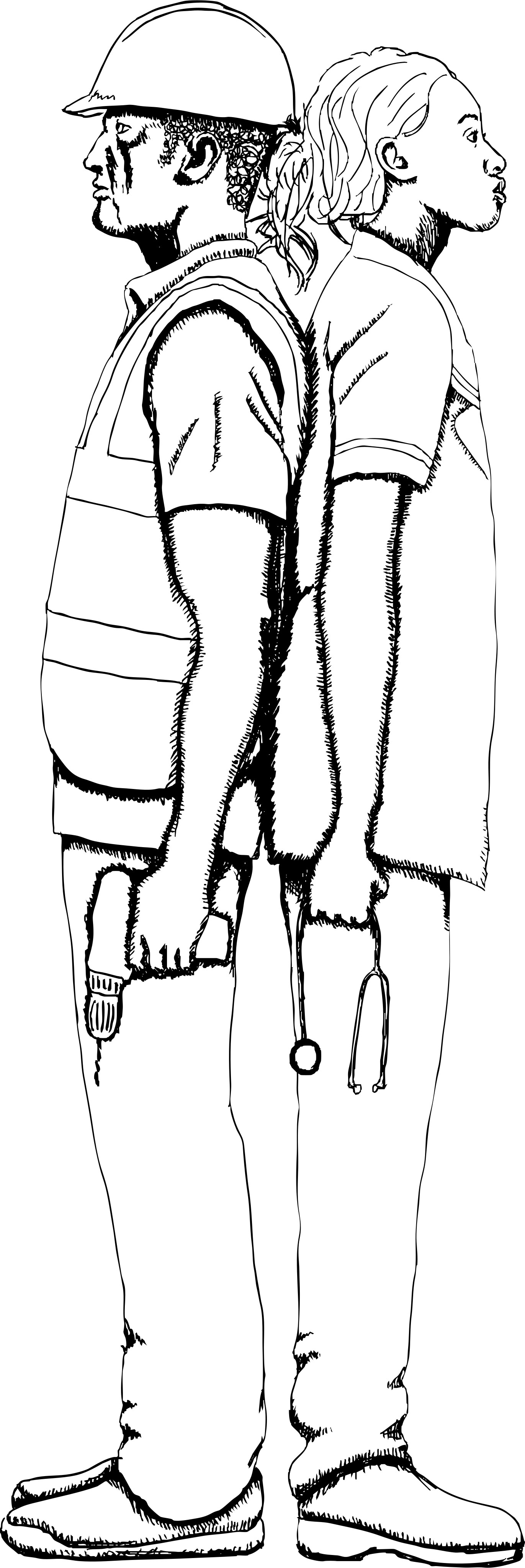
Answering the question posed in the name of his book, then, Smith says that it is, above all, “the productive powers of labour” – not the merchant’s trade, nor mountains of precious metal, nor the bounty bequeathed by nature – that makes a nation wealthy.
Furthermore, these productive powers can be augmented: through science and specialisation; through technology and technique; through the centralisation and coordination of production.
By contrast, Smith explained that the Church and aristocracy, along with the ‘armed bodies of men’ and administrators of the state, are unproductive: a drain on the economy; leeches and freeloaders who survive by sucking up a slice of the wealth produced in industry.
“The labour of some of the most respectable orders in the society is, like that of menial servants, unproductive of any value,” Smith asserts.
“The sovereign, for example, with all the officers both of justice and war who serve under him, the whole army and navy, are unproductive labourers. They are the servants of the public, and are maintained by a part of the annual produce of the industry of other people.”
“This is the language of the still revolutionary bourgeoisie,” Marx explained in his Theories of Surplus Value, “which has not yet subjected to itself the whole of society, the state, etc.”
“State, Church, etc., are only justified [by Smith],” Marx continues, “in so far as they are committees to superintend or administer the common interests of the productive bourgeoisie; and their costs… must be reduced to the unavoidable minimum.”
In this respect, Smith and his ideas were a clear product of the time. More than anyone else, he was the theoretical torchbearer for the liberal wing of the capitalist class; the champion of the ascending industrial bourgeoisie of the age, striking a blow against the remnants of the old order.
Labour theory of value
Smith and the classicists correctly saw capitalism as a system based on the production and exchange of commodities: goods and services produced not for personal consumption or use, but for trade; for exchange on the market.
As Marx outlines in the opening sentence of Capital (‘Das Kapital’): “The wealth of those societies in which the capitalist mode of production prevails, presents itself as an immense accumulation of commodities.”
The term ‘capitalism’ was not used by Smith, however, or by other economists of his time. Instead, he and his liberal peers referred to the ‘commercial society’ of the era.
The label may have been different, but they were essentially describing the same thing – an economy founded upon the market and the trading of commodities. And it was the forces governing the motion of said commodities that Smith and the classical economists (and later Marx) sought to scientifically explain.
The question seemed simple. Why are some commodities more valuable – more expensive – than others? Put another way: what determines the relative ratios in which different goods are exchanged with one another?
The answer to this had eluded generations of economists.
Previous economic schools, as discussed earlier, had identified particular forms of economic activity and concrete types of labour as producing value: the trading of the merchant, or the labour of the peasant.
The big breakthrough of Smith’s studies, however, was to identify labour in general as the source of society’s riches.
“It was an immense advance when Adam Smith rejected all restrictions with regard to the activity that produces wealth,” Marx comments in the introduction to his Contribution to a Critique of Political Economy. “For him, it was labour as such, neither manufacturing, nor commercial, nor agricultural labour, but all types of labour.”
This understanding was the basis for a vital development in political economy: the labour theory of value (LTV).
Smith hit upon a profound idea: that the value of a given commodity is determined by the quantity of labour embodied in it. In other words, commodities are exchanged in proportion to the amount of time required for their production.
“At all times and places, that is dear which it is difficult to come at, or which it costs much labour to acquire; and that cheap which is to be had easily, or with very little labour,” Smith states in The Wealth of Nations, in a chapter discussing ‘the real and nominal price of commodities’.
“Labour alone,” he continues, “is the ultimate and real standard by which the value of all commodities can at all times and places be estimated and compared. It is their real price; money is their nominal price only.”
And again, later in the same chapter: “Labour… is the only universal, as well as the only accurate measure of value, or the only standard by which we can compare the values of different commodities at all times and at all places.”
Adam Smith didn’t invent the labour theory of value, the embryo of which can be traced back to ancient times, appearing in Aristotle’s writings, for example. Smith was the first to assert this concept in such a definitive manner, however, and to construct a theoretical framework upon this foundation.
Marx congratulated the author of The Wealth of Nations for this important contribution to political economy. For today’s bourgeois economists, by comparison, Smith’s adherence to the LTV is an embarrassment; an anathema that they would rather forget, reject, or sweep under the carpet – as the aforementioned quotation from The Economist demonstrates.
Bourgeois straightjacket
Smith’s ideas about the labour theory of value – and about political economy in general – were far from the finished product. Nevertheless, despite their shortcomings, they represented a paradigm shift in economic thinking, laying the groundwork for further investigation.
Amongst subsequent classical economists, it was Englishman David Ricardo (1772-1823) who developed Smith’s theories the furthest – taking them as far as they could go within the confines of bourgeois thought.
Ricardo was more thorough and consistent than Smith in his scientific approach to economic questions, most notably in his application of the labour theory of value. This allowed him to make important advances in regards to political economy.
“Ricardo gave to classical political economy its final shape,” Marx explains, “having formulated and elaborated with the greatest clearness the law of the determination of exchange-value by labour-time.”
Ultimately, however, Ricardo hit up against a limit, due to his bourgeois outlook, which increasingly clashed with reality.
Capitalism had further expanded and evolved since Smith’s time, and was beginning to experience acute, periodic crises.
Ricardo – as with Smith before him, and other bourgeois economists after – denied that such crises were possible. Or rather, they asserted that these crises were due to various ‘accidents’, not inherent to the capitalist system; not implicit within the laws of value and profit. For them, as liberals, the market could do no wrong.
It was therefore left to Karl Marx (1818-1883) to take the science of economics forward: to take up the ideas and assumptions of Smith, Ricardo, and the other classical economists; to show the logical conclusions and contradictions that flowed from these; and, in turn, to break political economy free of its bourgeois straightjacket.
Enigma of profit
Basing himself on the labour theory of value, and the powerful philosophical method of dialectical materialism, Marx was able to reveal and expound the fundamental laws that govern the movements and motion of the capitalist system.
Most notably, he was able to solve a puzzle that had confounded the classical economists: the enigma of profit.
Smith and the classicists saw capitalism – ‘commercial society’ – as being based upon the exchange of commodities; moreover, upon a fair and equal exchange between individuals, not on cheating, robbery, or plunder.
And yet, somehow, out of this equal exchange arose inequality. In particular, in the exchange between the capitalists and the workers, the former evidently ends up with more than they started with.
In other words, the relation between capital and wage labour evidently gives rise to a profit, appropriated by the capitalist class. But how?
Tied in knots
Smith’s own muddles over this question were responsible for tying the classical school in knots. Although he had advanced a labour theory of value, he had done so crudely and inconsistently.
Sometimes Smith talks, correctly, for example, about the value of a commodity coming from the labour-time invested in its production. In other places, he suggests that a commodity’s value is “equal to the quantity of labour which it enables [the owner of the commodity] to purchase or command”.
But these two formulations are not the same. The first says that exchange-value is determined by the amount of labour expended on producing a given commodity. The second says that exchange-value is given by the “quantity of living labour which can be bought in exchange for this commodity”, as Marx puts it (our emphasis).
The former is an approximately correct, but rudimentary, articulation of the labour theory of value. The latter, however, means that the value of a commodity is given by the value of the ‘labour’ it can be exchanged for. This, in turn, is akin to saying that a commodity’s exchange-value is measured in wages: by the price of the ‘labour’ it can “command” and set in motion.
This second definition of value leads to a circular logic. The value of a commodity is said to be determined by the value of ‘labour’ it can be exchanged for. But what determines the value of this ‘labour’, which is itself a commodity, sold by the workers to the capitalists?
“Here value is made the measuring rod and the basis for the explanation of value,” Marx explains, “so we have a vicious circle.”
These two definitions of value correspond to the different perspectives that Smith was examining the question from.
The first relates to the individual commodity producer, working out the value of their commodity according to the labour-time they have personally invested in this. The second represents the viewpoint of the capitalist, who thinks about the value (or price) of their commodity in terms of the wage costs that they have had to pay out in order to produce this.
Yet here a contradiction arises. In the case of individual producers, exchanging with one another, there is an equal exchange; an exchange of commodities containing equal labour-time.
In the case of the capitalist and their employees, their waged labourers, however, it can be seen that workers generate more value – embodied in the commodities that they produce – than the equivalent that the capitalist pays in the form of their wages. The boss or business owner therefore seems to get more than what they have paid for.
Smith acknowledged that the capitalists’ profits were derived from this fact. “The value which the workmen add,” he states in The Wealth of Nations, for example, “resolves itself… into two parts, of which the one pays their wages, the other the profits of their employer.”
Without a firm grasp of the labour theory of value, however, Smith was unable to fully explain and appreciate this phenomena, or comprehend the conclusions flowing from it.
Labour and labour-power
Marx’s revolutionary theoretical leap was to explain the difference between labour and labour-power. In this lay the secret to understanding profit; and, in turn, the key to unlocking all of the other mysteries of the capitalist mode of production.
How did Marx unravel this seeming paradox? By explaining that workers do not sell their ‘labour’ to the capitalists, but their labour-power – that is, not the output of their work, but their capacity to perform work.
This labour-power, in turn, is a commodity like any other: with a value determined by the labour-time needed to produce and reproduce the working class. This includes the labour required to provide the food, shelter, clothing, healthcare, education, etc. needed to sustain workers and their families.
Wages, meanwhile, are the price of this labour-power; the monetary expression of the commodity that the worker sells to the capitalist.
In exchange for paying out workers’ wages, in other words, the capitalist purchases the ability of a workforce to labour for a given amount of time: a month, a day, or even an hour. In turn, the capitalist appropriates all the value produced in this working period.
The capitalists’ profits arise from the fact that workers, in this time, can produce commodities containing more value than the equivalent value that their wages can purchase.
Put another way: the use-value of workers’ labour-power, the output they produce in the time that the capitalist has paid for, is greater than the exchange-value of this labour-power, the wages that the capitalist pays his or her workers in exchange for their capacity to work.
Exploitation and class struggle
“The rock upon which the best economists were stranded, as long as they started out from the value of labour,” explains Engels in his introduction to Marx’s Wage Labour & Capital, “vanishes as soon as we make our starting point the value of labour-power.”
“Labour-power is, in our present-day capitalist society, a commodity like every other commodity, but yet a very peculiar commodity. It has, namely, the peculiarity of being a value-creating force, the source of value, and, moreover, when properly treated, the source of more value than it possesses itself.”
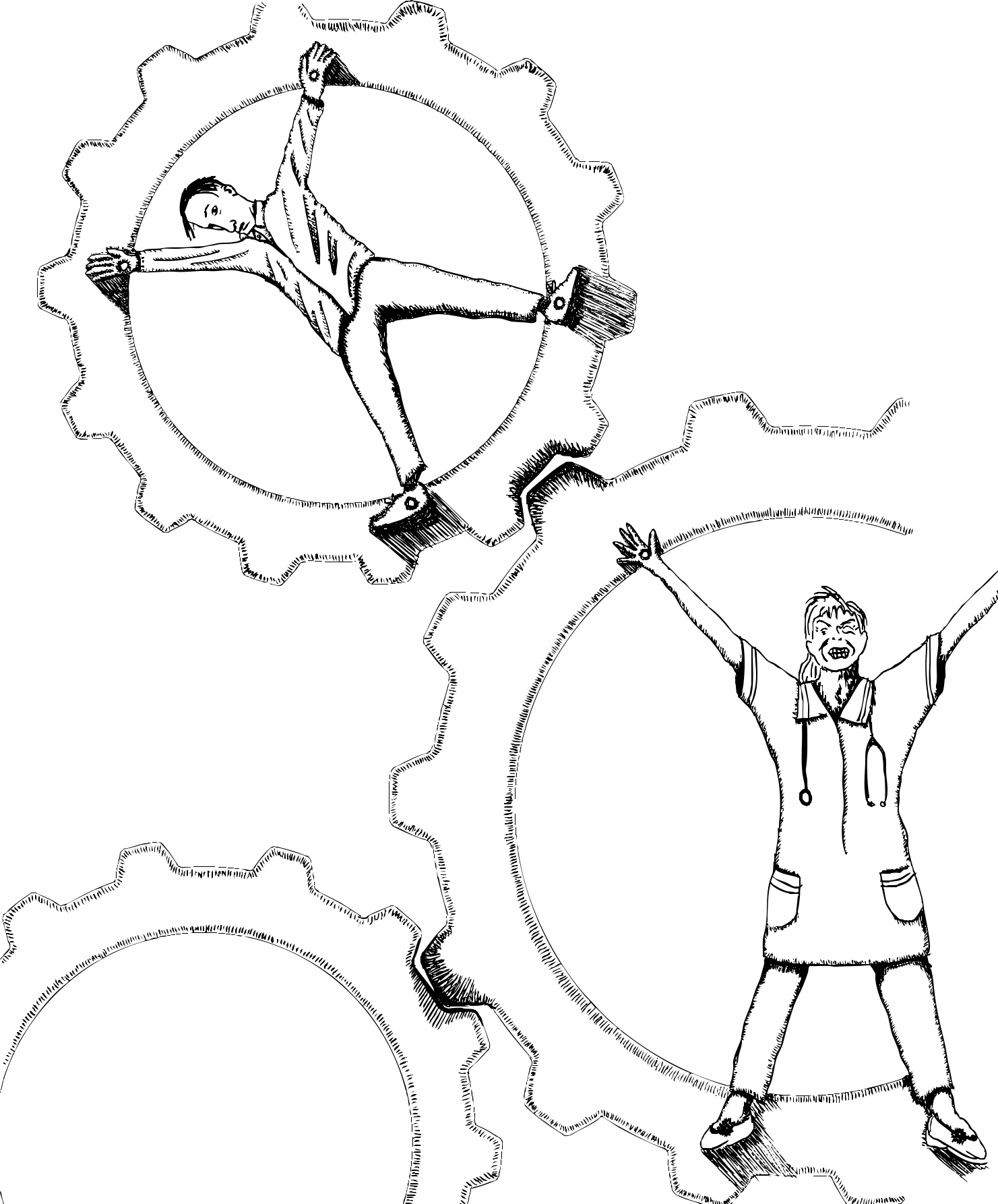
A workforce may put in an eight-hour working day, for example. But it will only take, say, four hours for them to produce commodities with a value equivalent to their wages; at a societal level, for the working class to produce its own means of subsistence.
The capitalist has purchased their labour-power – their capacity to work – for a whole day, however. The worker doesn’t stop after four hours, therefore, once they have reproduced their wages, but continues for the full eight-hours, until the end of the working day.
For the remaining four hours, then, the workers are effectively working for the capitalist for free. All the labour that they perform in this time is surplus labour, above the necessary labour needed to maintain themselves.
And all the value that they generate in this time is surplus value – from which the capitalists, landlords, and bankers obtain their profits, rents, and interest, respectively.
In short, the bosses’ profits come from the exploitation of their workforce: from the unpaid labour of the working class.
This, in turn, gives rise to class struggle – in the workplace and across society – over this surplus: produced by the workers, but appropriated by the capitalists.
Far from having a shared stake in the economy, then, as liberals like Smith suggest, a thorough understanding of the labour theory of value leads to the political conclusion that the material interests of the working class, for higher wages and better conditions, are diametrically opposed to those of the capitalists, for greater profits.
Confusions and contradictions
Unable to resolve the contradictions at the heart of his ideas, Smith and his followers ended up going down a number of theoretical blind alleys and cul de sacs.
Their confusions over the question of value, Marx noted in Capital, were the main “weak point of the classical school of political economy”.
Smith suggested, for example, that the labour theory of value only applied to pre-capitalist epochs, when simple commodity production prevailed: that is, to an idealised, imagined time when society was composed not of capitalists and workers, but of individual producers, exchanging their goods directly with one another through barter.
In fact, the opposite is true: the law of value only fully asserts itself at the point when capitalism is more developed; when commodity production and exchange has become universal and generalised; when the credit system and the world market have come into being and matured.
Flowing from this, Smith believed that the labour theory of value was no longer applicable in the industrial era: once capital and wage labour comes into being; when individual producers no longer face each other directly.
Instead, he said that the exchange-value of a commodity was now derived by adding up the wages, profits, and rents required to pay for the three main factors of production: labour, capital, and land, respectively.
Competition, in turn, acts to push the price on the market towards this value: the ‘natural price’ of the commodity, as Smith described it.
Marx explained, however, that these – wages, profits, and rents – are not costs of production that independently determine the price of a commodity. Rather, they are incomes and revenues – for the workers, capitalists, and landlords, respectively – derived from the value created, by the working class, in the process of production.
In essence, Smith was putting things back to front; presenting things “in inverted form”, as Marx put it.
“Instead of resolving exchange-value into wages, profit, and rent,” Marx outlines, “[Smith] declares these to be the elements forming exchange-value… Instead of having their source in value, they [wages, profit, and rent] become the source of value”.
This is an ‘explanation’ that explains nothing. If commodities’ prices are determined by the addition of wages, profits, and rents, then what determines these supposedly independent components of exchange-value? On this basis, one again ends up going round in circles.
Imagine the economy as a pie. You do not make a pie by adding together different slices, as Smith was effectively arguing. Rather, one bakes a pie, and then divides it up amongst the various diners. Similarly, the different classes in society would not have anything to consume without the value – embodied in commodities – that is generated in production.
Necessity and accident
These two – contradictory – conceptions of value again come down to a question of perspective.
Smith’s labour theory of value, despite its primitiveness, was an attempt to uncover the lawfulness governing commodity production and exchange.
His ‘wages, profits, rents’ model, by contrast, was an attempt to explain things from the viewpoint of the individual capitalist, who works out the price that they should charge for their commodity by totting up their costs of production and adding an expected rate of return.
In other words, Marx highlighted, Smith’s flaw lay in his alternation between an objective analysis of the essential, necessary, social relations of the capitalist system, i.e. the law of value; and a fixation on the subjective, superficial, and accidental – on how things appear to the capitalist, in terms of competition and price.
“The meaning of this change of approach,” Marx explains, “is that first he [Smith] grasps the problem in its inner relationships, and then in the reverse form, as it appears in competition.”
This latter notion has certain implications. It suggests that the price of commodities is subjective, determined by the whims of the various economic agents involved. If workers push for higher wages, or the capitalists demand higher profits, then prices will go up.
This false idea lives on today, with the bourgeois blaming workers for fuelling inflation by fighting for better pay, generating a so-called ‘wage-price spiral’; and certain left-wingers and union leaders responding that the bosses are responsible for ‘greedflation’ through profiteering and price gouging.
The political conclusions of these arguments are reactionary and utopian: either that workers should accept real-terms pay cuts in order to curb inflation; or that price rises can be halted simply by convincing the bosses not to be ‘greedy’.
Price and value
Marx outlined, in this respect, that Smith’s confusions arose from a failure to grasp the difference between value and price.
Furthermore, Marx developed Smith and Ricardo’s LTV by emphasising the idea of socially necessary labour time.
For the classical economists, as discussed, the labour theory of value was seen simply from the perspective of the primitive, individual producer. Robinson Crusoe, producing his means of survival on a desert island, they hypothesised, would establish the value of his produce by comparing the labour-time he had put into their fabrication or procurement.
If it took four hours to make a wooden raft, and four hours to collect one hundred coconuts, then Crusoe would conclude that a raft was worth the same as a hundred coconuts.
“If among a nation of hunters,” Smith similarly gives as an example, “it usually costs twice the labour to kill a beaver which it does to kill a deer, one beaver should naturally exchange for or be worth two deer.”
Marx emphasised, however, that capitalism is not a system of isolated producers and barter. Rather, the capitalist economy is one of socialised production, with exchange taking place not directly, but through the market.
In general, we do not get to haggle over prices under capitalism. Rather, we are confronted as consumers by a market price. Suppliers, meanwhile, cannot charge more than their competitors.
Value, therefore, is not something that can be ascertained or decided subjectively, but is an objective relation. It is, Marx explained, based not on the particular or individual labour spent on producing something, but on the socially necessary labour time involved in production: the average time required to mass produce a given commodity, given the current level of technology and technique in society.
The forces of competition, meanwhile, drive commodities’ prices towards their value. Supply and demand cause market prices to fluctuate. The axis around which these prices oscillate is not arbitrary, however, but corresponds to the value of a given commodity; its socially necessary labour time, established and determined through exchange.
In turn, wages and profits are not decided subjectively, but represent the material incomes of the workers and capitalists, determined through a class struggle; a battle of living forces over the value created in production by the working class.
‘Invisible hand’
This brings us back to the question of the division of labour.
Both within the factory and across society more widely, Smith correctly outlined, a division of labour increases productivity.
There is an important difference between his example of the pin manufacturer and the understanding of the economy as a whole, however – notably, in regards to how the division of labour is regulated in each case.
Within the confines of any capitalist business, work is allocated according to the directions of the boss, in order to maximise profits. The owner or manager decides who does what, according to a definite plan.
Smith noted, however, that there is no such conscious direction of the economy at the societal scale.
Instead, the distribution of society’s productive forces – including capital and labour – are left to the ‘invisible hand’ of the market; to the forces of supply and demand, with price signals (the divergence of prices from values) and the pursuit of profit guiding investment, blindly and anarchically. Ultimately, Smith believed this intangible force would lead to an outcome that would best serve the interests of society.
The capitalist, Smith says, “neither intends to promote the public interest, nor knows how much he is promoting it”. Instead, “he intends only his own security; and by directing that industry in such a manner as its produce may be of the greatest value, he intends only his own gain… led by an invisible hand to promote an end which was no part of his intention”.
“By pursuing his own interest,” Smith concludes, “[the capitalist; the investor] frequently promotes that of society more effectually than when he really intends to promote it. I have never known much good done by those who affected to trade for the public good.”
In other words, competitive markets and self-interest – that is, the chase for ever-greater profits – ought to create an economic ‘equilibrium’ that is optimal and efficient; that utilises society’s resources and productive capacity to generate the maximum amount of wealth possible, creating prosperity for all.
“It is not from the benevolence of the butcher, the brewer, or the baker that we expect our dinner, but from their regard to their own self-interest. We address ourselves, not to their humanity but to their self-love, and never talk to them of our own necessities but of their advantages.”
Law of value

What Smith was describing here, unconsciously, was the law of value: the objective pressures that govern the movements of commodities; that weed out inefficiency and increase productivity; that regulate and distribute resources across the economy.
“The laws which govern the various spheres of capitalist economy – wages, price, land, rent, profit, interest, credit, the stock exchange – are numerous and complex,” explains Leon Trotsky, in his introduction to Marx’s Capital. “But in the final reckoning they come down to the single law that Marx discovered and explored to the end; that is, the law of labour value, which is indeed the basic regulator of capitalist economy.”
Without a clear and thorough understanding of the labour theory of value, however, including concepts like socially necessary labour time, and the difference between price and value, Smith’s explanation of this process necessarily comes across in a subjectivist and semi-mystical manner – with his emphasis on individual self-interest and an ‘invisible hand’.
Furthermore, without a dialectical approach, Smith and the classical economists were unable to comprehend and show how the same market forces that establish efficiency and equilibrium also inevitably lead to their opposite: to destructive, wasteful, chaotic crises.
In short, the contradictions of capitalism, arising out of the law of value, mean that the rational pursuit of self-interest – of profit – leads to a situation that is incredibly irrational for society as a whole.
Yet all of this was a closed book to Smith – and continues to be to his modern-day disciples.
Scientific vs superficial
Smith’s great limit, then, as Marx explained, was his inconsistency – his tendency to flip-flop between contradictory approaches and ideas.

In some cases, he correctly focuses on value and the LTV; on the necessary lawfulness of capitalism. In others, he fixates on price and competition; on the accidental features of ‘commercial society’.
In terms of his outlook: he alternates between a social and objective understanding of questions, at one moment; to an individual and subjective perspective of problems, the next.
At points, he recognises that surplus value comes from the unpaid labour of the working class. At others, he effectively sees profit levels as being random, determined by the caprices of the capitalists.
In his aims, he is a materialist, trying to grapple with real economic questions, and grasping at the key role of labour and production in generating wealth. His modus operandi, however, tends towards idealism: presenting the categories and laws of capitalism as ‘natural’ and timeless, pre-dating capitalism itself.
Sometimes his method is scientific and rational, attempting to uncover the essential relations and interconnections of the capitalist system; at other times, he gets distracted by the superficial appearance of economic phenomena, and presents matters in a metaphysical fashion.
“With Smith,” Marx summarises, “both these methods of approach not only merrily run alongside one another, but also intermingle and constantly contradict one another.”
The result, he concludes, is that Adam Smith “moves with great naiveté in a perpetual contradiction” – a contradiction that only Marx and Marxism could resolve.
Vulgar economics
As discussed earlier, Ricardo overcame some of the contradictions in Smith’s ideas, applying a scientific approach and the labour theory of value with more consistency.
Bourgeois political economy peaked with Ricardo, however.
Following in the footsteps of Smith and Ricardo, Marx had shown the logical conclusions of their economic ideas; the inherent tendency towards crisis that flowed from the LTV and the law of value.
Furthermore, the growth of the working class and the threat of revolutionary class struggle started to bear down on the bourgeoisie and its representatives. This, Marx says in an afterword to Capital, “sounded the knell of scientific bourgeois economics”.
“It was thenceforth no longer a question whether this or that theorem was true, but whether it was useful to capital or harmful, expedient or inexpedient… In place of disinterested inquirers there stepped hired prize-fighters; in place of genuine scientific research, the bad conscience and evil intent of apologetics.”
Subsequent bourgeois economists therefore retreated into idealism, subjectivism, and dogmatism. Rather than trying to scientifically explain the capitalist system, as the classical school had, they became hacks and mercenaries for the bourgeoisie; zealots spewing out pro-market and anti-Marxist propaganda.
Marx described these thinkers – figures like Jean Baptiste Say, Thomas Malthus, amongst others – as the ‘vulgar economists’.
Whereas Marx based himself on the best of the classical school’s ideas and methods, the vulgar economists abandoned these.
Instead, they took up the most retrograde and idealistic aspects of Smith and the classicists: the focus on competition, prices, and the superficial, accidental aspects of phenomena; their ahistorical approach to economics; the empty abstraction of “the solitary and isolated hunter or fisherman, who serves Adam Smith and Ricardo as a starting point”, in Marx’s words.
This one-sided, reductionist interpretation of Smith’s writings by the vulgar economists conveniently neglected – and actively rejected – the other, more important and essential, facet of his economic ideas: the labour theory of value.
This continues to today, with the libertarian advocates of the free market treating Smith as an apostle for their reactionary creed, with its tenets of private property, competition, and the ruthless race for profit. The idea of the ‘invisible hand’, meanwhile, is taken as gospel; as a test of religious faith for capitalism’s most devoted followers and believers.
As a consequence, bourgeois economics today finds itself in a quagmire, with ideas like ‘marginal utility theory’ – a completely subjectivist view of value – and the Austrian School of Hayek now promoted in university syllabuses and textbooks as the final word in economic thought; as the real descendents of Adam Smith.
Yet Smith would likely be turning in his grave if he could see what unhinged ideas are pushed in his name by his contemporary capitalist acolytes.
In turn, without the labour theory of value, these free-market fanatics find themselves completely unable to understand their own system; incapable of explaining why capitalism periodically plunges into crisis, like that which we are witnessing at the present time.
In defence of Marxism
In his three volumes of Capital, Marx showed how the law of value is the basic regulator of the capitalist system, leading to all the other economic dynamics and tendencies we see under capitalism.
It is the labour theory of value, in this respect, that explains where profit comes from; how capital and labour are distributed across the economy; what the real causes of inflation are; why the bosses push workers to work longer and harder; why the capitalists invest in technology and machinery; why exploitation and inequality are intrinsic to capitalism; and why the system is fundamentally prone to crises – crises of overproduction.
On this basis, Marx was able to demonstrate, irrefutably, why capitalism cannot be patched up and reformed, but why it must be overthrown; why the laws of value, private property, and the market must be replaced with new economic laws, based on conscious socialist planning, common ownership, and workers’ control – with production for need, not profit.
So, on this 250th anniversary of The Wealth of Nations, we, the communists, defend the best theoretical contributions of Adam Smith and the classical school, to whom scientific socialism owes a tremendous debt.
We will defend the labour theory of value against all the attacks and distortions of today’s bourgeois economists, and expose the hypocrisy of those who proclaim capitalism to still be progressive; a supposedly liberating force for humanity.
But above all, we defend the ideas of Marxism, which alone can shine a light upon the capitalist system, strip away the mysticism of the market, and point the revolutionary way forward for the working class.
We leave the final word to Leon Trotsky:
“Classical political economy – Adam Smith, David Ricardo – reached its full bloom before capitalism had grown old, before it began to fear the morrow. Marx paid to both great classicists the perfect tribute of profound gratitude. Nevertheless the basic error of classical economics was its view of capitalism as humanity’s normal existence for all time, instead of merely as one historical stage in the development of society.
“Marx began with a criticism of that political economy, exposed its errors, as well as the contradictions of capitalism itself, and demonstrated the inevitability of its collapse. As Rosa Luxemburg has very aptly observed, Marx’s economic teaching is a child of classical economics, a child whose birth cost its mother her life.
“Science does not reach its goal in the hermetically sealed study of the scholar, but in flesh-and-blood society. All the interests and passions that rend society asunder, exert their influence on the development of science – especially of political economy, the science of wealth and poverty.
“The struggle of workers against capitalists forced the theoreticians of the bourgeoisie to turn their backs upon a scientific analysis of the system of exploitation and to busy themselves with a bare description of economic facts, a study of the economic past, and, what is immeasurably worse, a downright falsification of things as they are for the purpose of justifying the capitalist regime.
“The economic doctrine which is nowadays taught in official institutions of learning and preached in the bourgeois press offers no dearth of important factual material, yet it is utterly incapable of encompassing the economic process as a whole and discovering its laws and perspectives, nor has it any desire to do so.
“Official political economy is dead. Real knowledge of capitalist society can be obtained only through Marx’s Capital.”