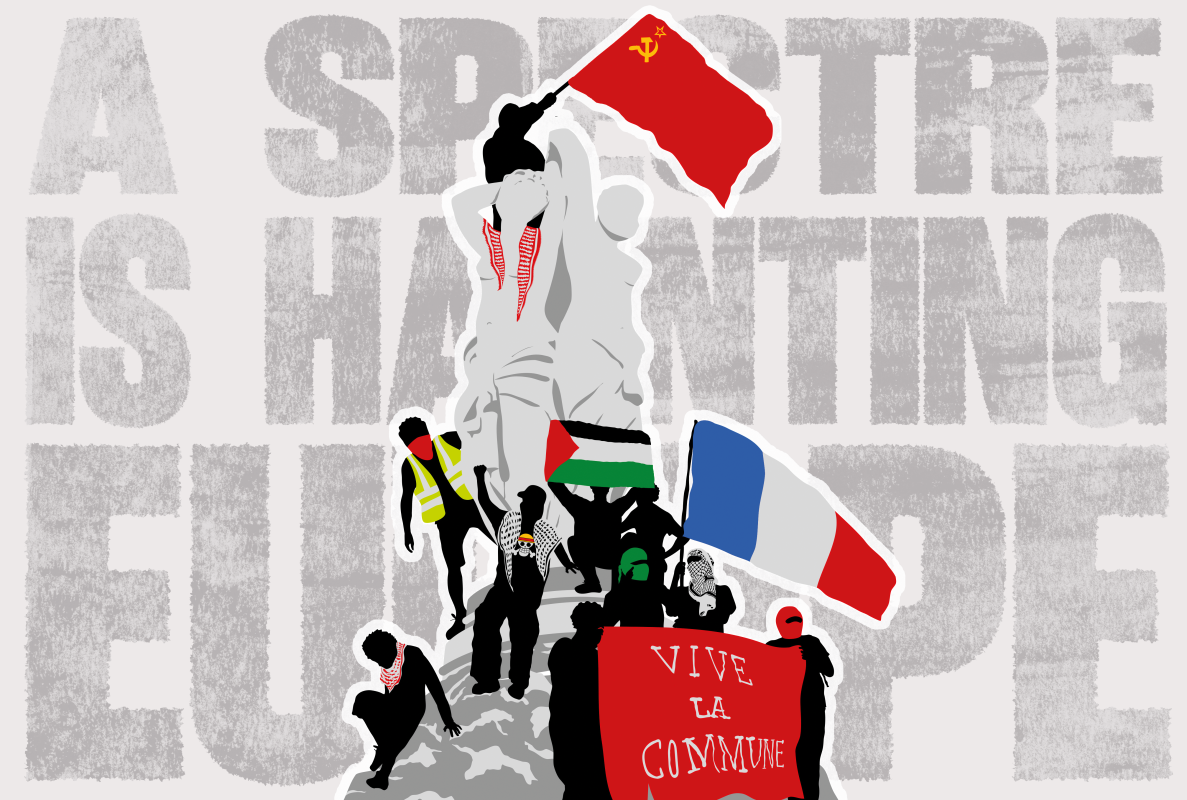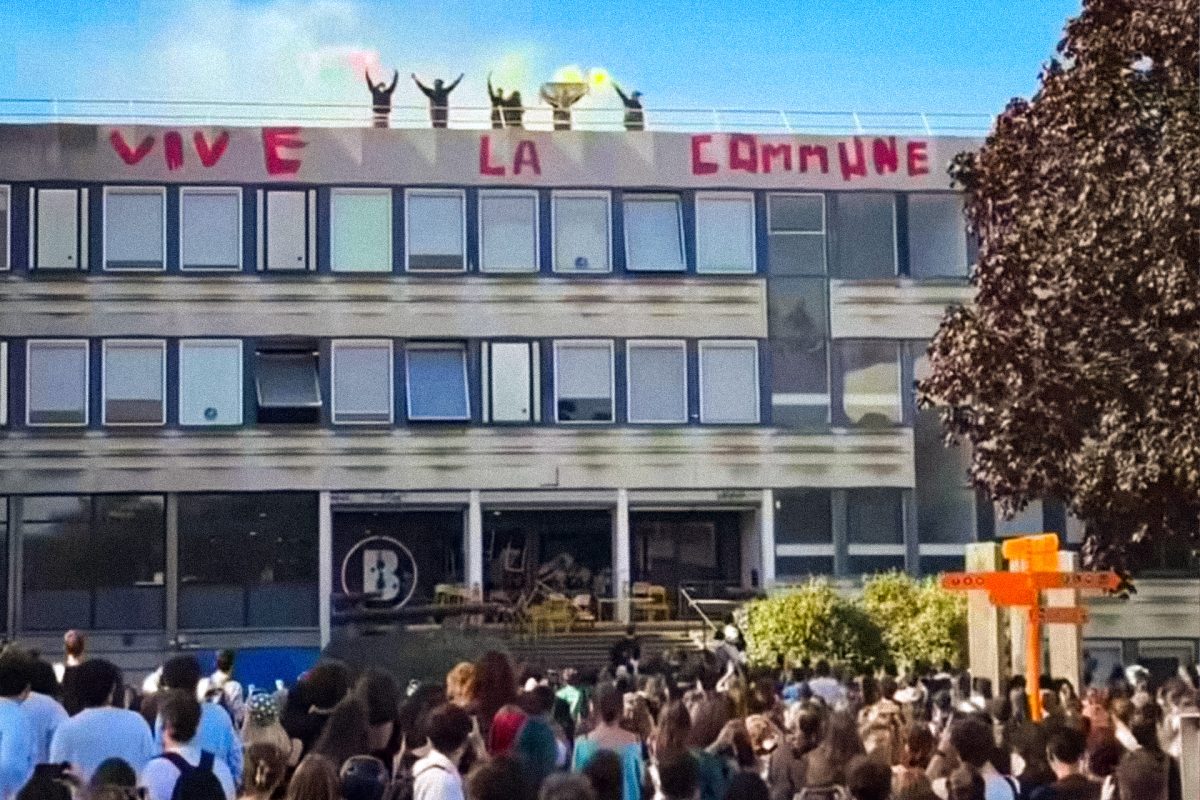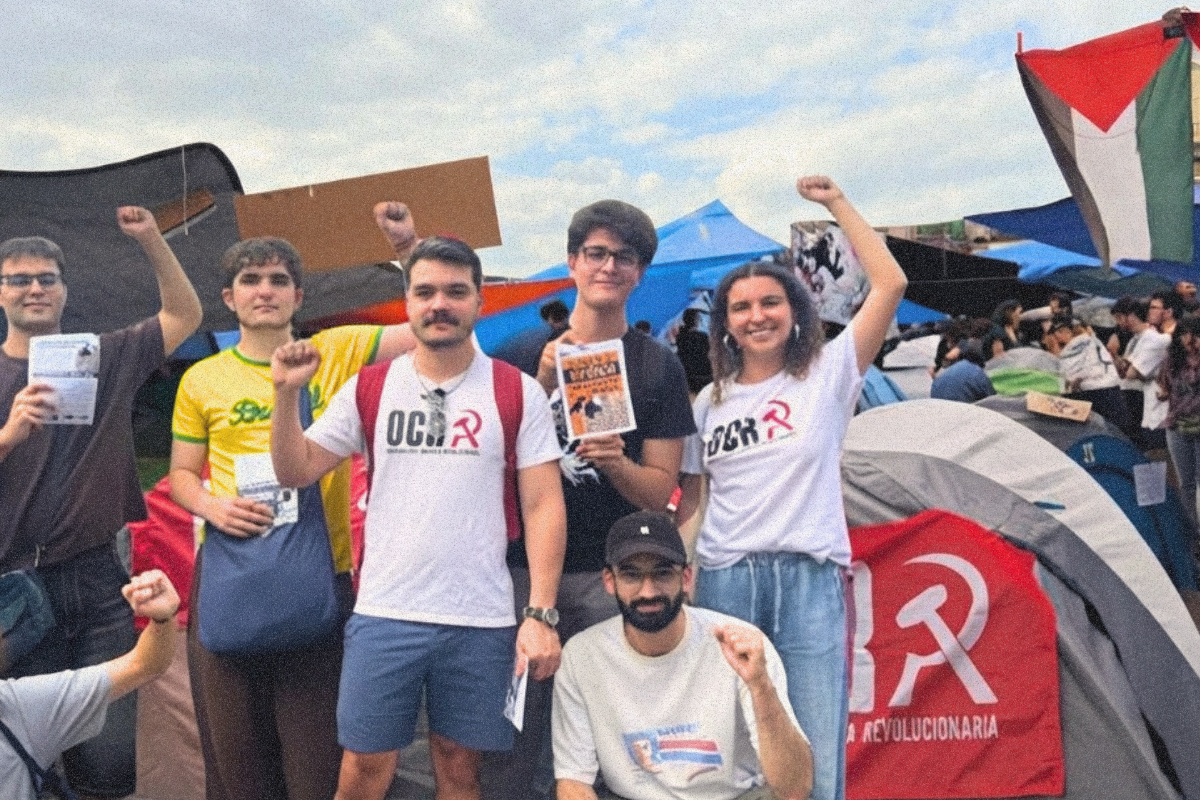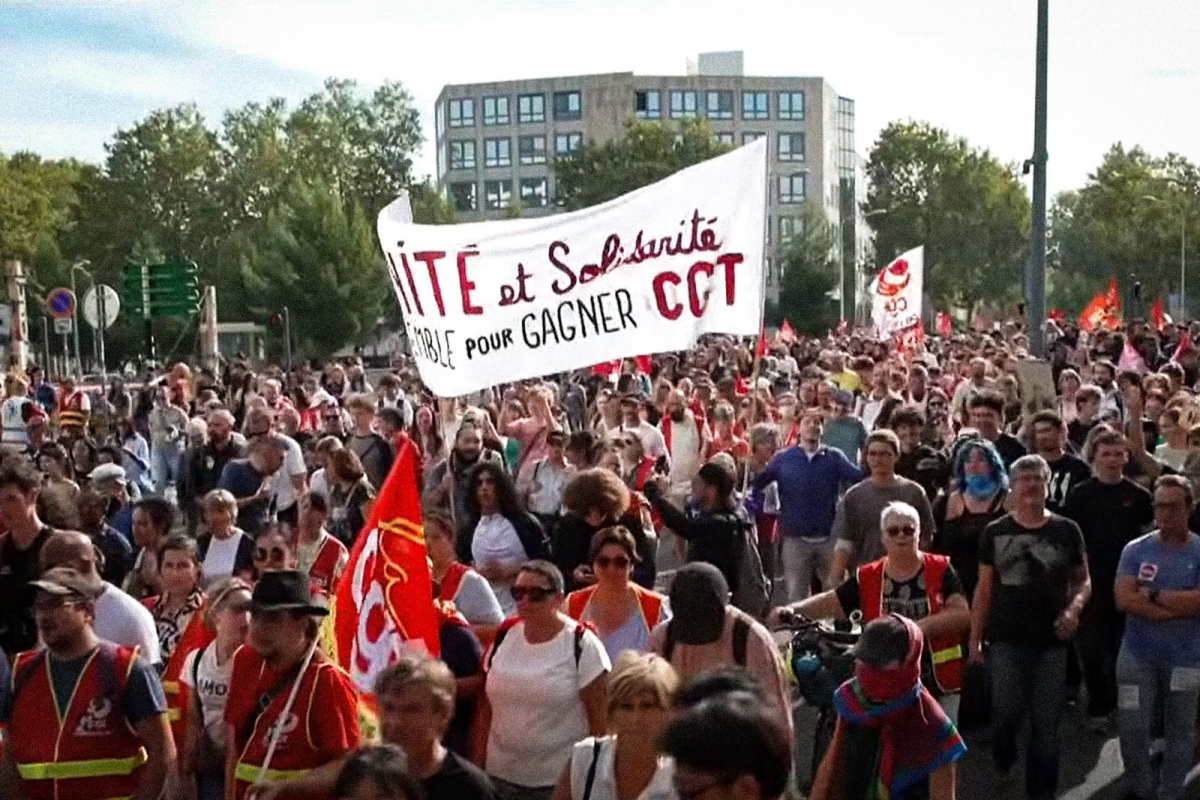
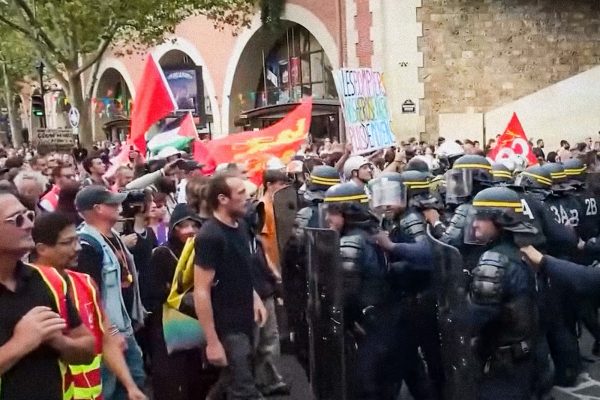
Since the beginning of September, social tensions have been rising day by day. As we write, tens of thousands of high school students across the country are taking to the streets to demand decent learning conditions. The government is responding with insults and police repression.
[Originally published in French at marxiste.org]
On 29 September, many school students joined the powerful mobilisation of firefighters and public sector workers.
The CGT at TotalEnergies – whose bosses are raking in billions of euros in super-profits at the expense of the people – is calling on all the company’s employees to strike on 8 October. Other movements are underway or on the agenda in the private sector, notably in response to the massive redundancy plan at Sodexo.
Finally, calls for action on 17 October have been widely shared on social media. The immediate cause of this initiative is the soaring cost of fuel, which is hitting the vast majority of workers, tradespeople, shopkeepers and farmers. It is difficult to say what will happen on 17 October and in the days that follow. But the fact that calls launched on TikTok have met with such success in just a few days is an expression of immense social anger.
Against this backdrop, the government is preparing €54 billion of budget cuts, at the expense of workers and the middle classes. From the ruling class’ point of view, these cuts are absolutely necessary to constrain the public deficit, and rising interest payments on this debt. From the point of view of the masses of exploited and oppressed, however, it is a provocation and a further reason to mobilise.
‘Enough is enough!’
This potentially explosive start to the academic year is causing serious concern amongst the bourgeoisie’s strategists and politicians. They had hoped that the upcoming presidential election would guarantee some degree of social stability for the next seven months. They have been telling the good people: ‘don’t take to the streets: read the manifestos of the parties, listen to the speeches (especially ours), and go and vote when the time comes (but not for Mélenchon). It is the winner of the election who, backed by your mandate, will solve all your problems (unless it’s Mélenchon).’
This, more or less, is the advice the rich and powerful are giving to ordinary citizens. But many young people and workers are unwilling and unable to wait patiently for the presidential election, followed by the parliamentary elections. It is now that they are suffering from deteriorating working conditions, stagnant wages, soaring prices, redundancy, budget cuts and the decline of public services.
They have waited long enough. For years, they have tightened their belts in the hope of better days. Some have even, at times, believed in Macron’s empty promises or his mendacious excuses (‘it’s the Russians’ fault’ and, now, ‘it’s the Houthis’ fault’).
But there is a limit to everything, including the patience of the masses. There is a mood in society that, in the coming weeks, could crystallise into a vast movement. One phrase sums it up: ‘enough is enough!’
What programme?
The leaders of the labour movement have a responsibility to organise the rising anger and, above all, to provide it with a programme commensurate with the stakes.
The nationalisation of TotalEnergies, under workers’ control, is a slogan that would strike a powerful chord amongst the mass of the working class and the poorest sections of the petty bourgeoisie.
Without such a slogan, the demand for a ‘cap’ or a ‘freeze’ on fuel prices would be impotent. Total’s executives have already warned that they would react cynically to any encroachment on their profit margins: by reducing supply, suspending or reallocating investments, and so on. They must be expropriated: only then will it be possible to control prices – and, at the same time, improve wages and working conditions within this multinational.
A second imperative is to raise all wages and index them to inflation. The rising prices of many raw materials will have a lasting impact on various sectors of the economy. Inflation will not subside in the coming months – it will undoubtedly rise.
Under capitalism, only a global recession – that is to say, another catastrophe – could curb inflation, at the cost of a sharp rise in unemployment and poverty.
The role of trade union leaderships
The crisis of French capitalism is so profound that nothing in the coming months will alleviate the suffering of the people: neither a change in economic conditions nor government policy. On the contrary: the purchasing power and living conditions of the majority of the population will continue to deteriorate, at a faster or slower rate.
To halt this ongoing social decline, a radical change in economic and social policy would be required. Put simply, the government of the rich would have to be replaced by a government of the workers. Unfortunately, this is not – not in the least – the direction of the current leaders of the trade union movement, including the CGT.
On the evening of 29 September, the leadership of the CGT issued a statement entitled: ‘Public services: in the face of public anger, the government has 48 hours to rethink its position’. It stated that “the government has 48 hours” to “increase civil servants’ wages, free up resources for our public services and stop picking the pockets of workers, pensioners, the sick, tenants and families”.
Yet everyone – including Sophie Binet of the CGT, one assumes – knows that the government will do nothing of the sort.
So, what does the CGT leadership have in mind? We do not know. The press release merely reiterates that several protests are planned for the 5, 6, 8 and 14 October. That is all. No strategy worthy of the name has been formulated. 17 October is not even mentioned. Why? Because the CGT leadership fears an explosive social movement spiralling out of its control.
This is the crux of the problem. The most militant CGT activists must take up the struggle within the union to ensure that its leadership reflects both the anger of the masses and the objective needs of the labour movement.
How can we win?
The immediate demands of the movement – on wages, employment, and learning and working conditions – must be linked to the prospect of overthrowing the Lecornu government and the system it defends. As for the methods of action, they must be equal to the task at hand.
No ‘day of action’, however large, will make the government and its supporters – the bosses of TotalEnergies, the multinationals and the banks – back down by so much as a millimetre.
The leaders of the left and the trade union movement – starting with the CGT and LFI – must join forces to build a powerful movement of rolling strikes, backed by a broad campaign of agitation. We must demonstrate to all workers that, without them, society is paralysed; that they create all wealth; and that, therefore, they must run the economy – which means wresting its key levers from the hands of the gigantic parasites who control them.
Finally, Jean-Luc Mélenchon and his comrades must not be content merely to support the various expressions of social anger – whilst deferring it to the presidential election in April and May 2027. LFI must throw all its strength into the struggles that are unfolding.
As he did before 10 September 2025, Mélenchon must call on the leadership of the trade union movement to put a nationwide economic blockade on the agenda. Whatever the outcome, that would strengthen LFI’s authority amongst young people, the poor and workers, whilst forcing Marine Le Pen and her clique into hiding – as they always do whenever the working people rise up against the exploiters and profiteers.
France: the struggle in high schools shows us the way!
Vincent J. and Gabriel V.
The wave of blockades sparked by the mobilisation of students and staff at the Saint-Exupéry high school in Créteil on 17 September has grown considerably in recent days. On Monday, 27 September, 180 schools across France were affected. And then on Tuesday and Wednesday, the number rose to more than 300. As of today, more than 400 schools have been blockaded.
[Originally published in French at marxiste.org]
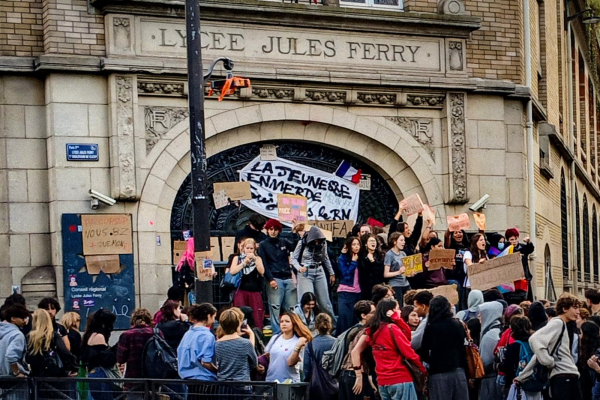
High school students are protesting unacceptable learning conditions: a shortage of teachers, overcrowded classrooms, dilapidated and unsanitary buildings, a lack of nurses and social workers, and the closure of student lounges and cafeterias – the list goes on.
High schools in poor neighbourhoods are the worst affected by these conditions, but the problem is widespread: 65 percent of the country’s high schools are understaffed. As for the buildings, 86 percent require energy-efficiency renovations, and 43 percent of classrooms lack shutters to provide shade for students during heatwaves.
These mobilisations also reflect the anxiety felt by young people about their future. The high school students are protesting Parcoursup – the main portal to apply for higher education – and its unfair selection process, which they have described as a form of social sorting that favours those from elite schools and well-off areas. They are also fighting against austerity and the high cost of living, at the same time as the government has announced more than €50 billion in cuts for the 2027 budget.
Repression and slander
The state has met this movement with brutal repression: tear gas, baton blows, shots fired at point-blank range. Already, over a thousand people have been arrested, and around a hundred injured. In Saint-Ouen-l’Aumône, a 14-year-old had his teeth knocked out after being shot point-blank in the face by a policeman firing a grenade launcher. Another high school student lost the use of one eye after being hit by a ‘flash-ball’ round in Tours.
🇫🇷 FLASH – Un policier a TIRÉ une GRENADE LACRYMOGÈNE à BOUT PORTANT au visage d’un lycéen qui participait au blocus du lycée professionnel Château d’Épluches, à Saint-Ouen-l’Aumône, ce matin. (document AlertesInfos) pic.twitter.com/dBfcY2cPXM
— AlertesInfos (@AlertesInfos) September 28, 2026
Bourgeois politicians and the ruling-class media have unleashed an escalating barrage of insults and lies aimed at the movement, in order to discredit it and divert attention from its causes. High school students are being accused of ‘irresponsibility’ and ‘violence’ by the very same people who are destroying their educational opportunities and sending in the security forces to maim them! 24-hour news channels sound the alarm over every single burning bin, while the police unleash their fury on teenagers.
With the presidential election approaching, the right wing is attacking its usual scapegoat: high school students are allegedly being ‘manipulated’ by La France Insoumise (LFI). Former Minister of the Interior Bruno Retailleau is openly calling for a ban on LFI, which he accuses of “organising an insurrection” by supporting the high school students’ struggle.
The role of the labour movement
In the face of these attacks, workers’ organisations must mobilise all their forces to provide effective support for the protests: we must defend the right of high school students to fight for their future. Mélenchon’s call to “stand up against police brutality” is a step in the right direction, and must be widely heeded. This is already what teachers and teaching assistants are doing in several schools, in solidarity with their students.
The unions – and in particular the CGT – have a decisive role to play. Beyond merely verbally condemning police violence, they must encourage their activists to join the blockades.
They must also launch an agitational campaign to prepare for what comes next. At the start of this already-turbulent back-to-school season, struggles are multiplying – from firefighters to hospitality workers. In anticipation of the planned 17 October mobilisation against the high cost of living, a broad, renewable strike movement in workplaces must be prepared, based on a militant programme to fight austerity.
The demands of young people and workers point in the same direction, and high school students are aware that they cannot win this fight alone. Just as they participated in the public-sector demonstrations on 29 September, they in turn need the support of the labour movement. As the German Marxist Karl Liebknecht wrote, “youth is the flame of revolution.” But this faint flame will be extinguished if it remains isolated. It is up to other sectors of workers and youth to fuel it, to make it a blazing inferno.