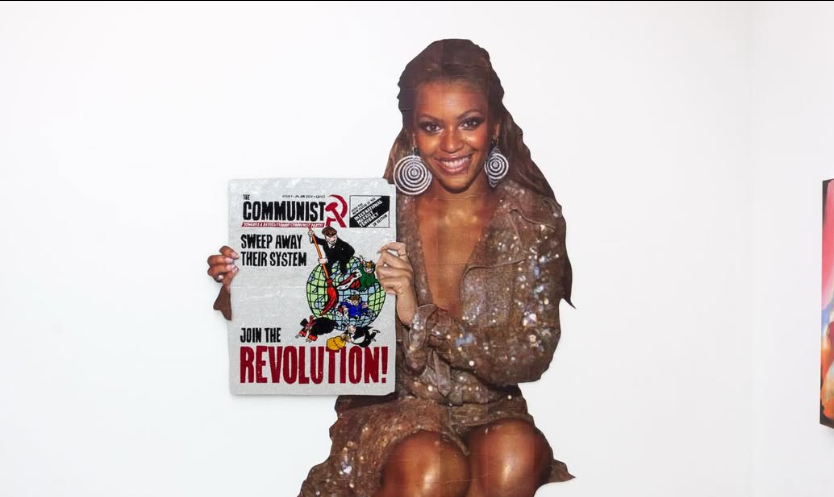
Earlier this year, a spectre haunted the Saatchi Gallery – in the form of a three-metre tall Beyoncé, diligently selling the very first issue of The Communist.
This new artwork, titled Attack of the 50 Foot Comrade, made by myself, Elleanna Chapman, was on display at the gallery in London from 29 January – 1 February 2026.
Art and revolution
I am both an artist and an active member of the Revolutionary Communist Party (RCP). I joined the party during art school, and have always been interested in the way art can be used in the revolutionary struggle, in the way that Trotsky outlines in his writings.
Too often, working-class voices, tastes, and ideas are actively excluded from the art world. In my practice, I draw heavily from my work in the party to try to put forward communist ideas in a way that is both witty and accessible, using pop-culture as a means to investigate the exhaustive crimes of the capitalist system we live under.
Beyoncé has featured a lot in my recent work. And whilst I am a fan of her music, I imagine what it might look like if she took her politics further. I believe she does tap into a certain rage and discontent that is abundant in society.
In her 2016 Superbowl performance, for example, she donned the dress of the Black Panther Party, which had been formed less than 50 miles from the stadium 50 years prior. Her most recent albums, Renaissance, and Cowboy Carter seek to investigate the erasure of black innovation within queer ballroom culture and country music, respectively.
Regardless of her intentions however, she fails to draw the conclusion that to meaningfully fight back against sexism and racism, you have to challenge the economic system of capitalism.
Instead, I try to bridge that gap myself, reimagining her as a militant communist in order to point to the limitations of her identity politics, and simultaneously platform the ideas and methods of Marxism as the real, revolutionary way forward.
Revolutionary press
In mid-2025, I found out that I would have the opportunity to exhibit a piece of art as part of the exhibition Good Eye Projects at the Saatchi Gallery with ‘comrade’ Beyoncé on my mind.
I knew this opportunity meant lots of footfall, four metre tall walls, and the opportunity to platform my art and politics to a wider audience than ever before. Before long, I set to work, dreaming up a plan of action to bring revolutionary politics into one of London’s poshest gallery spaces, at the hands of one of the richest women in the world.
When scouring Pinterest, I stumbled upon a bizarre photo of Beyoncé from 2003, where she is holding up a copy of the New York Post. She is cracking a cheesy grin next to a 9/11 headline. I knew I had struck gold, and needed to reappropriate this image, supersized, to emphasise my own political message.
Whilst Beyoncé has featured in various recent artworks, Attack of the 50 Foot Comrade is, to me, my most interesting piece to date, as it explicitly promotes the RCP and nods to one of the most important activities we undertake: selling the paper.
Whilst print media can seem old-fashioned to some, I really value the importance of the revolutionary press for its role in both recruiting other radicalised people and providing a framework for party members to develop themselves politically.
Our paper is a vehicle not only for meeting other people who are open to our ideas, but to test our understanding of the world around us and our ability to coherently explain Marxist ideas.
On every front, a good workers’ paper can act as a revolutionary weapon.
Party and politics
In the completely classist, commercialised art industry, such ‘old school’ methods of party building are conveniently all but absent from any discussion on how to change the world.
Most political discourse is reduced to mere representation or diverted down the safer channel of identity politics – failing to connect single issue politics or identity-based repression to the wider system that perpetrates all of these ills.
If action is acknowledged, it is often only that of the individual. Discussions of building a revolutionary party are never mentioned.
Through this new artwork, I wanted to shine a light on, and in a sense celebrate, the often overlooked labour of paper selling, as well as the wider need to organise seriously and collectively.
The context of the Saatchi Gallery, a giant pop star, and an oversized issue of The Communist, pieced together using over 30,000 glittering rhinestones, feels a bit more glamorous than my typical branch sale outside Mile End.
Nevertheless, I aimed to use this fabulosity to call attention to the party, our politics, and our methods, where an individual can make a difference. You just need to get organised first.