HOV Conference a big success
Hands Off Venezuela Britain held its 4th annual conference on Saturday November 22nd at Birckbeck College, London. Read the full report on Hands Off Venezuela.

Hands Off Venezuela Britain held its 4th annual conference on Saturday November 22nd at Birckbeck College, London. Read the full report on Hands Off Venezuela.
We
have received news of the assassination of three prominent trade union leaders
in Venezuela. Their comrades point the finger at the bosses in the Colombian
owned Alpina factory, where the workers are on struggle and where the three
killed comrades were coming from. They also point out the responsibility of
Didalco Boliviar, former governor of Aragua, defeated in the regional elections
last week. Didalco, was elected on a Bolivarian ticket but then joined the
opposition, and was known for his support for the bosses and the use of the
regional police against the workers.

Five
years into the occupation of Iraq
and seven years after the war in Afghanistan started the Americans
and their allies are bogged down in an unwinnable situation. Even if they
withdraw from Iraq
in the medium term future, the political and social repercussions of the war
will go on for decades. The attempt to carve out a new sphere of influence in
the Middle East, and thus guarantee oil
supplies has proven to be a lot more difficult than the American Imperialists
imagined, and serves to demonstrate the limits to the power that they can
wield. The New World Order has become disorder and the economic and financial
crisis in America
brilliantly confirms Trotsky’s analysis when he explained that the cost of the
growth of American Imperialism was to accumulate “dynamite in its foundations”.
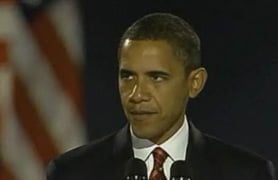
The U.S. has elected a new president,
Barack Hussein Obama. Along with the dramatic turn in the economic situation,
this marks a definite turning point in the history of the country and of the
world. Big illusions have been created that Obama will provide “change”. What
American workers have voted for is an end to policies that benefit the rich,
but Obama does not represent real change. In the coming years workers will
learn from real life experience that what is required is a genuine voice of the
US working class, and that can only be a mass party of labor.
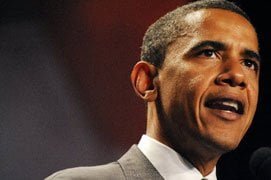
Elections can reveal a lot about a country, and the fast-approaching
U.S. presidential election is proving to be no exception. Above all,
the current election shows just how much working Americans need their
own political representation. This fact is expressed and cynically
taken advantage of by Barack Obama’s campaign slogan: “Change We Can
Believe In.” Even the “old guard” represented by John McCain has had to
raise the idea of change in his campaign rhetoric.
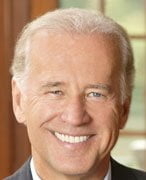
Millions have hoped against hope that Barack Obama represents real
change. But these sincere hopes were dealt another blow with the
selection of Senator Joseph Biden from Delaware as Obama’s vice
presidential running mate. Biden has had a long career in politics, and
is often portrayed as a “liberal.” However, a brief look at his
policies only goes to show the sorry state that bourgeois liberalism
finds itself in!
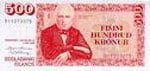
“The
Icelandic economy is prosperous and flexible” (IMF 4 July 2008)
(There
is) “a very real danger…that the Icelandic economy, in the worst case, could
be sucked with the banks into the whirlpool and the result could be national
bankruptcy.” (Iceland’s Prime Minister Geir Haarde – address to the nation 6
October 2008)
What happened to Iceland in the period of three
months to explain this change?

Communism is
suddenly back in fashion in Japan. The reason is not hard to seek. ‘Lifetime
employment’ is a thing of the past for young workers, who face a casualised and
insecure future. One in three is temping. Some 44% of country’s workforce are
part-time only, while a profusion of short-term contracts has created a
generation of freelancers who are often ‘between jobs’. They have already worked
out that, as recession bites, they will be first in the firing line. They are
drawing political conclusions in increasing numbers.
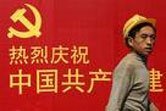
China’s urbanization process has
reached a critical juncture. Inequality between town and country is producing
explosive revolts surrounding the cities. The problem of how to contain these
revolts is at the core of policy making and is reflected in conflicts inside
the Central Committee of the ruling Communist Party.
The background to this is that rural
rebellions have escalated over recent years. Yu Jianrong director of the Rural
Development Institute’s Social Issues Research Center at the Chinese Academy of
Social Sciences gave explicit warnings to the Chinese leadership of a revolutionary crisis developing in
the countryside and new proletarian zones in the interior provinces.

The disarray among ruling circles in the
European Union could hardly have been more clearly depicted than at the
‘summit’ over the weekend of October 4th and 5th. In
reality the event was little more than a photo-shoot. The meeting brought
together the Prime Ministers of Britain, Germany, Italy and France. The Prime
Minister of Spain clearly had his nose put out of joint by the lack of an
invitation. The other EU members (currently 27 nation states) also may well
have asked why they weren’t to be asked to take part in decisions that could
profoundly affect their futures.
The only realistic reply could be that the
meeting would have been even more of a shambles. Europe cannot get its act
together. First the participants at the summit swore to unite in action in the
teeth of the crisis. Secondly, when it came to pumping money in to the European
banking system (which must come if the plan is serious) they all got cold feet.
National interests came first. German finance minister Peer Steinbruck blew the
gaff. “We as Germans do not want to pay into a big pot where we do not have
control and do not know where German money might be used,” he complained. Since
the EU nations are not hanging together, they will hang separately.
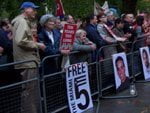
Yesterday saw an impressive show of
solidarity for the Miami Five in front of the US embassy at London’s
Grosvenor Square. About five hundred people turned up to the annual
candlelit vigil organised by the Cuba Solidarity Campaign in Britain.
Hands Off Venezuela joined the protest, which marked the 10th
anniversary of the arrest of these five courageous men.
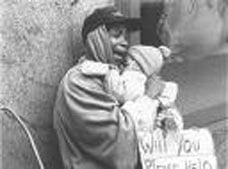
Our
lives, those of our children, our health and living are subjected to the whims
of the gambling table, otherwise known as the ‘world financial system’. In what
way can betting on the prices of stock and shares benefit humankind? Rather, it
inevitably leads, at some stage, to crisis, as the blind bets get called in.
Now,
with the crisis of the capitalist system unfolding, the poverty, hunger and
homelessness experienced by some sections of working class people is spreading
to wider and wider layers. This is initially being expressed in foreclosures on
home loans and an increase in homelessness.