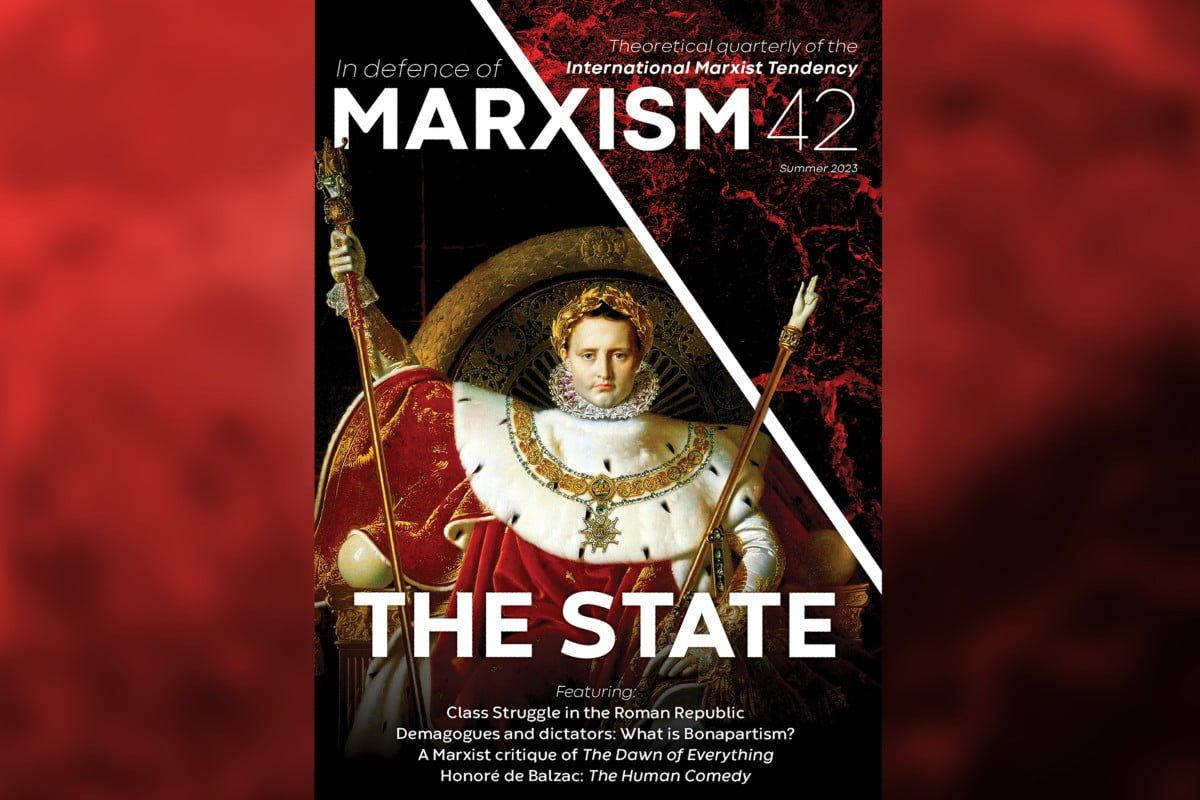
Marxism and the state | What did Lenin really stand for?
Fiona Lali discusses the origins of the state, and refutes the views of the reformists and anarchists on this question.
In this episode of Marxist Voice, Olivia Ruadh will explore how the state developed, how it is maintained, and how to fight against it.
The Monarchy calls itself a neutral observer, but this illusion was shattered when Johnson used the Queen to force through his programme. This casts light on the real role of the Monarchy, a reserve of reaction. We say abolish this feudal relic!
Under capitalism, the ruling class maintains its privileges and power through a bureaucratic state apparatus, in which members of the rich elite move freely between government and big business. We must put an end to this ‘revolving door’.
This month marks the 100th anniversary of the writing of Lenin’s great work The State and Revolution, written in the midst of the Russian Revolution to prepare the working class for taking power. To mark this important anniversary we reproduce here key extracts from an introduction of a new edition of this pamphlet, written by Alan Woods.
Adam Booth explains the Marxist theory of the state, and how these are different from anarchist and reformist theories.
In this recording from the Marxist Summer School 2013, Jorge Martin, writer for www.marxist.com and International Secretary for Hands Off Venezuela, discusses the contributions made by Ted Grant – founder of the Militant Tendency – towards the Marxist theory of the state and the analysis of the Stalinist regimes in Russia and Eastern Europe after the Second World War, primarily based on Ted Grant’s excellent document “Against the Theory of State Capitalism”.
Silvio Berlusconi, the former Prime Minister of Italy, has, after numerous trials for countless crimes, finally been convicted. This wealthy politicians and businessman has protested about being the victim of a politicised judiciary. Such an accusation raises an important question: is the judiciary under capitalism “political”? Ben Gliniecki looks at the role of judges and the law in capitalist society.
In 1949, Ted Grant, founder of the Militant Tendency and Socialist Appeal, wrote a polemical response to Tony Cliff on the class nature of the Soviet Union, arguing against Cliff’s theory of “State Capitalism”. Ted’s response provides an in-depth Marxist analysis on a range of questions, from the transition from capitalism to socialism, to the key issues of the state and the nature of Stalinism.
Standing between the working class and the socialist transformation of society is a colossal state machine. In order to carry out this transformation, we must have a clear understanding of what the state is, and what must replace it.
Real living examples of revolution are the test of any theory. May 1968 was such a historical example. These events reveal that defeat of the working class has not come about by such a thing as the “strong state” but by the ineptitude of the reformist and Stalinist leaders who were not prepared to mobilise the full force of the working class.
For there to be a revolution does there have to be violence? To the sectarian mind the answer is always in the affirmative. Marxists look at the question in a more rounded out manner, looking at the many factors that come into play: the balance of class forces, the nature of the leadership of the working class, the tactics and programme adopted, and so on.