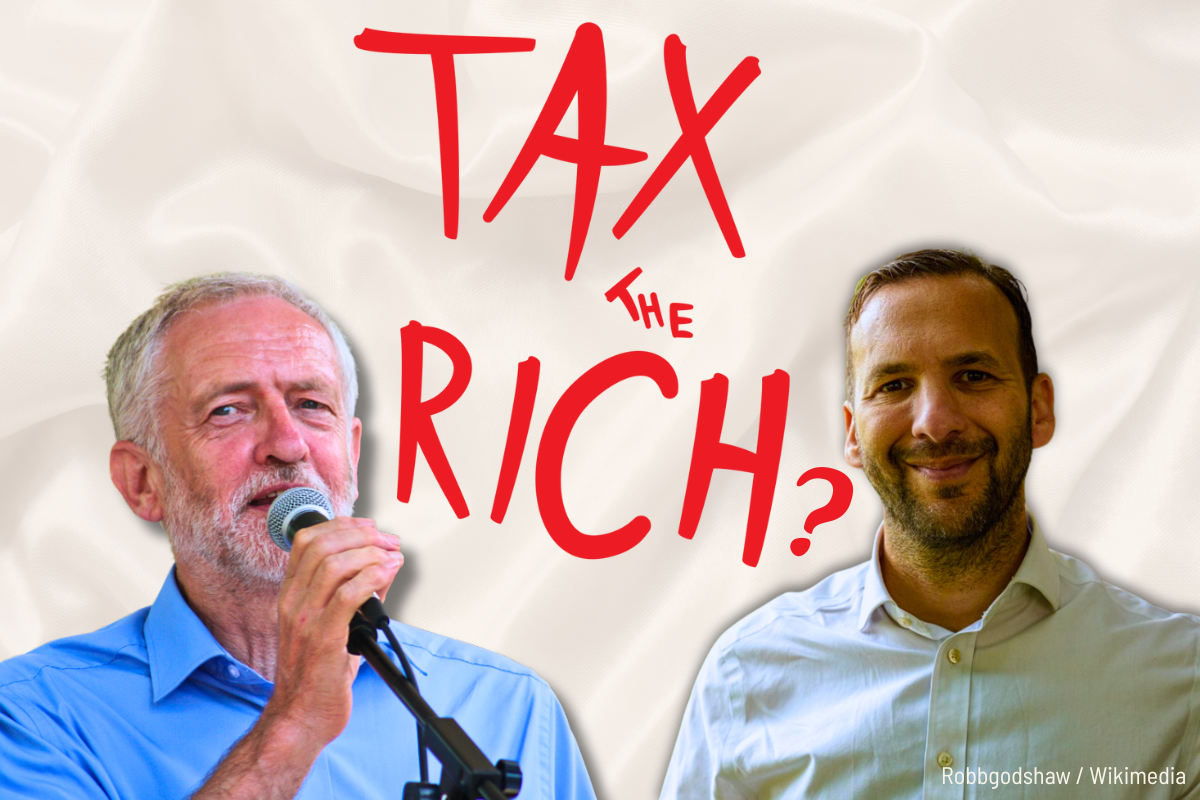

Recently, reformists like Zack Polanski and Jeremy Corbyn – alongside Zohran Mamdani in the US, and Mélenchon in France – have been putting forward the idea of a wealth tax.
Their proposals are certainly popular. Demand for a wealth tax is growing louder by the day: 86 percent of the French public support a wealth tax, along with 75 percent of Brits and 67 percent of Americans.
In Britain, some wealth-tax advocates argue that even a two percent tax on assets over £10 million could raise £24 billion for the British economy.
A recent meeting of four G20 finance ministers, meanwhile, estimated that a global two percent tax on the world’s 300 billionaires would bring in $250 billion in tax revenue annually.
This kind of money could certainly go a long way towards solving poverty, hunger, and addressing the climate crisis.
But do these policies truly offer a way forward?
Inequality

In 1987, when Forbes published its first list of billionaires, it recorded 140 names. Today, there are more than 3,000 billionaires around the world, with a combined wealth of $16 trillion. Elon Musk, meanwhile, is on track to possibly become the world’s first trillionaire.
Anger against inequality is brimming over. It has been a major catalyst in the ‘Gen Z Revolutions’ erupting around the world.
Gabriel Zucman, a professor of economics at the Paris School of Economics, points out that the wealthiest are paying the least in tax. In the UK, the richest 1 percent own more wealth than the bottom 70 percent – but pay tax rates close to merely 0.3 percent of their wealth.
In the US, the 400 wealthiest Americans paid a total effective tax rate of 23.8 percent between 2018-2020, including taxes on income, estates, corporation tax, and gifts. This is compared to an average rate of 30 percent for the wider US population, or 45 percent for the highest earning workers.
The injustice of this inequality is contributing to a rising anger and rejection of the capitalist system.
Capitalist crisis
At the same time, governments are facing complex and intractable economic problems. These governments are in massive amounts of debt – and borrowing to fill the gaps is only digging the financial hole deeper.
France has a deficit of €160 billion, more than 5 percent of GDP. The US budget deficit is a staggering $1.775 trillion, or 6.4 percent of GDP. In Britain it is £131 billion, equivalent to 4.8 percent of GDP.
Yet, after 15 years of austerity, public services are stretched to their limits. Any efforts to cut further, such as Reeves’ disability benefit cut proposals, elicit a furious backlash and make governments deeply unpopular.
And when governments prove incapable of ‘balancing the books’, this in turn pushes up state borrowing costs.
With few directions left to turn, taxing the super rich presents itself as a perfect panacea – both for the reformists on the left, as well as a section of the capitalist class itself, represented by groups like ‘Patriotic Millionaires’ and ‘Proud to Pay More’, which gathered over 250 signatories at last year’s Davos conference.
Do wealth taxes work?
In the 1980s, wealth taxes were taken up in around half of the ‘OECD’ (i.e. economically advanced) countries. Today they remain in only Norway, Switzerland, and Spain – one of the G20 countries pushing for a global tax today.
But the rich are notoriously skilled at hiding their wealth and avoiding tax, with the support of ‘wealth management companies’ and tax advisors. This makes it costly and complex to even value the wealth of the super rich, let alone enforce a wealth tax.
Let’s remember that one of the primary functions of Britain’s financial services sector is to squirrel away the wealth of billionaires and oligarchs in a labyrinth of shell companies and Cayman Islands tax havens. The capitalists have decades of experience in this domain.
On top of these hurdles, and in contrast to hopeful estimations, in practice wealth taxes have been shown to raise disappointing revenues. In Spain, less than one percent of tax revenue is raised through the wealth tax; in Norway, it’s under two percent.
Current estimates by The Economist, looking at the situation in France, suggest in practice a wealth tax would still not raise enough funds to fill the aforementioned budgetary black holes – meaning further cuts would still be required.
Evidently, ‘taxing the rich’ therefore would not be a catch-all solution, considering the extent of the budget deficits we face today.
Capital flight

The risk of capital flight is also a major deterrent to governments considering a wealth tax.
The super rich can live anywhere they want, and countries such as Italy and the UAE are enacting policies to attract footloose billionaires. When they go, they will often take their investment, spending, and existing tax revenues with them.
The media uses this spectre of capital flight to whip up hysteria against the idea of taxing the rich.
In 2024, there were over 10,900 news pieces about a mass exodus of rich people. An analysis by the Tax Justice Network found that there were an average of 30 news pieces a day last year on the topic.
The ‘tax the rich’ advocates, however, say these threats of a ‘capital strike’ have little substance. But let’s look at the reality.
In 2024, Chancellor Rachel Reeves did implement an ever-so-modest tax increase on the super rich.
These included a rise in national insurance payments for employers, and an end to the ‘non-dom’ tax status, which had allowed people to live in the UK but declare their permanent home to be abroad, so as to avoid tax on income earned outside the UK.
While there is no conclusive data to show how many have left, there does seem to have been some capital flight already.
The Office for Budget responsibility have predicted 25 percent of non-doms who have lost their tax-free status will leave the UK. This figure is corroborated by a survey of 500 UK millionaires. Wealth managers and tax advisory firms have reported a significant increase in clients planning to leave the country.
Some more anecdotal evidence can be found in the dip in demand for butlers! Greycoat Lumleys, a butler service, received 14 percent fewer requests this year to fill permanent roles compared to 2024.
Company directors leaving the UK is also reported to have increased by 79 percent in April 2025, compared to the same period in 2024, and 104 percent compared to 2023.
Investment and growth

But let’s assume, for the sake of argument, that threats of capital flight are indeed overblown, and that we can skim a bit of cream off the top to address the state deficit. The question remains: would this fundamentally solve the crisis of capitalism?
The root of the crisis is overproduction: it is harder now for capitalists to make a profit because the market is oversaturated, and workers cannot afford to buy back what they have produced.
If capitalists aren’t confident they will make a profit, they will not invest. This has contributed significantly to the prolonged crisis and anaemic growth we have been facing since the 2008 crisis.
Alongside all of this, banks and companies are being propped up with enormous amounts of cheap credit.
Instead of improving the productive forces – by investing in machinery and efficiency savings – companies use any profit they do receive to pay interest on their loans, and award their shareholders and directors handsome dividends bonuses.
All of these factors – low investment, low productivity, stagnant wages, etc. – combine to produce a long-term ‘organic crisis’ of the system that no tweak or policy can overcome.
The ideal solution for the capitalists would be to grow their way out of the crisis. This is what Robert Shrimsley argued in the Financial Times last week, and is what Starmer and co. are pinning their hopes on.
But ‘growing your way out of a crisis’ is a complete tautology. The reason there is a crisis in the first place is because there is no growth!
In a period of deep and prolonged crisis, taxing the rich does nothing to fix the fundamental problem. It cuts deeper into the capitalists’ profit margins, which further discourages investment and growth.
‘Tax the rich’ advocates are essentially calling for a fairer distribution of wealth within the confines of a dying, crisis-ridden system. They do not understand that their ‘solution’ – far from being a palliative that will at least partially improve workers’ lives – would actually deepen the crisis that working people face.
Communists, on the other hand, are not interested in patching up capitalism – we want to end the system altogether.
The state and big business
Another question which the idea of a wealth tax raises is: which institutions can carry out such a measure?
Those who propose a wealth tax rarely address this question. We are left to assume, therefore, that a wealth tax would be carried out by the present capitalist state, with a reformist government at the helm.
But the state is not a neutral institution standing above the various classes in society. As Marx highlighted, the state is a committee for managing the affairs of the capitalist class. It is tied to the capitalists by a thousand threads. Politicians who want to challenge the status quo have their hands tied.
View this post on Instagram
When Rachel Reeves – who can at best be described as a right-wing reformist – threatened to remove a tax break of 17 percent on carried interest (essentially performance-related pay for private equity executives), the British Private Equity and Venture Capital Association got to work lobbying.
They arranged meetings between private equity-backed companies and 50 different MPs. They paid £20,000 to be a commercial partner at the Labour Party conference.
They hired Karim Palant as Director of External Affairs, responsible for ‘engagement with policymakers, stakeholders and the media’. Palant was a longtime advisor to arch-Blairite Ed Balls, who is also married to Yvette Cooper, current Foreign Secretary.
Starmer and Reeves both met with bosses of Blackstone, the largest private equity group in the world, who have earned $33.6 billion in carried interest since 2000.
Of course, these conversations all took place behind closed doors, so we cannot know exactly what was said. However, we can make an educated guess.
The private equity firms will have explained that if their tax breaks were taken away, they would take their business elsewhere. And that when they left, this would have a domino effect, taking work from accountants, lawyers, and bankers.
British capital is heavily dependent on these financial service industries. These people are parasites – or, as Reeves once called them before climbing into their pockets, ‘asset strippers’ – and they offer less than nothing to the majority of the population.
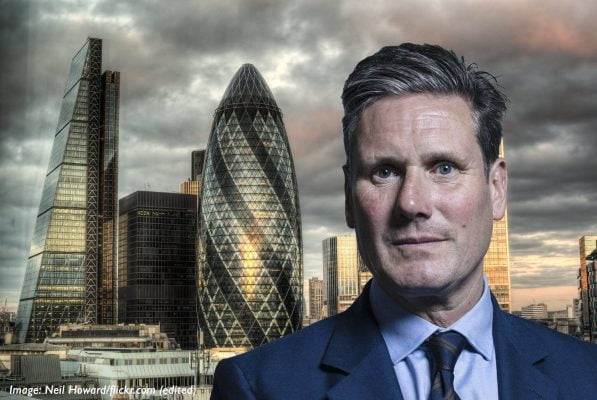
But the profits of British capitalism are largely built on the paper shuffling that goes on in the City of London. So when the private equity firms tell Reeves and Starmer, two faithful servants of capital, ‘do as we say, or we’re off’, then they don’t have a lot of choice in the matter. Capitalism truly is a dictatorship of the banks and big business.
And so of course, the tax break was not removed, it was merely reduced by 4 percent.
The likes of Polanski and Corbyn may have better intentions than Reeves and Starmer, but they will be bound by the same constraints if they choose to stay within the confines of capitalism and the capitalist state.
The above example shows how quickly and decisively the capitalist class will respond to a minor tweak to the tax system. Imagine how fiercely they would intervene to prevent a serious encroachment upon their wealth and privilege.
If gentle lobbying and nudging doesn’t work, the ‘bond markets’ – i.e. the private investors who bankroll the government – can quite easily tighten the purse strings if a government pursues policies they deem unacceptable.
And yet more drastic options are available, should none of this pressure produce the desired outcome.
Although she was pursuing a very different economic agenda, the downfall of the Liz Truss government in 2022 provides us with a glimpse of what could befall a reformist government. Truss’ tax-cutting bonanza threatened economic catastrophe, and so the establishment mobilised to replace her with Rishi Sunak faster than you can say “wilted lettuce”.
A reformist government limiting itself to mild measures would be pressured into submission at best, or sabotaged and booted out of power at worst.
As long as we have a system that runs on profit, and a state that exists to defend those profits, we will never see a just distribution of wealth.
In order to seriously improve the lives of working people, we must expropriate the wealth of the capitalists, and place it firmly in the hands of the class who produced it, as part of a democratic, socialist plan of production.
That’s why we, as communists, say:
- Don’t just tax the super rich, seize their wealth altogether!
- Expropriate the commanding heights of the economy – Nationalise the top banks and monopolies!
- For a democratically-planned economy, in the interests of need and not profit!