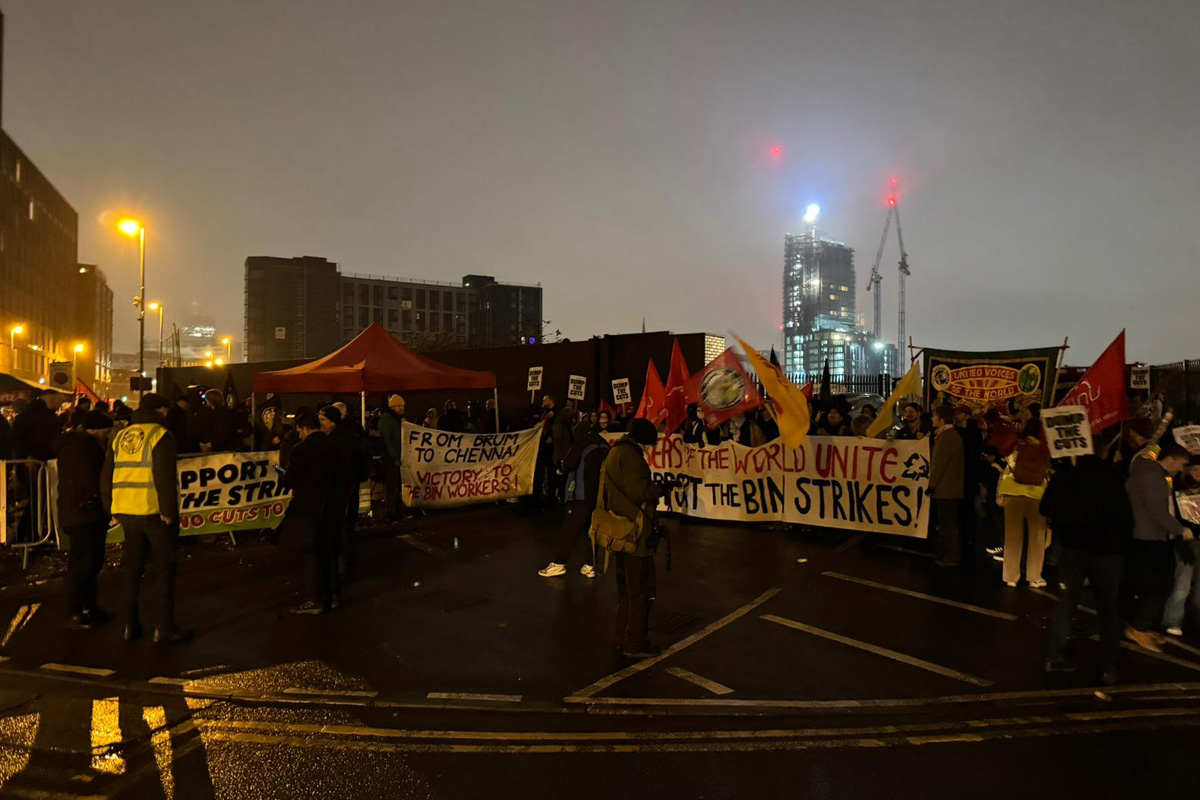

Birmingham City Council (BCC) has gone running to the High Court to shut down the ‘megapickets’ – mass protests that have taken place during the heroic eleven-month strike of the city’s bin workers, in order to stop scab labour from entering the depots.
The most recent megapicket in January successfully shut every major depot in the city and significantly boosted the strikers’ morale and fighting resolve.
Each demonstration has drawn increasing solidarity, including support from national unions such as the Fire Brigades Union and the RMT, and prominent political figures like Green Party leader Zack Polanski, as well as Your Party leaders Zarah Sultana and Jeremy Corbyn.
This growing momentum reflects the mood of workers from across the country, who recognise their own experiences in the bin workers’ fight against austerity.
Voir cette publication sur Instagram
Council getting desperate
This is not the first time that the Council has hidden behind the courts to crush the strike. Back in May, they got a High Court injunction that indefinitely banned striking workers from hard picketing (physically blocking the entrance to a workplace).
The new injunction explicitly states that anyone, not just striking workers, who shows up to support the bin strike without the Council’s permission could face fines, asset seizure, and even up to two years in prison!
In other words, the Council is getting so desperate that it must now – scandalously – attack the right to protest. Taking their lead from Starmer’s government and all its trumpeting about ‘law and order’, Birmingham’s gang of careerists clearly thinks that acting to promptly defeat the strike with repressive methods will save its skin at the coming May elections.
The Council’s actions may well turn out to be more provocation than salvation. In fact, both the Council and outsourced Job&Talent workers have now passed a reballot to continue the strike for another six months – with 100 percent support!
🚨 BREAKING: Birmingham bins strikers vote 100% to keep striking right through the summer.
That will be another summer of chaos for workers and residents and a whole year of @BhamCityCouncil failing to even negotiate. The bin workers and people of Birmingham deserve better!…— Unite the union: join a union (@unitetheunion) February 10, 2026
The right to protest
In their desperation, however, the Council is revealing some very unpleasant truths about whose side the law is on.
Britain’s anti-union laws, mostly introduced under Margaret Thatcher in the 1980s, are already some of the most draconian in the developed capitalist world.
Nominally, picket lines are not supposed to have more than six pickets present; they must be attended by ‘picket supervisors’ from the union officialdom; and all this to ensure that hard picketing is banned both in law, and in practice.
In reality, since the days of Thatcher, these laws have functioned more as a threat. They are rarely enforced universally. The bosses and the state have relied on the union bureaucracy – who slavishly cow down before the law, and fear confrontation with the authorities – to police the picket lines themselves.
In effect, the Birmingham strikers called this bluff by initiating hard pickets back in March and April. When they were threatened with an injunction to stop the hard pickets, the workers ingeniously got around this by mobilising large solidarity protests, which essentially acted as de facto hard pickets.
Voir cette publication sur Instagram
But BCC is obviously not satisfied with the fact that the megapickets act lawfully, exploiting a kind of legal loophole. Desperate to defeat this strike, the Council is now demanding that only they should have the right to decide who can or cannot protest.
This makes things very clear. Our democratic rights, from the point of view of the bosses and establishment politicians, are only worth as much as the paper they are written on.
When the interests of the Council, their billionaire creditors, and the Labour government (which has given full support to the Council) are threatened, our right to protest can be torn up and scattered to the four winds.
Better to break the law than break the poor!
The Birmingham bin strikers, while remaining steadfast in their determination, are facing an unholy trinity of politicians, judges, and investors determined to crush them.
— Strike Map (@strike_map) February 8, 2026
These criminals, crooks, and thieves possess no shortage of dirty tricks in their playbook. Most recently, they have tried to undermine the strike by saying that if they gave more money to the bin workers, it would get in the way of equal pay arrangements with other unions – thereby making their budget illegal.
As if the Council had any concern for legality, let alone pay questions! Hand-in-hand with Job&Talent bosses, it has blacklisted and victimised agency workers.
With their latest move, the Council has declared that the gloves are off. Legal avenues of struggle are blocked. ‘Business as usual’ has been upended. But unfortunately, this obvious conclusion has not been drawn by the Unite leadership.
Onay Kasab, Unite’s lead national organiser, responded to the equal pay question saying that “we would look to make a compromise so we are not further exacerbating any equal pay issues… So we are not going down the road of any illegality in any way…” (our emphasis).
Unite should be shouting from the rooftops that BCC is attacking our basic democratic rights, in order to break one of the most militant strikes in the country!
Many other union members – both inside Unite and across the labour movement – identify with the Birmingham bin workers. A third of councils are going bankrupt. Whatever the outcome of the Birmingham bin strikes, it will set a precedent for struggles to come.
The union leaders should be calling on the whole labour movement to organise solidarity demonstrations and strike action – as part of a nationwide campaign to restore all union rights and fight back Labour’s austerity!
If the Birmingham bin strikes are to succeed, then the union leaders must acknowledge that fighting on the ground the Council wants to fight on – the murky terrain of ‘legality’ – is a road to ruin.
Only the path of mass resistance – drawing in workers from other sectors and unions – remains open.
Don’t be shy on the picket line!
I’m a young student and newer member of the RCP. On Friday 30 January, myself and other Revolutionary Communist Party (RCP) members in Birmingham joined a bin strike ‘megapicket’.
I’m steadily improving at starting conversations with people at picket events, often leading with the fact I’m with the RCP, saying that we’re out talking to people and want to get a picture of what’s going on with the strike.
I’d gone to one such picket beforehand in December of last year. Workers were unsure how the strike action would end, but were very aware that a lost battle here would result in the implementation of similar wage cuts across the board.
One worker drew my attention to the council’s tactic of offering promotions to workers who scab, in order to undermine the strike. One thing that had been clear since my experience in December came to the fore: that the council of Birmingham is an enemy of the working class.
Overall, it was an enriching experience that put myself and other comrades back in touch with the mood on the ground of the Birmingham bin strike. I feel I learned a great deal more about the infuriating tactics of the council and the struggle of the bin workers. Holding even the shortest of conversations left me all the more incensed towards the council bosses, and all the more convinced that this strike must spread.
Sol Camden, Birmingham
SHUT IT DOWN 3-D
All sites, all day. Not a wheel turned.
Victory to the @unitetheunion Brum Bin workers.
Your move @Keir_Starmer 🫵
#Megapicket #StrikeMap #Megapicket3D #Megapicket3 #Birmingham #BirminghamBinStrike #BrumBinStrike pic.twitter.com/IvkeI34BRj
— Strike Map (@strike_map) January 30, 2026
Birmingham’s new normality
Since 2023, Birmingham City Council has been bankrupt. But in what seems to be a rather miraculous reversal of fate, Labour proclaims: “no more!”
At the beginning of February, John Cotton (leader of the beleaguered council) declared that Birmingham is no longer effectively bankrupt.
After £750 million of assets were gutted from the council, including key services like social care, and a whopping 17.5 percent rise in council tax bills, it seems that Labour’s bitter pill of austerity has afforded the city some breathing room.
But while council leaders can pop open the champagne, local communities will be left wondering how the end of official bankruptcy benefits them.
The public resents the councillors for stripping key parts of their daily lives: that is, making them pay for the council’s failures.
The city council went bankrupt not because libraries, or social care, or special education was a massive drain. But in contrast, the council’s own shocking failures played a big role in creating this situation.
Prior to bankruptcy, for instance, the council sought to upgrade their IT systems – to disastrous consequences. Spending £138 million of taxpayer money, and going far over-budget, the IT service they employed turned out to be so faulty that it led accountants to “lose track of some parts of the budget”.
Instead of acknowledging their own incompetence, the councillors have been satisfied to seek a plethora of other excuses for bankruptcy, such as an equal pay lawsuit (which they are equally responsible for).
Where does this leave Birmingham today? Well, we could expect another 4.99 percent council tax rise. Not only that, this new budget details £66 million in new “efficiency savings”; that is, we should expect further cuts.
If we are still effectively facing the cuts, then we must wonder, why declare now that bankruptcy is over? Only one reason jumps out: Birmingham council holds elections in May.
There is little time for Labour to save themselves from utter disaster, with Reform set to send their already sinking ship to the bottom of the ocean.
To lose a city once considered safe for Labour is a sign of the times: workers are angry at a government that promised change, but only made austerity worse.
Marie de Laurelle, Birmingham