In Defence of the Syrian Revolution: The Marxist position- Part Two
Much confusion exists on the left as
to the real nature of the Syrian regime because of what it was in the
past.


Much confusion exists on the left as
to the real nature of the Syrian regime because of what it was in the
past.
It is a year since the Syrian masses
rose up against the Assad regime. Since March 2011, the Syrian people
have faced the open brutality of the state in wave after wave of mass
demonstrations, strikes and civil disobedience. These movements arose in
response to the stifling dictatorship, and against the massive
inequality, unemployment and poverty in Syrian society.
Saturday February 11 marks the one year
anniversary of the fall of Mubarak. Summer, Autumn and Winter have
passed since the beginning of the “Arab spring”, and the Egyptian masses
are still taking to the streets. Despite all that has happened over the
past 12 months, nothing has fundamentally changed for the majority of
ordinary Egyptians. There have been a series of victories and defeats
for the workers and youth of Egypt, but now, with the anniversary of the
Revolution, the movement is entering a new phase.
One year after the revolutionary
overthrow of Ben Ali, Tunisia faces a wave of strikes, regional
uprisings, sit-ins and protests of all sorts. For hundreds of thousands
of Tunisian workers and youth who bravely defied the bullets of the
dictatorship to get jobs and dignity nothing has fundamentally changed.
The Syrian revolution has entered a
higher stage in the last few weeks. The number and size of
demonstrations have reach record numbers, towns are falling under the
control of defecting soldiers- including areas surrounding the
capital of Damascus and embryonic forms of popular power are appearing in the form of popular councils.

Today, Saturday, 17th December, marks
the first anniversary of the Arab Revolution. On this day, one year
ago, Mohammad Bouazizi, a young Tunisian fruit vendor, driven by
desperation, poverty, and anger, set himself on fire in the city of Sidi
Bouzid. The revolutionary wildfire that began after his death — first
in southern Tunisia, then the entire country, then erupting across the
entire Arab-speaking world—marked a turning point in human history
On Friday more than a million Egyptian
youth, workers and poor yet again assembled in Tahrir Square. The
masses have once again risen in an attempt to remove the remnants of the
Mubarak regime, which are still in power. Not far from Tahrir, in
Abbassiya Square, not more than a couple of thousand people gathered in a
pathetic demonstration in support of the SCAF. To the sceptics who did
not believe in the revolution, this should be a clear demonstration of
the real balance of forces. But at the same time the revolution clearly
faces obstacles, not from external forces, but in its own internal
contradictions.
Events in Egypt are developing at
lightning speed. Similarly to the last days of Mubarak in February this
year, we see daily battles on the streets of Cairo and elsewhere. The
Egyptian masses are determined to see the revolution carried through to
the end. The clash between revolution and counter-revolution is
provoking a crisis inside all political forces, as the rank and file
instinctively move towards revolution and the leaderships vacillate and
try to hold the masses back.
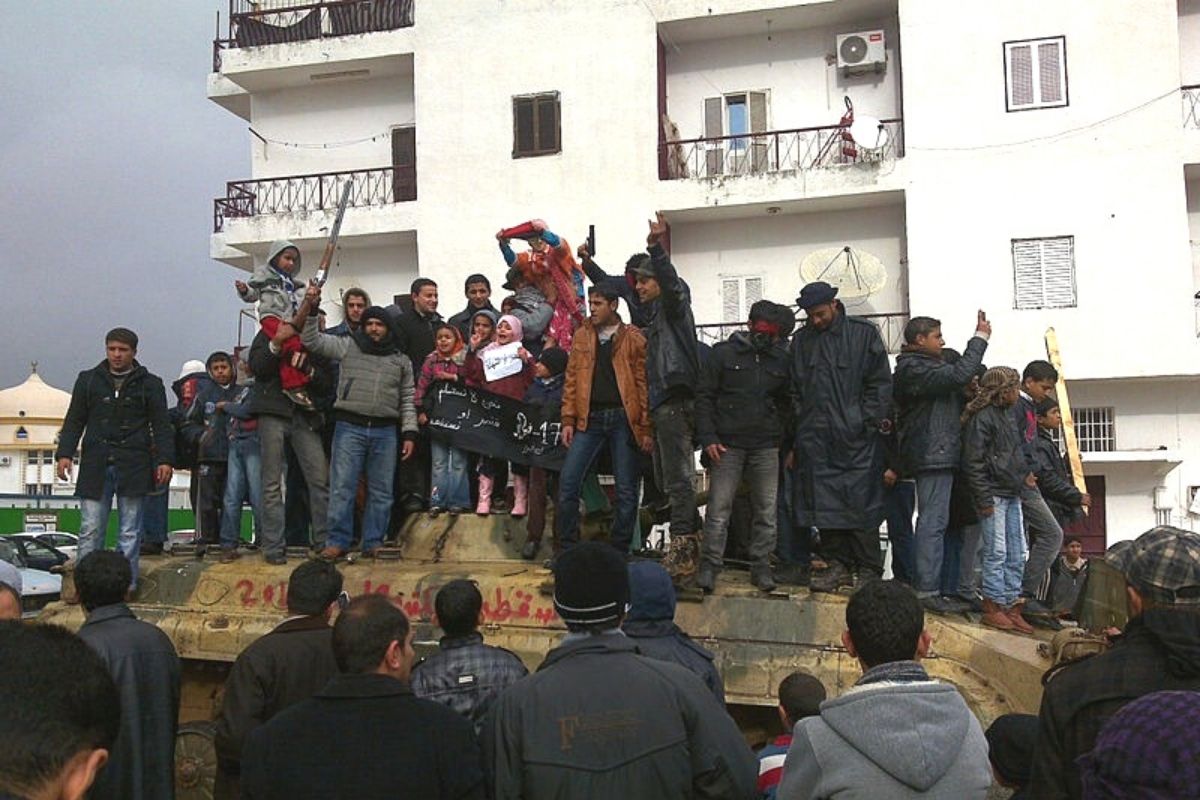
The death of Gaddafi and the final collapse of his regime closes one chapter. However, this merely marks one turning point in the situation. Now that the old regime is finally gone, a struggle will open up over the future of Libya. In this struggle we will see the forces of both revolution and counter-revolution trying to get the upper hand. Here we publish an analysis of the situation by Alan Woods.
With the
re-introduction of the emergency law, the military junta is desperately
trying to strangle the revolution and return to the “normality” of the
Mubarak era. But the workers are on the move. The recent upsurge in
strikes and protests could spell the end for the SCAF regime.
The euphoria amongst the Egyptian masses that followed the fall of
Mubarak in February has disappeared. The hard reality of the situation –
in which political, social, and economic conditions have barely changed
– has set in. The revolution has not ended, however, but has, after a
brief lull, transitioned from the streets to the workplaces. The working
class in Egypt – the motor force of the revolution – is organising and
is on the move.
The social
protest movement in Israel, after a hiatus, is now planning to gather
one million people in Tel Aviv on September 3. The ruling class is
certainly worried by this prospect and the Israeli railways have
announced that they will shut down train services between Tel Aviv and
Jerusalem, and between Tel Aviv and Be’er Sheva, supposedly for "for
maintenance work". Clearly this is a manoeuvre to try and weaken the
mobilisations that are being prepared