Boris the Barbarian scraps London-Caracas oil deal
A few days ago London’s Tory mayor, Boris Johnson, scrapped
the discounted oil deal with the Venezuelan government which allowed half price
bus fares for Londoners on income support.

The latest news, analysis, and Marxist theory from The Communist, alongside reports of RCP activity.
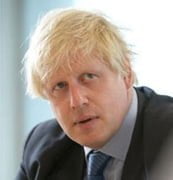
A few days ago London’s Tory mayor, Boris Johnson, scrapped
the discounted oil deal with the Venezuelan government which allowed half price
bus fares for Londoners on income support.

This year sees the 40th anniversary of the May events of France 1968,
which culminated in the biggest general strike in history, involving
more than 10 million workers. TV programmes and newspaper columns will
mark the occasion but few, if any, will give a real reflection of the
role played by the main actors and actresses, the working class.

The election of Boris Johnson as London Mayor in May should be met with
foreboding. This is not good for train operators or working people in
and around London. Boris appears to be born not only with a silver
spoon in his mouth (having been educated in Eton), but also a foot. We
should not be taken in by the appearance of barmy Boris.

The wealth in the UK today is the product of the labour of
working people. The problem is that they do not control how that wealth is
distributed. The value that they have created over and above what they receive
in their pay packets is appropriated by the owners of industry who ensure,
through their State apparatus, that the lion’s share is creamed off to those
who already have more than enough for their needs. The present leaders of the Labour Party are tied hand
and foot to the interests of the rich, the capitalist class. A new leadership
of the Party is required that will harness social wealth to provide for all.

The Crewe by-election, with an 18% swing to the Tories,
confirms that they are on target for a landslide win in the next general
election. Railway workers and other working class people who have voted Labour
for generations have finally had enough. The betrayals and disappointments of
New Labour have caused these electors to break the habit of a lifetime. Make no
mistake about it. Mass working class abstentions have done for Brown and his
witless crew.

There is no such thing as a natural disaster. That may come as a surprise to those of you who were wibble-wobbled out of bed over much of the south of England at the end of February by the UK’s largest ever earthquake, which went over 6 on the Richter scale in some areas.
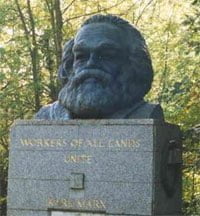
On the 14th of March, at a quarter to three in the afternoon, the greatest living thinker ceased to think. He had been left alone for scarcely two minutes, and when we came back we found him in his armchair, peacefully gone to sleep — but for ever.
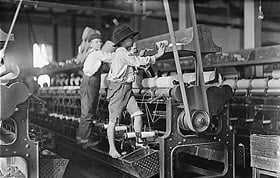
This is the first of two articles looking at the decline in the quality
of life for working people in Britain today. This first article focuses
on the workplace, where there has been relative decline in wages and
deterioration in the conditions of employment. The second part looks at
the attack on the ‘social wage’. This consists of the services and
facilities we access such as health care, education, public transport
and local services – all of which contribute towards the quality of
life for working people in modern society. They form the provision in
society of things working people, unlike the rich, could not afford to
buy individually but provided on behalf of people by the State.
Together the two elements – direct wages and the social wage – provide
our quality of life, but both are now under attack, creating an
impoverished life in Britain for working people.
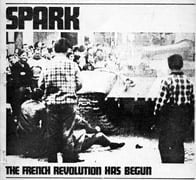
In August 1968 Ted Grant drew a balance sheet
of the revolutionary crisis ignited in France with the May events. In this
important article he carefully analysed the main problems facing the
revolution, exposing the treacherous policies of the Stalinist CP leaders, who
gave De Gaulle the possibility to recover from his earlier paralysis, and the
sectarian mistakes of the leaders of the "revolutionary left".
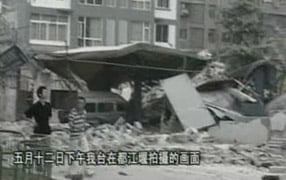
Following a massive earthquake measuring
7.9 of the Richter scale, a collective shock and grief has gripped China. The
epicentre of the quake was Wenchuan County in the Ngawa
Tibetan and Qiang Autonomous Prefecture; the majority of people here are ethnic
Tibetans. A new mood of mutual solidarity has been born throughout the
nation, strengthened by the fact that the quake was felt as far away as
Beijing. Present figures are; over 20,000 dead, 25,000 buried under rubble,
14,000 missing, and 64,000 injured. The death toll looks set to rise to over
50,000.
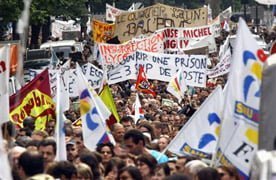
Marxism is the memory box of the class, but more than that it is a
means to an end, a weapon in the hands of the working class. We don’t
stand aside and carp like the sectarians, but play a role in the
movement and try to develop the struggles that take place. This is
precisely the approach that Marx advocated in the ‘Communist Manifesto’
160 years ago.
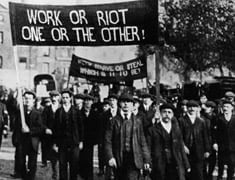
The class struggle arises from the conditions of life of human beings.
It’s a struggle of living forces; there are complicated and
complicating factors. Different industries have different conditions;
there are different traditions of struggle, different forms of
organisation, different political conditions over time and different
leaders.