Trotsky and the Struggle Against Fascism
Fred Weston explains Trotsky’s role in clarifying the Marxist understanding of fascism and how to fight it.
The latest news and analysis from The Communist, alongside reports of our activity. For Marxist theory and history, click here.
Fred Weston explains Trotsky’s role in clarifying the Marxist understanding of fascism and how to fight it.
“Art can neither escape the crisis nor partition itself off. Art cannot save itself. It will rot away inevitably — as Grecian art rotted beneath the ruins of a culture founded on slavery — unless present-day society is able to rebuild itself. This task is essentially revolutionary in character. For these reasons the function of art in our epoch is determined by its relation to the revolution.” Leon Trotsky, 1938.
We publish here the transcript of a speech by Alan Woods on the subject of the relationship between Art and the Class Struggle. The speech was given at a Marxist Summer School in Barcelona (Spain), in July 2001.
Real living examples of revolution are the test of any theory. May 1968 was such a historical example. These events reveal that defeat of the working class has not come about by such a thing as the “strong state” but by the ineptitude of the reformist and Stalinist leaders who were not prepared to mobilise the full force of the working class.
The economic and financial crisis has dominated the whole year. Speculation and uncertainty in the US led to the price of oil hitting
$100 a barrel by January 2nd, followed shortly after by the first stock
market crash of the year amid fears of a global recession caused by
last year’s crisis in the sub-prime mortgage market. The world has entered perhaps the most disturbed period in the whole of human history.
Saturday 13th
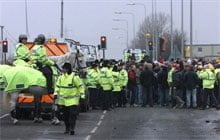
December saw fascists once again attempt to organise in Glasgow’s city centre.
A few weeks ago it was the pleasantly named and completely ineffective ‘Racial
Volunteers Squad’ who were intimidated just by the sight of the number of left
wingers who were also handing out propaganda on Buchannan Street. However this Saturday saw those fine
defenders of white nationalism, the racist British National Party attempting to
distribute their paper, the aptly titled ‘Voice of Freedom’ to unwitting members
of the public.
December 14th 2008 marks the 90th anniversary of a landmark election in
Britain. Following the end of World War I it was the first election in
which women were entitled to vote. The Representation of the People Act
which became law in February 1918 had granted the right to vote on a
restricted basis to women. Only women over 30 would be entitled to
vote. Voting rights for all women aged over 21 did not come until ten
years later, in 1928.
The recent much
publicised arrest of Tory immigration spokesman Damian Green
has led to acres of newsprint
being used up by normally establishment papers in
defence of Mr Green and the tradition of whistleblowing.However are we not seeing double standards
here? When it is a right wing MP leaking stuff about immigration then it is all
OK, but when it is a trade unionist revealing management lies being perpetrated
in the public sector or in government then it is quite a different story.
Comrade George McCartney passed away in November 2007 at the age of 90. George was active in the trade union movement and Labour movement for most of his life and it is fitting that we remember him a year after his death. We are reproducing the tribute given at his funeral service by his sons Sean and Neil in Cambridge last December.
For us, another world is not only possible but also
necessary. However, to achieve all this, to get our ideas out to workers,
students, homeworkers, unemployed and all those who find capitalism to
be lacking, we need your support. At this festive (although not so
festive for the thousands now facing losing their job or having a cut
in salary) it is traditional to make a special appeal for donations to
help build our resources.
For there to be a revolution does there have to be violence? To the sectarian mind the answer is always in the affirmative. Marxists look at the question in a more rounded out manner, looking at the many factors that come into play: the balance of class forces, the nature of the leadership of the working class, the tactics and programme adopted, and so on.