We publish here the editorial of issue 54 of ‘In Defence of Marxism’ magazine – the quarterly theoretical journal of the Revolutionary Communist International. Get your copy here!
This July marks 90 years since the beginning of the Spanish Civil War. In this titanic struggle between revolution and counter-revolution, millions of workers and peasants rose up and fought valiantly against fascism. And while they were ultimately defeated and brutally repressed, their struggle has left an indelible record in the memory of the working class, serving as an inspiration for all class fighters today.
At the same time, as this issue of the magazine goes to print, the last remnants of the Rojava Revolution in northeast Syria are facing an existential crisis.
As well as standing with those who are fighting to defend their freedom in Rojava, we must also seek to understand how this has come to pass. The articles in this issue of In Defence of Marxism are therefore devoted to the lessons of these important movements.
View this post on Instagram
Parallels
There are a number of striking parallels between the Spanish and Rojavan revolutions.
First, both were intimately bound up with civil war, in which the authority of the old state broke down. In both Spain and Rojava, faced with destruction by an ultra-reactionary enemy, ordinary people took up arms and organised themselves for the defence of their communities.
In the process, the masses set up their own organs of grassroots workers’ and peasants’ democracy. These took the form of ‘revolutionary committees’ or ‘people’s councils’ in neighbourhoods, villages and workplaces, which began to take over the running of society.
Among the important social and democratic gains won in the course of both revolutions, the position of women was central. Women took up arms and joined the revolutionary militias, as well as performing vital roles at the rear.
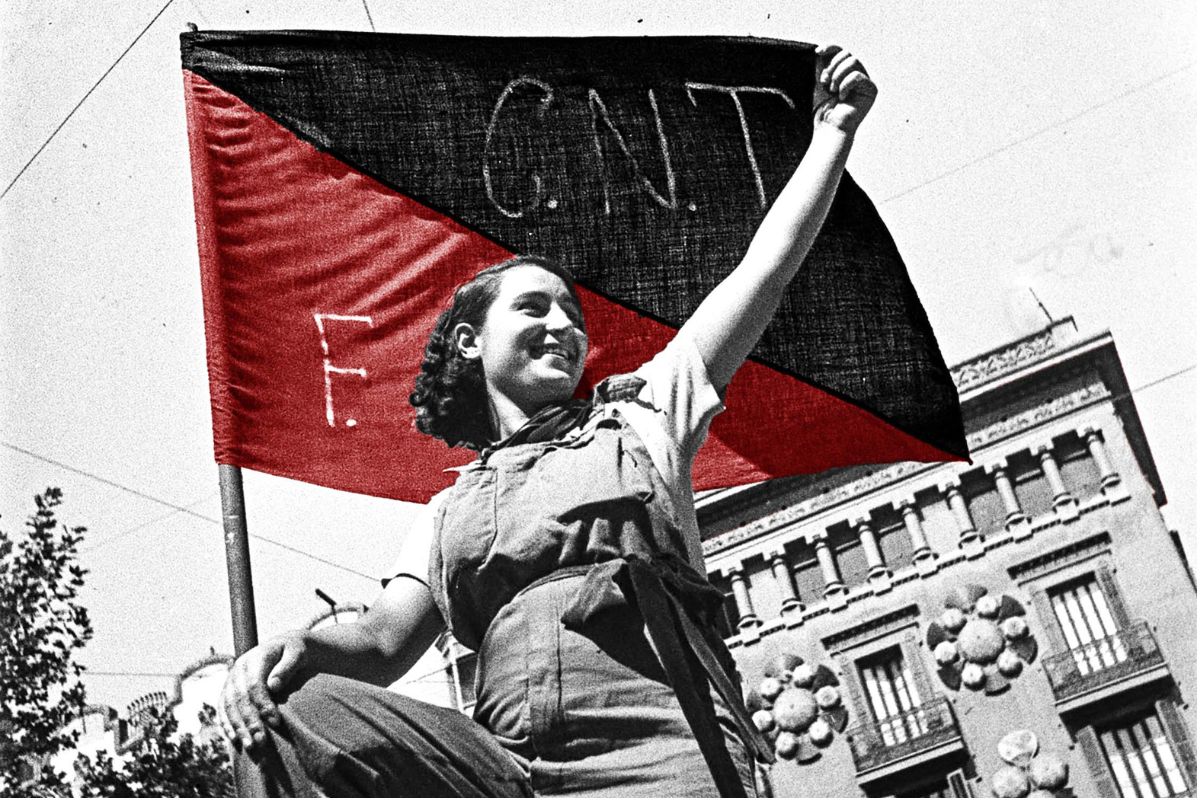
Both revolutions also featured a strong anarchist influence. The anarcho-syndicalist trade union confederation, the CNT, played a leading role during the Spanish Revolution, and the decisions of its leaders would shape events to a considerable degree. In Rojava, the party which led the revolution, the PYD, claims steadfast allegiance to ‘democratic confederalism’ – the ideology of Abdullah Öcalan – which was heavily influenced by the ‘libertarian municipalism’ of anarchist Murray Bookchin.
This common thread is proudly highlighted by anarchists themselves. David Graeber, arguably the most influential anarchist of the 21st century, described the developments in Rojava as “one of the most exciting political experiments really since the anarchists in Spain in the 1930s”.[1]
As well as recognising the inspiring and progressive achievements of both revolutions, we must confront the tragic fact that both were ultimately defeated.
In both cases, the enemies of the revolution received support from foreign powers, whilst the hopes placed by both Rojava and the Spanish Republic in the so-called ‘democratic’ imperialist powers were betrayed. But their defeat cannot be explained simply by reference to the machinations and betrayals of imperialism.
Crucially, in both instances, their leaders held back the revolutionary social side of the movement in order to focus on the purely military side, and in doing so undermined both.
In Spain, the workers and peasants were prevented from seizing the bulk of the landlords’ and capitalists’ property. The leadership justified this with the argument that only a broad, cross-class ‘Popular Front’, fighting to defend a capitalist republic, could defeat fascism. Only after this was achieved could there be any talk of socialist revolution.
In Rojava, a parallel logic emerged. The YPG militia and grassroots councils were hemmed in by the PYD leadership, which diluted the programme of the revolution in order to secure military alliances with local Arab sheikhs, neighbouring states, and US imperialism.
Ultimately, the leaders of both revolutions consistently prioritised its formal democratic aspects over the fundamental social and class questions posed by the struggle. And rather than strengthening the two movements, this sapped them politically, preparing the way for defeat.
This parallel is not accidental. The errors of the Spanish anarchists and of the PYD in Syria flow from the fundamental problems of anarchism itself.
The state
Marxism and anarchism have been considered opposing revolutionary theories for as long as both have existed. But all too often the fundamental difference between the two is obscured by specific historical debates over things like the First International and the Russian Civil War.
The key political difference between Marxism and anarchism concerns the question of the state, which is a central part of any revolutionary theory.
Today it is impossible to exist in society without encountering the awesome and ubiquitous power of the state. We see it above all in its armies, police, courts, etc., but also in the sprawling civilian bureaucracy, which monitors and interferes in almost all aspects of day-to-day life.
Far from being a neutral arbiter or forum for the population to collectively run society, the state exists primarily for the protection of the property and profits of the bosses and landlords. Whether we are talking about a military dictatorship or a liberal parliamentary democracy, the state exists for the maintenance of ‘order’ – that is, the social order of the ruling class.
One need only look at the innumerable links between government and big business, the repressive legislation against the labour movement in all countries, and the imperialist looting of the masses of the world by a series of states to see the truth of the matter. The state is fundamentally nothing more than an instrument of class oppression. If the economic power of the ruling class is the basis of its rule, the state is the indispensable means by which this rule is maintained.
The close connection between the state and the oppression of the majority is something recognised by anarchists and Marxists. Where they disagree is over the nature of that connection, and what stance the revolution we are fighting for should take in relation to it.
The debate between Marxism and anarchism is often presented as follows: on the one hand, Marxists defend the state in general, with its police, army and bureaucracy, but insist that the working class must replace the old, bourgeois state apparatus with one of its own; on the other, anarchists seek to abolish the state in its entirety in the shortest possible time.
According to Graeber, for example: “When those Marxists come, the police will still be there. There are probably going to be more of them, right? Anarchists come, the whole structure will be changed. People will be told that it’s completely unnecessary.”[2]
Accordingly, anarchists usually refer to Marxists as ‘state socialists’, whereas they are ‘libertarian’, or ‘anti-state’ socialists.
This is actually a false characterisation of both positions.
Marx and Engels were explicitly in favour of the abolition of the existing state apparatus. All of it. “[T]he working class cannot simply lay hold of the ready-made state machinery, and wield it for its own purposes”, wrote Marx in 1871.[3]
But what then, if anything, is to replace the old state? Writing about the Paris Commune of 1871 – which he hailed as “the political form at last discovered under which to work out the economical emancipation of labour” – Marx explained:
“The unity of the nation was not to be broken, but, on the contrary, to be organised by Communal Constitution, and to become a reality by the destruction of the state power which claimed to be the embodiment of that unity independent of, and superior to, the nation itself, from which it was but a parasitic excrescence.”[4]
Engels expressed the same sentiment when he described the state as an “evil inherited by the proletariat” whose worst features must be lopped off immediately, until a new generation can “throw the entire lumber of the state on the scrap-heap”.
So what is left of the state in the vision of these so-called ‘state socialists’? Essentially the organised force of the oppressed, directed against the resistance of the exploiters – the ‘dictatorship of the proletariat’ – which Engels described in one letter as “not a state in the proper sense of the word”.[5]
All of these ideas were taken up and defended by Lenin in The State and Revolution, written only months before he led the Russian workers to power in 1917. And they have remained at the core of the genuine Marxist programme ever since.
The anarchist path
It is quite clear from the above that Marxists are ultimately fighting for a stateless society, free of all oppression. In fact, ironically, this is the most important reason why Marxists oppose anarchism.
Anarchism, coming from the ancient Greek for ‘no ruler’, is commonly summed up as ‘against the state’, or ‘abolition of the state’. But what does anarchist theory actually propose?
Pierre-Joseph Proudhon, the first to describe himself as an anarchist, wrote boldly about the need for the state to be “dissolved”, or even “destroyed”. But his conception of how this was to be achieved was far from the revolutionary “destruction of the state power” proposed by Marx.
Rather than calling for the workers to rise up and seize political power from the ruling class, before then dismantling its state machinery, Proudhon adamantly rejected the struggle for political power in any form. In his own words:
“The social revolution is seriously compromised if it is delivered by political revolution.”[6]
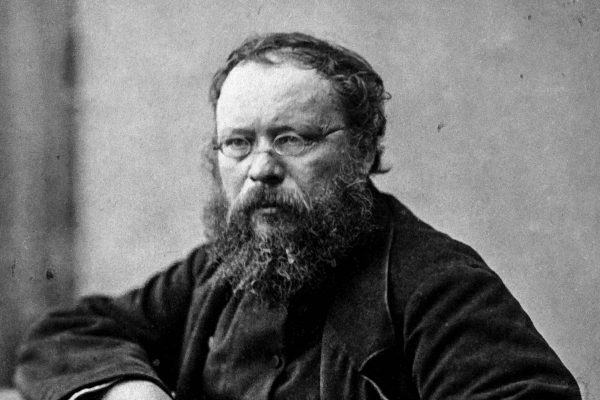
Instead, he believed that the state would be gradually dissolved by the extension of workers co-operatives and mutual societies trading with each other and taking over the functions of the state themselves. In the meantime, the oppressive apparatus of the state would be left in place.
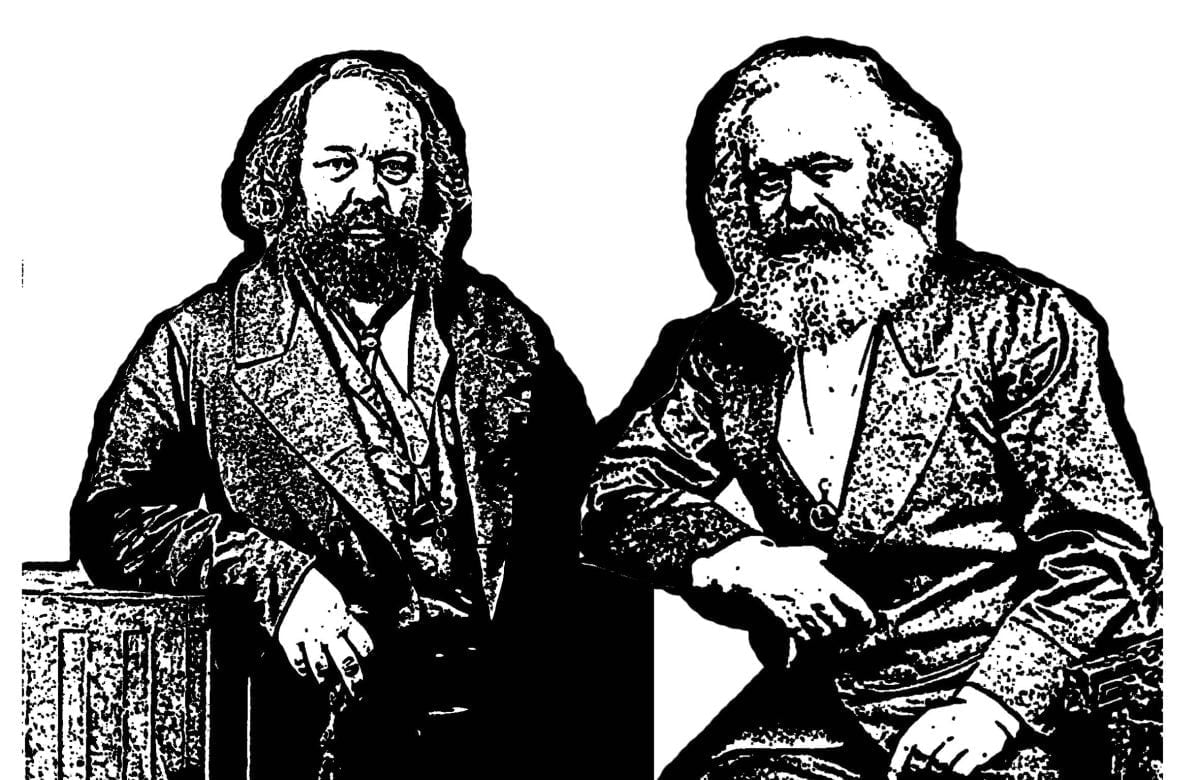
The Russian anarchists Mikhail Bakunin and Peter Kropotkin differed from Proudhon in that they thought that the state should be abolished in the shortest possible period of time. They envisioned the state being cleared away in a single sweep of spontaneous revolution, emanating from the people all at once.
Like Marx, they advocated the replacement of the state bureaucracy by democratic communes established by the masses. However, they rejected the socialist planned economy as an extension of state power, and the party as a means of leading and organising the insurrection.
According to them, these would inevitably lead to the restoration of all the evils of the state, whether that be a bourgeois or a workers’ state. Instead, the tasks of the social revolution should be carried out by each commune at a local level, with only spontaneous and voluntary coordination.
Both accepted the need for some common force to defend the revolution, such as a workers’ militia. But they insisted that this must be composed of a federation of autonomous associations, with no central authority to impose its will on any of its component parts.
Ultimately, all iterations of anarchism propose to hollow out the bourgeois state rather than directly seize and dismantle it. In this respect, both Bakunin and Kropotkin were merely proposing Proudhonism sped up.
Following this strategy, the revolution confronts the resistance of the exploiters and their state on a purely defensive basis: communes only fight when attacked, hoping the bourgeois state will eventually wither away. In Rojava, this was given the poetic title, “the thorn that protects the rose” – a policy of “peaceful coexistence”, resorting to violent conflict only when attacked.
But in Rojava, in Spain, and in the Paris Commune, the fruit of this strategy has always been the same: the class struggle and the social revolution stopped short at the seizure of political power, leaving the bourgeois state in place.
In short, Marxists oppose anarchism, not because anarchists want to abolish the state, but precisely because they do not.
Dual power
Errors in theory inevitably lead to disaster in practice. And the anarchists’ mistaken strategy in relation to the state becomes most glaring and dangerous precisely during periods of revolution and counter-revolution.
In every revolution, the masses spontaneously create democratic organs – communes, councils (‘soviets’), or committees – to protect and expand their movement. The creation of these mass organs of revolutionary democracy is never dictated by a single party or individual; they arise naturally out of the movement.
On the face of it, this gives support to the worship of spontaneity and rejection of leadership that are often found in anarchist circles. But the revolution does not end simply with the creation of democratic organs. Eventually, a situation of ‘dual power’ emerges where these organs confront the state of the pre-existing ruling-class.
A dual power situation is fundamentally unstable and will ultimately be resolved in one of two ways: either the workers’ councils depose the old state, or the ruling class reasserts control and crushes the revolution. Anarchist strategy, however, attempts to prolong this agonising tension indefinitely, hoping the ‘non-state’ will eventually render the old state redundant. In practice, this is fatal.
In his masterpiece, Revolution and Counter-revolution in Spain, Felix Morrow writes:
“Class collaboration, indeed, lies concealed in the heart of anarchist philosophy. It is hidden, during periods of reaction, by anarchist hatred of capitalist oppression. But, in a revolutionary period of dual power, it must come to the surface.”[7]
In Spain, the anarchist leaders boasted that they could have taken power in July 1936, but refused to do so because they rejected political power in any form.
Consequently, the bourgeois state – with its generals, its civil service and its parliamentary machinery – was able to regroup and reassert itself, rolling back the conquests of the workers and peasants. In the ultimate irony, anarchist ministers even joined the government in November, with the excuse that because the workers and peasants controlled the militias and revolutionary committees, the state had effectively ceased to be an instrument of class oppression!
It is not an accident that the anarchist leaders ended up repeating the same ideas as the social democrats. Anarchism turns into reformism in practice because both hold ‘democracy’ in the abstract, over and above the class struggle. Arguing that either a bourgeois or workers’ state is equally bad, they therefore fight for neither one nor the other, but only the greatest possible ‘democracy’ in general.
The same problem arose in Rojava, where arguably the bourgeois state was even weaker. Having led the creation of democratic organs of self-rule, the PYD then erected a liberal parliamentary regime on top of it, whilst retaining control of both.
Graeber explicitly brought out this question in 2016, explaining, “[t]his is what one would expect in a revolutionary dual power situation”, adding that “both sides are not just in alliance […] but were actually set up by the same movement, even, in some cases, the same individuals”.[8]
His only advice for the Rojava Revolution was to ‘formalise’ the arrangement. But dual power cannot be resolved on paper. Either the bourgeoisie is overthrown and its state destroyed, or the workers are defeated and their councils destroyed.
Far from destroying the state, the PYD effectively rebuilt it, whilst safeguarding the property of the major landlords and capitalists. This brought the revolutionary process in Rojava to a halt, with dire consequences for the Kurds and for the region as a whole.
Thus anarchism, which is so revolutionary in words during times of peace, becomes conservative during times of revolution and civil war. And what good is a revolutionary ideology which ceases to be revolutionary in times of revolution?
Bolshevism
So what is to be done? From the experience of the Paris Commune to the councils of Rojava, the conclusion is the same. The only way to preserve and expand the new, revolutionary power of the oppressed is to lead them to the direct seizure of political power from the hands of the old ruling class.
The fact is that the closest that humanity has ever got to the replacement of an oppressive capitalist state with the democratic self-organisation of the oppressed is the Russian Revolution of 1917, led by those bêtes noires of anarchism: Lenin, Trotsky and the Bolshevik Party.
The Bolshevik programme from April 1917 could be summed up as: “All power to the soviets!” Every other demand and slogan was explicitly linked to this. And this was not simply a slogan – the Bolsheviks actually carried it out.
Basing themselves on the revolutionary workers and peasants, the Bolsheviks made the soviets the sole political power in the country. In doing so they had to overcome the furious resistance and condemnation of the other ‘republican’ parties, both in Russia and abroad.
In this sense Bolshevism can be considered the unity of word and deed. In contrast, both reformism and anarchism promise freedom and democracy, only to then limit the struggle to the horizons of the democratic bourgeoisie. And it is for this reason that Lenin remains anathema in respectable society and anarchist circles alike.
But it must be recognised that within the anarchist movement there are reformist and revolutionary wings, just as there have been many reformists who claim to be ‘Marxists’. The crucial difference is that while a reformist has to revise and distort Marxist theory to justify class collaboration, an anarchist who breaks definitively with reformism must also abandon the holiest of anarchist holies – their rejection of the dictatorship of the proletariat.
We welcome all comrades fighting to destroy the bourgeois state and establish workers’ self-rule. We would only add that it is not enough for us to fight for this spontaneously, on a local basis. We must organise internationally and build a revolutionary party capable of putting these lessons into practice.
This is not some project for the distant future. New revolutions are inevitable in the period ahead. Let us be ready, and realise the vision of freedom for which the revolutionaries of Spain, Rojava, and the world, have given their lives.
References
[1] ‘David Graeber: Why Rojava Matters’, Novara Media, Youtube
[2] D Graeber, ‘Syria, Anarchism & Visiting Rojava’, The Anarchist Library, 2 July 2017
[3] K Marx, The Civil War in France, Wellred Books, 2021, pg 41
[4] ibid. pg 45-46
[5] F Engels, ‘Engels to August Bebel in Zwickau’, Marx Engels Selected Correspondence, Progress Publishers, 1982, pg 275
[6] Quoted in G Woodcock, Pierre-Joseph Proudhon: A Biography, Black Rose, 1987, pg 75
[7] F Morrow, Revolution and Counter-revolution in Spain, Wellred Books, 2022, pg 42
[8] D Graeber, ‘Forward’, Revolution in Rojava, Pluto Press, 2016, pg 15